


China is prepared to interfere in November’s nine-in-one local elections by launching massive attacks on the Taiwanese government’s service network (GSN), a report published by the National Security Bureau showed.
The report was submitted to the Legislative Yuan ahead of the bureau’s scheduled briefing at the Foreign Affairs and National Defense Committee tomorrow.
The national security team has identified about 13,000 suspicious Internet accounts and 860,000 disputed messages, the bureau said of China’s cognitive warfare against Taiwan.
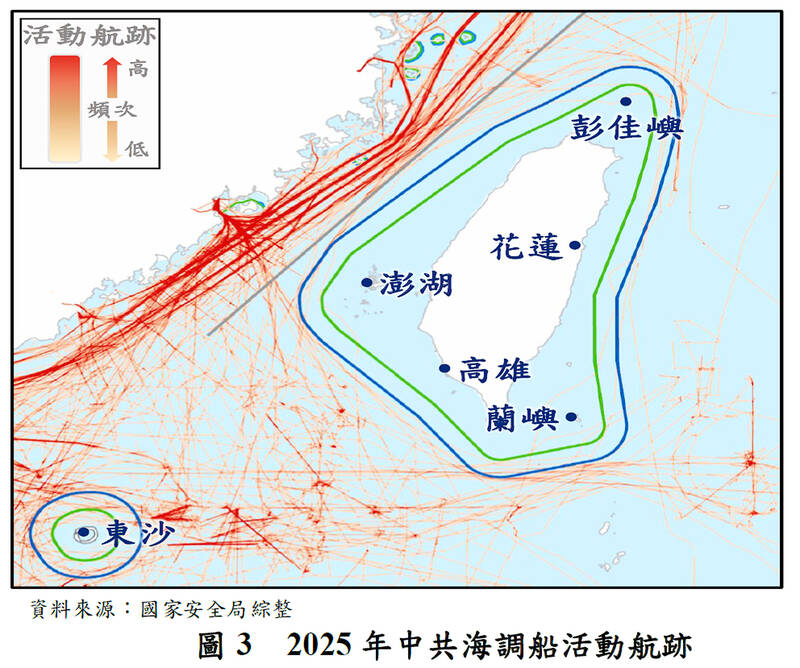
Photo courtesy of the National Security Bureau
The disputed messages focus on major foreign affairs, national defense and economic issues, which were produced using generative artificial intelligence (AI) and distributed through Chinese state media, Internet trolls, suspicious accounts and content farms, the bureau said in the report.
Meanwhile, the government service network was attacked more than 173.28 million times during the first quarter this year, the bureau said, adding that the actions could be a prelude to Chinese intervention in the nine-in-one elections.
They were also designed for intelligence-gathering, surveillance and data theft purposes, it said.
“For the elections at the end of this year, China is expected to intervene by adopting a hybrid approach, including spreading disputed content using AI-powered deep-fake technology, publishing false public opinion surveys and setting up illegal betting rings,” the bureau said.
Beijing is also likely to try to sway election outcomes by inviting Taiwanese tour groups to China, paying for their travel costs, and purchasing agricultural products from pro-China cities or counties, the bureau said.
In addition, Chinese military aircraft entered Taiwan’s airspace more than 420 times during the first quarter, the report said
These incursions were coordinated with Chinese naval vessels to conduct 10 “joint combat readiness patrols,” and were designed to test operational capabilities against Taiwan through periodic drills, the bureau said.
China Coast Guard vessels intruded into the restricted and prohibited waters around Kinmen County 44 times last year, and 12 times in the first quarter, the report said.
During the operations, the vessels deliberately turned off their automatic identification system (AIS) to test Taiwan’s surveillance and response capabilities, the bureau said.
China has also deployed a “shadow fleet” to support military training, it said.
Last year, there were four incidents involving damage to undersea cables serving Taiwan’s outling islands, three of which were suspected to have been caused by Chinese vessels, it said.
Chinese survey and research ships have frequently conducted hydrological surveys and seabed mapping in waters surrounding Taiwan, raising concerns that such activities might be intended to support battlefield reconnaissance and operational planning in key maritime areas, the bureau said.
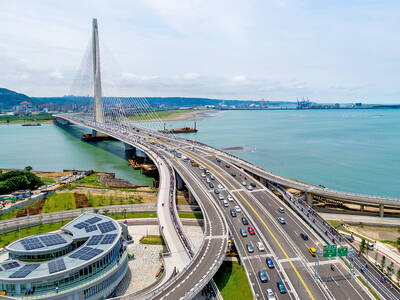
The Ministry of Transportation and Communications yesterday inaugurated the Danjiang Bridge across the Tamsui River in New Taipei City, saying that the structure would be an architectural icon and traffic artery for Taiwan. Feted as a major engineering achievement, the Danjiang Bridge is 920m long, 211m tall at the top of its pylon, and is the longest single-pylon asymmetric cable-stayed bridge in the world, the government’s Web site for the structure said. It was designed by late Iraqi-British architect Zaha Hadid. The structure, with a maximum deck of 70m, accommodates road and light rail traffic, and affords a 200m navigation channel for boats,

Taiwan Semiconductor Manufacturing Co (TSMC, 台積電), the world’s largest foundry service provider, yesterday said that global semiconductor revenue is projected to hit US$1.5 trillion in 2030, after the figure exceeds US$1 trillion this year, as artificial intelligence (AI) demand boosts consumption of token and compute power. “We are still at the beginning of the AI revolution, but we already see a significant impact across the whole semiconductor ecosystem,” TSMC deputy cochief operating officer Kevin Zhang (張曉強) said at the company’s annual technology symposium in Hsinchu City. “It is fair to say that in the past decade, smartphones and other mobile devices were
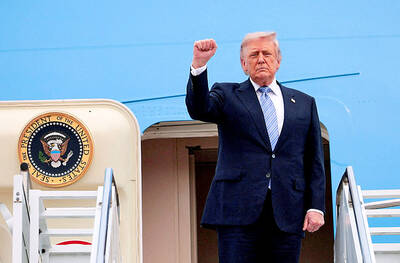
US-CHINA SUMMIT: MOFA welcomed US reassurance of no change in its Taiwan policy; Trump said he did not comment when Xi talked of opposing independence US President Donald Trump yesterday said he has not made a decision on whether to move forward with a major arms package for Taiwan after hearing concerns about it from Chinese President Xi Jinping (習近平). Trump’s comments on Taiwan came as he flew back to Washington after wrapping up critical talks in which both leaders said important progress was made in stabilizing US-China relations even as deep differences persist between the world’s two biggest powers on Iran and Taiwan. “I will make a determination,” Trump said, adding: “I’ll be making decisions. But, you know, I think the last thing we need right

TAIWAN ISSUE: US treasury secretary Scott Bessent said on the first day of meetings that ‘it wouldn’t be a US-China summit without the Taiwan issue coming up’ There were no surprises on the first day of the summit between US President Donald Trump and Chinese President Xi Jinping (習近平), the Mainland Affairs Council (MAC) said yesterday, as the government reiterated that cross-strait stability is crucial to the Asia-Pacific region, as well as the world. As the two presidents met for a highly anticipated summit yesterday, Chinese state media reported that Xi warned Trump that missteps regarding Taiwan could push their two countries into “conflict.” Trump arrived in China with accolades for his host, calling Xi a “great leader” and “friend,” and extending an invitation to visit the White House


 RSS
RSS