


As a dairy farmer, Richard Usack's twice-a-month milk checks paid just enough to keep his creditors at bay.
In 1993, Usack sold his 40 milk cows, paid his bills and borrowed money to buy 425 goats from a Texas farmer. He raised the goats to be slaughtered for meat. Today, he and the several dozen other goat farmers in New York State can't keep up with demand, driven mainly by immigrants.
"The market is screaming, it really is," said Usack, whose farm is in Erin, near Elmira in New York's south-central Finger Lakes region. "You can sell them as fast as you can grow them."

PHOTO: BLOOMBERG
The goat meat market has increased with the influx of millions of people from goat-consuming countries of the Muslim world, the Caribbean and Latin America. Market growth has been most dramatic in Florida, California, Texas and the urban Northeast, according to a 1999 study by Terry Gipson of the E (Kika) de la Garza Institute for Goat Research at Langston University in Oklahoma.
With US production short of demand, frozen goat imports from Australia and New Zealand rose about 300 percent between 1990 and 1998, Gipson's study said.
At Greenville Packing, a slaughterhouse 37km south of Albany, New York, owner Robert Mattick butchers up to 20 goats a day. Wholesale and retail customers include Jamaicans, Mexicans and Bosnians from as far as New York City, a 2 1/2-hour drive away.
"Immigration is a boon to me," Mattick said. "Fifty years ago we couldn't give a goat away. Today it's big business." In the past two decades, federal beef and veal slaughter counts have remained steady at about 37 million animals a year, according to US Department of Agriculture statistics. The demand for goat has risen more than six-fold, to 530,371 animals slaughtered in 2000 from 81,770 in fiscal 1983. The department doesn't have statistics on the dollar value of the industry.
The federal slaughter numbers don't include live goats purchased by private buyers and slaughtered at home, or those killed at 23 "custom-exempt" slaughterhouses in New York City -- so named because they are state-inspected and exempt from USDA regulations.
Larry Decker, a chief meat inspector with the New York State Department of Agriculture and Markets, said, "at certain times of the year, with the various holidays ... probably in the city there's hundreds [of live animals] going through" the custom-exempt slaughterhouses. He said the state doesn't keep precise numbers.
The New York City metropolitan area is home to an estimated 800,000 Muslims who are prime goat consumers, said Kevin James, spokesman for the New York chapter of the Council on American- Islamic Relations. Under Muslim dietary laws, meat -- goat or otherwise -- must be slaughtered according to halal ritual.
An estimated 2 million people of Caribbean descent in the New York metropolitan area also create a market, said Jean Alexander, executive director of the Caribbean American Center.
"I am from Trinidad and I would love to have goat meat a couple of times a week," she said. "I like to eat it curried or stewed. Also, you can grill it on a skewer .... The most popular red meat among Caribbean people is goat."
Halal Meat USA, a slaughterhouse in Paterson, New Jersey, kills about 1,500 goats every week, said owner Ibrahim Batca.
"We have Latinos, Muslims from the Far East, the Jamaicans -- they all want goat," Batca said. To satisfy them, he gets one or two shipments a week from Texas and has reached out to farmers in Alberta and Saskatchewan, Canada.
The nation's biggest producer is Texas, where farmers long raised goats for their wool. Falling profits and the growing meat demand made slaughtering more attractive in recent years.
To be certified as halal an animal must be slaughtered by a Muslim butcher who recites a prayer over the animal and then quickly slits its throat.
Goat meat at halal grocery stores in New York City and northern New York State costs from US$1.79 to US$3.89 a pound, depending on the cut and the age of the goat, store workers said.
Goat meat sales are up in Utica, New York, since about 4,000 Bosnian Muslims arrived in the 1990s, said Judy Winfield, a spokeswoman for the Mohawk Valley Resource Center for Refugees.
For holidays and other special occasions, families will buy a live goat, slaughter it and roast it on a spit in their backyard, Winfield said.
Despite the efforts of Usack and about 40 other farmer members of the Empire State Meat Goat Producers Association, there hasn't been an upsurge in goat farming in New York.
Several groups are sponsoring a series of workshops Saturday in Voorheesville, near Albany, to tout meat goat farming as an alternative to dairy farming, where tight margins between prices and production costs often are too low to keep smaller farms going.
Usack, who concentrates on breeding goats and brokering sales of Texas meat goats to New York farmers, said labor and feed costs are lower for meat goats than dairy cows. The goats eat on their own half the year, munching on brush and leaves and twigs. They don't get milked twice a day.
"The dairy industry has been declining, and that's freed up a lot of land and farms for alternative production," said Robert Melchior, marketing coordinator for the Northeast Sheep and Goat Marketing Program at Cornell University in Ithaca, New York. "Our feeling is that goats and sheep are areas where that land and those farms could be properly utilized."
For now, it's still a seller's market for goat meat. Ghilman Hussain, a Pakistani immigrant who owns Halal Meat and Groceries in Latham, a suburb of Albany, said if customers "don't place an order until Friday, they're not going to get it."

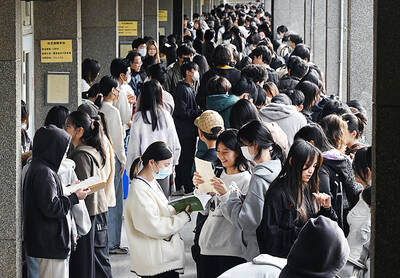
A global survey showed that 60 percent of Taiwanese had attained higher education, second only to Canada, the Ministry of the Interior said. Taiwan easily surpassed the global average of 43 percent and ranked ahead of major economies, including Japan, South Korea and the US, data from the Organisation for Economic Co-operation and Development (OECD) for 2024 showed. Taiwan has a high literacy rate, data released by the ministry showed. As of the end of last year, Taiwan had 20.617 million people aged 15 or older, accounting for 88.5 percent of the total population, with a literacy rate of 99.4 percent, the data

CCP ‘PAWN’? Beijing could use the KMT chairwoman’s visit to signal to the world that many people in Taiwan support the ‘one China’ principle, an academic said Chinese Nationalist Party (KMT) Chairwoman Cheng Li-wun (鄭麗文) yesterday arrived in China for a “peace” mission and potential meeting with Chinese President Xi Jinping (習近平), while a Taiwanese minister detailed the number of Chinese warships currently deployed around the nation. Cheng is visiting at a time of increased Chinese military pressure on Taiwan, as the opposition-dominated Legislative Yuan stalls a government plan for US$40 billion in extra defense spending. Speaking to reporters before going to the airport, Cheng said she was going on a “historic journey for peace,” but added that some people felt uneasy about her trip. “If you truly love Taiwan,

NEW LOW: The council in 2024 based predictions on a pessimistic estimate for the nation’s total fertility rate of 0.84, but last year that rate was 0.69, 17 percent lower An expected National Development Council (NDC) report expects the nation’s population to drop below 12 million by 2065, with the old-age dependency ratio to top 100 percent sooner than 2070, sources said yesterday. The council is slated to release its latest population projections in August, using an ultra-low fertility model, the sources said. The previous report projected that Taiwan’s population would fall to 14.37 million by 2070, but based on a new estimate of the total fertility rate (TFR) — the average number of children born to a woman over her lifetime — the population is expected to reach 12 million by
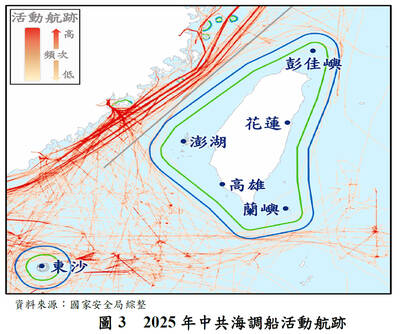
INTENSIFYING THREATS: Beijing’s tactics include massive attacks on the government service network, aircraft and naval vessel incursions and damaging undersea cables China is prepared to interfere in November’s nine-in-one local elections by launching massive attacks on the Taiwanese government’s service network (GSN), a report published by the National Security Bureau showed. The report was submitted to the Legislative Yuan ahead of the bureau’s scheduled briefing at the Foreign Affairs and National Defense Committee tomorrow. The national security team has identified about 13,000 suspicious Internet accounts and 860,000 disputed messages, the bureau said of China’s cognitive warfare against Taiwan. The disputed messages focus on major foreign affairs, national defense and economic issues, which were produced using generative artificial intelligence (AI) and distributed through Chinese


 RSS
RSS