


Two teenage shooters on Monday opened fire at a San Diego, California, mosque and killed three men — then killed themselves a few blocks away — in an attack police are investigating as a hate crime.
There was no specific threat made against the Islamic Center of San Diego, but authorities found evidence that the suspects engaged in “generalized hate rhetoric,” San Diego Police Chief Scott Wahl said.
He declined to give more details, but said the “circumstances that led up to this” would come out in the days ahead.
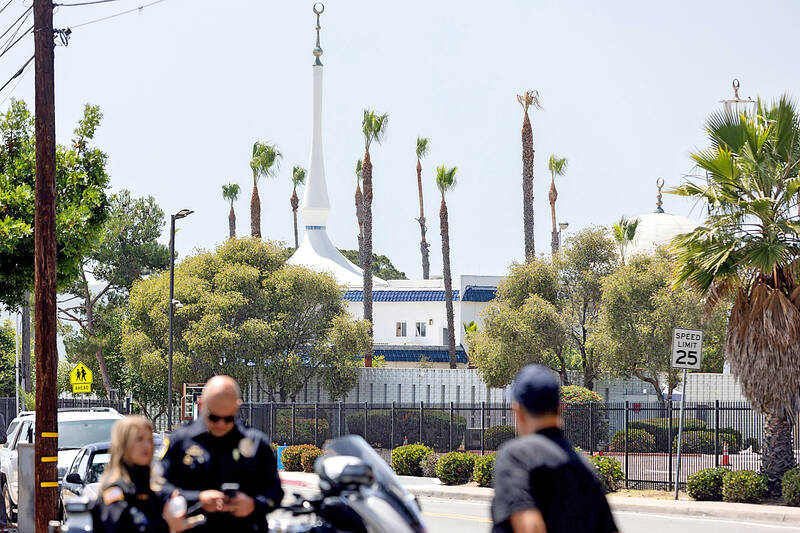
Photo: AFP
Before the attack, officers were already looking for one of the teenagers after his mother called police concerned that her son was suicidal and had run away, Wahl said.
There were weapons missing from the home and the mother’s vehicle was gone, he added.
The search took on even more urgency as police learned that he was dressed in camouflage and with an acquaintance — details that were unexpected for someone about to die by suicide, he said.
Police began using whatever technology they could to find the 17 and 18-year-old, including automated license plate readers. The department dispatched authorities to a mall near where the car had been tracked by police, and officers alerted a school where at least one of the suspects had been a student, Wahl said.
As officers continued interviewing the mother about places the teens might be, they got reports of a shooting at the mosque.
Among those killed was a mosque security guard, who police believe “played a pivotal role” in keeping the attack from being “much worse,” Wahl said.
“It’s fair to say his actions were heroic,” the chief said at a later news conference. “Undoubtedly he saved lives today.”
A family friend identified the guard as Amin Abdullah, a well-known face at the mosque who had been working there for more than a decade.
“He wanted to defend the innocent so he decided to become a security guard,” said Shaykh Uthman Ibn Farooq, who had spoken with Abdullah’s son.
The family could not immediately be reached for comment.
The center is the largest mosque in San Diego County and includes the Al Rashid School, which offers courses in Arabic language, Islamic studies and the Korean for students ages 5 and up, its Web site says.
Police responded within four minutes of being called, Wahl said.
As they arrived, gunshots rang out a few blocks away where a landscaper was shot at, but uninjured. The shooters were found dead in a vehicle stopped in the middle of a road nearby, he said.
Aerial TV footage showed more than a dozen children holding hands and being walked out of the parking lot of the center as it was surrounded by scores of police vehicles.
The mosque is in a neighborhood of homes, apartments and strip malls with Middle Eastern restaurants and markets. Parents were directed to a nearby area to retrieve their children.
Mosque director Imam Taha Hassane called it “extremely outrageous to target a place of worship.”
“All the places of worship in our beautiful city should always be protected,” he said.
The Council on American-Islamic Relations, one of the largest Muslim civil rights and advocacy groups in the US, condemned the shooting.
“No one should ever fear for their safety while attending prayers or studying at an elementary school,” CAIR-San Diego executive director Tazheen Nizam said in a statement. “We are working to learn more about this incident and we encourage everyone to keep this community in your prayers.”
US President Donald Trump called the shooting a “terrible situation.”

Kouri Richins, a Utah mother who published a children’s book about grief after the death of her husband is to serve a life sentence for his murder without the possibility of parole, a judge ruled on Wednesday. Richins was convicted in March of aggravated murder for lacing a cocktail given to her husband, Eric Richins, with five times the lethal dose of fentanyl at their home near Park City in 2022. A jury also found her guilty of four other felonies, including insurance fraud, forgery and attempted murder for trying to poison her husband weeks earlier on Feb. 14, 2022, with a

DELA ROSA CASE: The whereabouts of the senator, who is wanted by the ICC, was unclear, while President Marcos faces a political test over the senate situation Philippine authorities yesterday were seeking confirmation of reports that a top politician wanted by the International Criminal Court (ICC) had fled, a day after gunfire rang out at the Philippine Senate where he had taken refuge fearing his arrest. Senator Ronald “Bato” dela Rosa, the former national police chief and top enforcer of former Philippine president Rodrigo Duterte’s “war on drugs,” has been under Senate protection and is wanted for crimes against humanity, the same charges Duterte is accused of. “Several sources confirmed that the senator, Senator Bato, is no longer in the Senate premises, but we are still getting confirmation,” Presidential

HELP DENIED? The US Department of State said that the Cuban leadership refuses to allow the US to provide aid to Cubans, ‘who are in desperate need of assistance’ US Secretary of State Marco Rubio on Wednesday said that Cuba’s leadership must change, as Washington renewed an offer of US$100 million in aid if the communist nation agrees to cooperate. Cuba has been suffering severe economic tumult led by an energy shortage that plunged 65 percent of the country into darkness on Tuesday. Cuba’s leaders have blamed US sanctions, but Rubio, a Cuban American and critic of the government established by Fidel Castro, said the system was to blame, including corruption by the military. “It’s a broken, nonfunctional economy, and it’s impossible to change it. I wish it were different,” he told
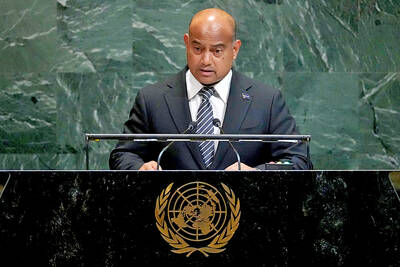
Nauru said it would hold a referendum to change its official name, described as a colonial relic from a time when “foreign tongues” mangled the native language. Nauru would change its name to Naoero to “more faithfully honor our nation’s heritage, our language and our identity,” Nauruan President David Adeang said in a statement on Tuesday. The Pacific island nation’s native language is Dorerin Naoero, which is spoken by the vast majority of its approximately 10,000 inhabitants. “Nauru emerged because Naoero could not be properly pronounced by foreign tongues, and was changed not by our choice, but for convenience,” the government said in


 RSS
RSS