


Philippine authorities yesterday were seeking confirmation of reports that a top politician wanted by the International Criminal Court (ICC) had fled, a day after gunfire rang out at the Philippine Senate where he had taken refuge fearing his arrest.
Senator Ronald “Bato” dela Rosa, the former national police chief and top enforcer of former Philippine president Rodrigo Duterte’s “war on drugs,” has been under Senate protection and is wanted for crimes against humanity, the same charges Duterte is accused of.
“Several sources confirmed that the senator, Senator Bato, is no longer in the Senate premises, but we are still getting confirmation,” Presidential Communications Office Undersecretary Claire Castro told a news conference.
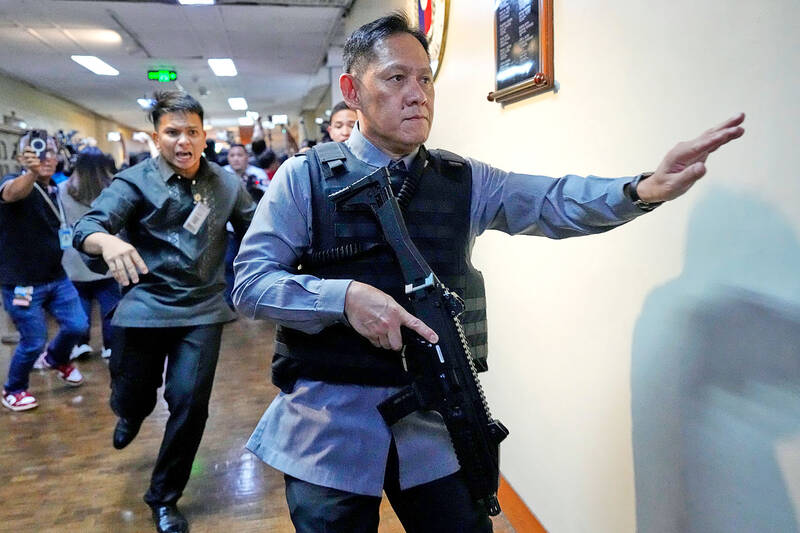
Photo: AP
Gunshots were heard late on Wednesday inside the Senate and people there scrambled for cover, hours after Dela Rosa, 64, appealed on social media for supporters to mobilize, saying that law enforcement agents were going to arrest him.
The incident sparked chaos, with a heavy presence of police and armed guards at the Senate, protests outside and more than a dozen shots fired just moments after Marines were called in to bolster security.
Philippine President Ferdinand Marcos Jr met with security chiefs yesterday and police said one person had been detained, with investigations under way to identify individuals who tried to enter the Senate, and bullet casings and rifle magazines recovered.
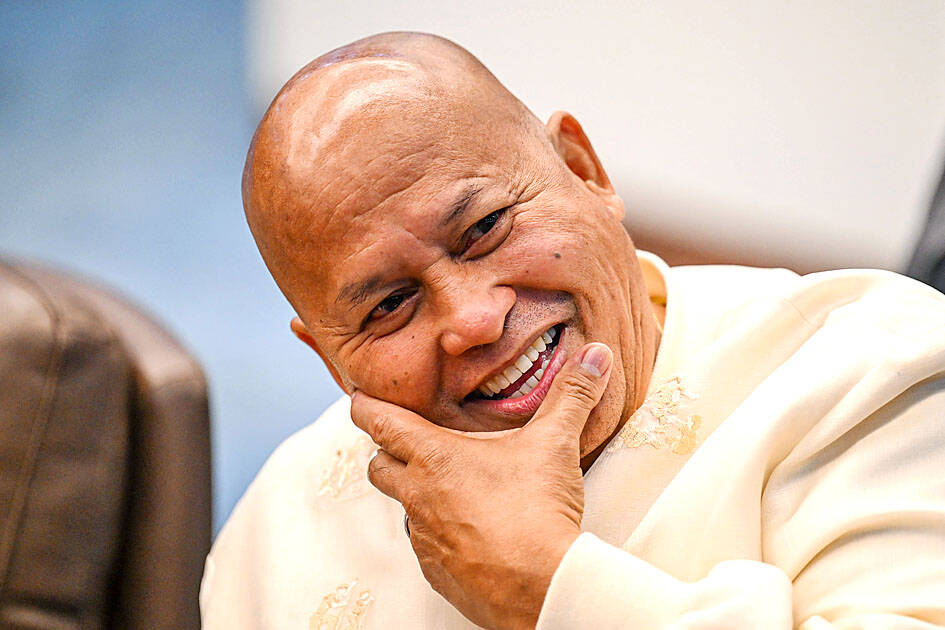
Photo: AFP
“The person has provided names, but these still need confirmation,” police spokesperson Randulf Tuano told DZBB radio.
It was unclear who fired the shots, or if Dela Rosa was still in the Senate yesterday, with speculation that he had slipped away overnight.
The Hague, Netherlands-based ICC unsealed a warrant on Monday for his arrest, dated November last year, while he has filed an emergency appeal at the Philippine Supreme Court, arguing that the ICC has no jurisdiction in the Philippines after its 2019 withdrawal from the international institution.
Earlier yesterday, while entering the heavily guarded Senate, Dela Rosa’s lawyer Jimmy Bondoc said he spoke to him during the night and believed he was inside.
“I asked him if you have plans to leave, he said none,” Bondoc told reporters.
Marcos has sought to distance his government from the Senate drama and said that no order was given to apprehend Dela Rosa, who on Tuesday appealed to the president not to arrest him.
Philippine National Bureau of Investigation Director Melvin Matibag said that intelligence officers from the agency were at a building near the Senate on Wednesday, but were unarmed.
The possibility that the incident could have been staged was also part of the investigation, Matibag said.
In an interview with DZBB aired early yesterday, Dela Rosa said he would “exhaust all available remedies” to block his ICC transfer and having learned about conditions Duterte was being held under, he was no longer willing to fight his case in The Hague.
It was unclear when the interview was conducted.
Dela Rosa has denied involvement in illegal killings.
The Senate standoff is a major challenge to the authority of Marcos, who relied on support of the Duterte family to win a 2022 election before an acrimonious fallout that led to him handing over Duterte to the ICC.
Duterte, 81, is set to become the first former Asian head of state to go on trial at the ICC.
He denies inciting police to commit murder.
Political tension has mounted in the past few days over Dela Rosa and Monday’s impeachment of Philippine Vice President Sara Duterte, Marcos’ former ally and running mate, and Rodrigo Duterte’s daughter.
Sara Duterte, who is in The Hague visiting her father, is fighting for her political survival, facing an impeachment trial in the Senate that could derail her run for the next presidency in 2028.

‘CROSSING THE LINE’: China’s embassy in Seoul criticized US Forces Korea Commander General Xavier Brunson, asking if his ‘hostile’ remarks were authorized by Washington South Korea and the US are in talks over recent public remarks by the commander of US Forces Korea, Seoul’s presidential office said yesterday, after the comments drew sharp criticism from China. In a recent podcast interview, US Forces Korea Commander General Xavier Brunson described South Korea as “the dagger in the heart of Asia” from China’s east coast, prompting the Chinese embassy in Seoul to say that he had “truly crossed the line.” The interview came amid growing speculation that Washington might seek to expand the role of US Forces Korea in countering the growing regional influence of China, a key

SEEKING ORDER: Rodrigo Paz said that ‘anyone who wants to destroy the nation will have to deal with this president and the full force of the constitution’ Bolivian President Rodrigo Paz on Wednesday said that the nation was at a “breaking point” after nearly a month of protests that have caused shortages of food, fuel and medicine. Paz, who took office six months ago amid the worst economic crisis there in four decades, is battling a groundswell of fury over his policies. The political capital, La Paz, has been besieged by low-income workers and members of the indigenous majority calling for his resignation. “The country needs order and is reaching breaking point,” the 58-year-old said at a public event in La Paz, renewing his appeal for dialogue. On Tuesday, the Bolivian

Through the noise of rushing papers and whirring belts at a print factory in Kyoto, two creators watch their photo essay come to life in broadsheet form — part of an effort to win new audiences in the age of artificial intelligence (AI). Despite the decline of the publishing industry, self-publication and handmade “zine” magazines are growing in popularity in Japan, reflecting the nation’s enduring love of paper in the digital era. While speaking to Agence France-Presse at the plant, his hands black with ink, one of the creators, Kazuma Obara, said: “I think [paper] is a medium that engages all five

Australian researchers have trained lab-grown brain cells on a silicon computer chip to play the 1990s shooter game Doom and said they are just scratching the surface of what the neurons could be capable of doing. It is the science-fiction work of biotech boffins at Cortical Labs, who researched and developed the technology that harnesses the workings of the brain’s networking system. Each so-called “biological computer” contains about 200,000 living human brain cells, grown from stem cells that were harvested from blood donations. Having mastered the simple computer game Pong, where a paddle is moved up and down to send a ball


 RSS
RSS