


US Secretary of State Marco Rubio on Wednesday said that Cuba’s leadership must change, as Washington renewed an offer of US$100 million in aid if the communist nation agrees to cooperate.
Cuba has been suffering severe economic tumult led by an energy shortage that plunged 65 percent of the country into darkness on Tuesday.
Cuba’s leaders have blamed US sanctions, but Rubio, a Cuban American and critic of the government established by Fidel Castro, said the system was to blame, including corruption by the military.
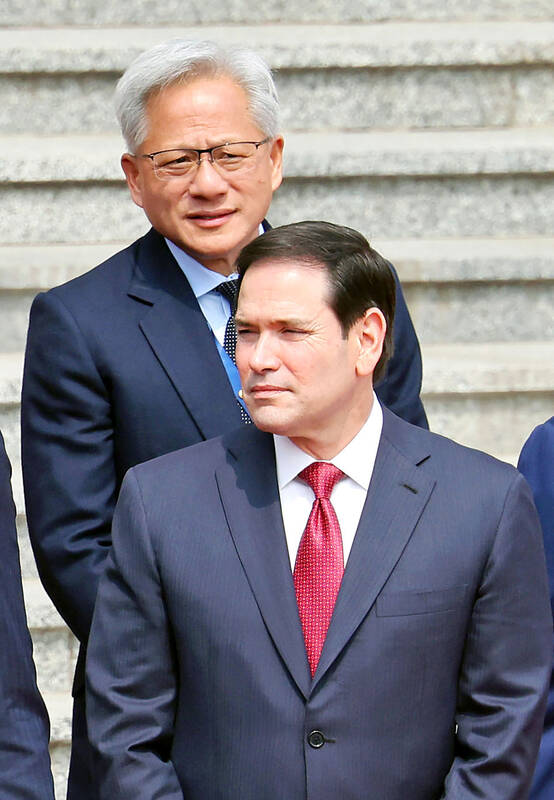
Photo: AP
“It’s a broken, nonfunctional economy, and it’s impossible to change it. I wish it were different,” he told Fox News host Sean Hannity on Air Force One as he traveled with US President Donald Trump to China.
“We’ll give them a chance, but I don’t think it’s going to happen,” Rubio said. “I don’t think we’re going to be able to change the trajectory of Cuba as long as these people are in charge in that regime.”
Trump has said that the US could take over the nation 145km off Florida.
Rubio last week said after talks at the Vatican that Cuba had rejected a US offer of US$100 million in assistance, an assertion denied by Havana.
The US Department of State publicly renewed the proposal on Wednesday, a week after new US sanctions targeted key actors in Cuba’s state-controlled economy and their foreign partners.
“The regime refuses to allow the United States to provide this assistance to the Cuban people, who are in desperate need of assistance due to the failures of Cuba’s corrupt regime,” the state department said in a statement.
“The decision rests with the Cuban regime to accept our offer of assistance or deny critical [life]-saving aid and ultimately be accountable to the Cuban people for standing in the way of critical assistance,” it said.
The support would include direct humanitarian assistance, and funding for “fast and free” Internet access, it said.
Cuba has seen a series of rare protests as economic misery grips the nation of 9.6 million people.
On Wednesday, several dozen people, some banging pots and pans, protested against power outages in the San Miguel del Padron neighborhood on Havana’s outskirts, a resident said.
Several other neighborhoods saw similar protests by evening, with residents in Playa shouting: “Turn on the lights,” witnesses said.
Cuban President Miguel Diaz-Canel acknowledged the “particularly tense” situation, but pinned the blame squarely on the US.
“This dramatic worsening has a single cause: The genocidal energy blockade to which the United States subjects our country, threatening irrational tariffs against any nation that supplies us with fuel,” he wrote on X on Wednesday.
Cuba lost the source for about half its fuel needs when US forces snatched then-Venezuelan president Nicolas Maduro in a raid in January, with his successor complying with US pressure not to aid Cuba.
Since then, only one oil tanker, from Russia, has reached Cuba.

‘CROSSING THE LINE’: China’s embassy in Seoul criticized US Forces Korea Commander General Xavier Brunson, asking if his ‘hostile’ remarks were authorized by Washington South Korea and the US are in talks over recent public remarks by the commander of US Forces Korea, Seoul’s presidential office said yesterday, after the comments drew sharp criticism from China. In a recent podcast interview, US Forces Korea Commander General Xavier Brunson described South Korea as “the dagger in the heart of Asia” from China’s east coast, prompting the Chinese embassy in Seoul to say that he had “truly crossed the line.” The interview came amid growing speculation that Washington might seek to expand the role of US Forces Korea in countering the growing regional influence of China, a key

SEEKING ORDER: Rodrigo Paz said that ‘anyone who wants to destroy the nation will have to deal with this president and the full force of the constitution’ Bolivian President Rodrigo Paz on Wednesday said that the nation was at a “breaking point” after nearly a month of protests that have caused shortages of food, fuel and medicine. Paz, who took office six months ago amid the worst economic crisis there in four decades, is battling a groundswell of fury over his policies. The political capital, La Paz, has been besieged by low-income workers and members of the indigenous majority calling for his resignation. “The country needs order and is reaching breaking point,” the 58-year-old said at a public event in La Paz, renewing his appeal for dialogue. On Tuesday, the Bolivian

Through the noise of rushing papers and whirring belts at a print factory in Kyoto, two creators watch their photo essay come to life in broadsheet form — part of an effort to win new audiences in the age of artificial intelligence (AI). Despite the decline of the publishing industry, self-publication and handmade “zine” magazines are growing in popularity in Japan, reflecting the nation’s enduring love of paper in the digital era. While speaking to Agence France-Presse at the plant, his hands black with ink, one of the creators, Kazuma Obara, said: “I think [paper] is a medium that engages all five

Australian researchers have trained lab-grown brain cells on a silicon computer chip to play the 1990s shooter game Doom and said they are just scratching the surface of what the neurons could be capable of doing. It is the science-fiction work of biotech boffins at Cortical Labs, who researched and developed the technology that harnesses the workings of the brain’s networking system. Each so-called “biological computer” contains about 200,000 living human brain cells, grown from stem cells that were harvested from blood donations. Having mastered the simple computer game Pong, where a paddle is moved up and down to send a ball


 RSS
RSS