


France on Tuesday announced a “first of its kind” plan to phase out coal by 2030, oil by 2045 and gas by 2050 during a global conference aimed at breaking reliance on fossil fuels.
The “road map” was published as dozens of nations gather in Santa Marta, Colombia, for the first-ever international talks on how to transition away from fossil fuels.
France’s road map does not present new pledges, but brings climate and energy policies and targets under one umbrella with an explicit goal.
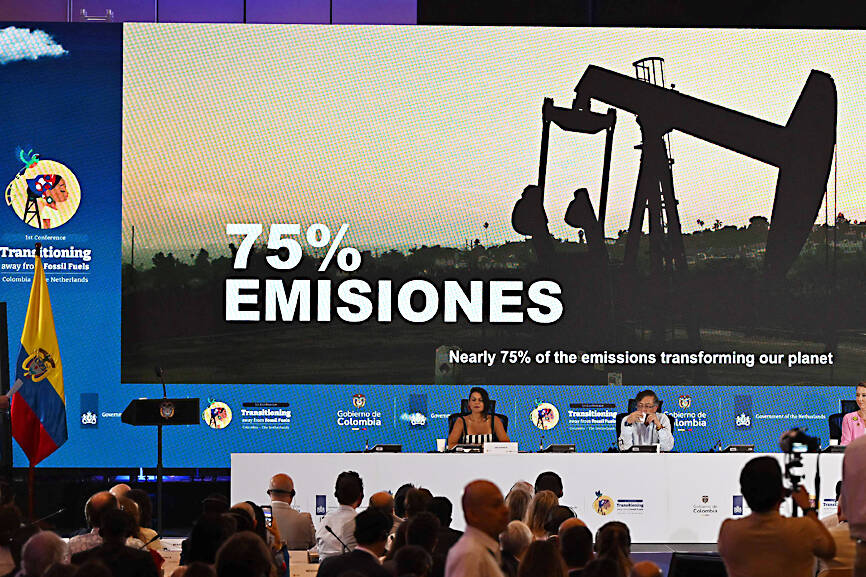
Photo: AFP
Analysts said no other country had published such a clear and comprehensive plan, and it sent an important signal at a moment when countries are reassessing their reliance on fossil fuels.
France’s envoy at the conference, Benoit Faraco, said the road map set deadlines for the end of fossil fuel use across the economy, the second-largest in Europe.
Coal would be phased out by 2030, oil by 2045 and gas by 2050 for energy purposes, the road map said.
“That’s quite original, because we are probably one of the rarest countries who have a clear deadline for all fossil fuel energy,” Faraco told reporters in Santa Marta.
France only generates a fraction of its electricity from hydrocarbons, thanks to its extensive nuclear power generation.
However, Faraco said the road map also committed to phasing out fossil fuel production, electrifying sectors such as heating and transport, and helping finance the transition in other countries.
It formalizes France’s targets for reducing greenhouse gas pollution — namely to reduce emissions by 5 percent a year over the 2024-to-2028 period with the goal of achieving carbon neutrality by 2050.
France’s cuts to greenhouse gas emissions slowed for a second straight year last year and remain well below what is needed to meet its climate goals.
Fossil fuel road maps differ to national pledges to reduce emissions or “net zero” plans because they have an explicit end goal, said Leo Roberts, an energy analyst at the E3G think tank.
The French road map “self describes itself as a document that sets out a pathway for a country to transition the whole economy away from fossil fuels,” Roberts told reporters in Santa Marta. “In that sense, it is the first of its kind.”
Faraco said that France decided to push ahead on its own after a proposal for a global fossil fuel road map was blocked at the COP30 climate summit in November last year.
Brazil, which was steering the climate negotiations, agreed to pursue a voluntary road map process instead and has asked willing countries to make submissions.
Frustration at COP30 led to the creation of the Santa Marta conference, which is taking place outside the UN process and is being cohosted by Colombia and the Netherlands.
Nearly 60 nations are attending.

Kouri Richins, a Utah mother who published a children’s book about grief after the death of her husband is to serve a life sentence for his murder without the possibility of parole, a judge ruled on Wednesday. Richins was convicted in March of aggravated murder for lacing a cocktail given to her husband, Eric Richins, with five times the lethal dose of fentanyl at their home near Park City in 2022. A jury also found her guilty of four other felonies, including insurance fraud, forgery and attempted murder for trying to poison her husband weeks earlier on Feb. 14, 2022, with a

DELA ROSA CASE: The whereabouts of the senator, who is wanted by the ICC, was unclear, while President Marcos faces a political test over the senate situation Philippine authorities yesterday were seeking confirmation of reports that a top politician wanted by the International Criminal Court (ICC) had fled, a day after gunfire rang out at the Philippine Senate where he had taken refuge fearing his arrest. Senator Ronald “Bato” dela Rosa, the former national police chief and top enforcer of former Philippine president Rodrigo Duterte’s “war on drugs,” has been under Senate protection and is wanted for crimes against humanity, the same charges Duterte is accused of. “Several sources confirmed that the senator, Senator Bato, is no longer in the Senate premises, but we are still getting confirmation,” Presidential
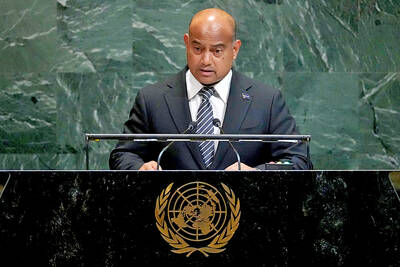
Nauru said it would hold a referendum to change its official name, described as a colonial relic from a time when “foreign tongues” mangled the native language. Nauru would change its name to Naoero to “more faithfully honor our nation’s heritage, our language and our identity,” Nauruan President David Adeang said in a statement on Tuesday. The Pacific island nation’s native language is Dorerin Naoero, which is spoken by the vast majority of its approximately 10,000 inhabitants. “Nauru emerged because Naoero could not be properly pronounced by foreign tongues, and was changed not by our choice, but for convenience,” the government said in

HELP DENIED? The US Department of State said that the Cuban leadership refuses to allow the US to provide aid to Cubans, ‘who are in desperate need of assistance’ US Secretary of State Marco Rubio on Wednesday said that Cuba’s leadership must change, as Washington renewed an offer of US$100 million in aid if the communist nation agrees to cooperate. Cuba has been suffering severe economic tumult led by an energy shortage that plunged 65 percent of the country into darkness on Tuesday. Cuba’s leaders have blamed US sanctions, but Rubio, a Cuban American and critic of the government established by Fidel Castro, said the system was to blame, including corruption by the military. “It’s a broken, nonfunctional economy, and it’s impossible to change it. I wish it were different,” he told


 RSS
RSS