


More than four years on from one of the most powerful volcanic eruptions in history, Tonga is struggling to improve its infrastructure as it pays off a massive Chinese loan.
When Hunga Tonga-Hunga Ha’apai erupted on Jan. 15, 2022, the blast could be heard as far away as Alaska and sent a powerful tsunami crashing into Tonga’s main island about 65km away, killing three people.
Hundreds of homes were destroyed, businesses flattened and roads washed out, while most water supplies were left undrinkable as 15.24cm of ash fell on the Tongan islands.
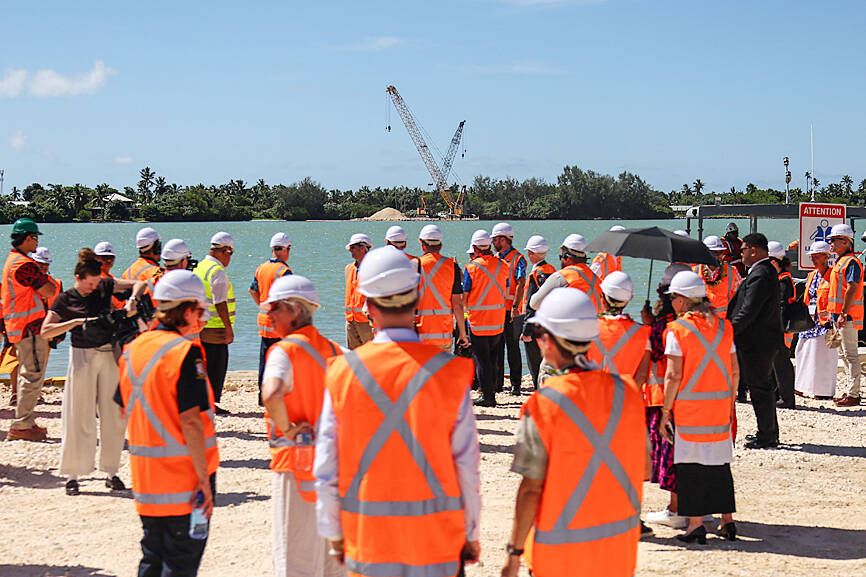
Photo:AFP
Tongan Prime Minister Lord Fatafehi Fakafanua last month said that most government programs to rebuild were complete, but conceded there were “some leftovers” his government needed to finish.
The damage caused by the tsunami remains obvious in parts of Tonga.
Debris from homes and businesses knocked down by the waves remains scattered near beaches on Tongatapu’s west coast, and on the nearby ‘Eua island, tourists are encouraged to bring cash with them from the capital, Nuku’alofa, as automated teller machines and banking services have not been restored.
As much as Lord Fakafanua might want to address the issues, he said his government has stopped taking loans.
Budget documents show a US$67.36 million loan owed to the Export–Import Bank of China, taken out to rebuild Nuku’alofa’s central business district after riots in 2006.
The initial loan, taken out in 2008, was for US$55 million, but with interest, the debt reached more than US$100 million by 2024.
Tonga’s government has committed to paying down its debt by 2030, and in the year to June last year, it paid China US$17.7 million as part of total debt repayments of US$29.4 million.
The repayments represent a large share of government spending in the small nation where the annual infrastructure budget was just US$10.1 million. The health budget for the same year was US$24.9 million, boosted by one-off funding provided by donors, including New Zealand and Australia, to redevelop Nuku’alofa’s hospital and nursing buildings.
The health budget is expected to be significantly lower this year, despite the country’s dire rates of obesity, diabetes and noncommunicable diseases.
“We could use that money for other things,” Lord Fakafanua said, when asked if the debt to China hurt Tonga’s health and infrastructure needs. “But Tonga committed to signing a loan agreement, and we intend to pay off what we signed to do.”
While Tonga shows fiscal restraint, China wants to spread its influence in the Pacific by offering loans and building infrastructure.
During a November visit to Beijing by Tongan King Tupou VI, President Xi Jinping (習近平) said that China was ready to “provide assistance to Tonga’s economic and social development” and said he wanted Tonga’s “independence and sovereignty” to be safeguarded.
Lord Fakafanua said his country would not be accepting any more Chinese loans.
“We’re currently in a position where we’re not taking any more loans, we’re not taking any more debt,” he said.
“We’re being a lot more clever with our fiscal management,” he added.
The country faces significant risk from its loan to China, with “refinancing risk and exchange rate risk being the primary concerns,” according to Tonga’s budget documents.
The IMF said Tonga is at high risk of debt distress.
Tonga has received several grants from the World Bank and the Asian Development Bank to build much-needed infrastructure.
That includes the US$97 million Fanga’uta Lagoon Bridge project currently under construction — the largest infrastructure project in Tonga’s history.
The 720m-long bridge would connect Nuku’alofa with the southern side of the main island, Tongatapu.
More than 120 Tongans are working on the project, which would provide a new evacuation path for Nuku’alofa in the event of a tsunami or flooding caused by tropical cyclones.
New Zealand Prime Minister Christopher Luxon viewed the bridge site during his two-day visit to Tonga last month, speaking to the New Zealand firm McConnell Dowell, which is building the bridge.
Luxon said he supports Tonga’s focus on fiscal restraint, and it “goes without saying” that New Zealand was ready to help when needed.

When a hiker fell from a 55m waterfall in wild New Zealand bush, rescuers were forced to evacuate the badly hurt woman without her dog, which could not be found. After strangers raised thousands of dollars for a search, border collie Molly was flown to safety by a helicopter pilot who was determined to reunite the pet and the owner. A week earlier, an emergency rescue helicopter found the woman with bruises and lacerations after a fall at a rocky spot at the waterfall on the South Island’s West Coast. She was airlifted on March 24, but they were forced to

CONFIDENCE BOOSTER: ’After parkour ... you dare to do a lot of things that you think only young people can do,’ a 67-year-old parkour enthusiast said In a corner of suburban Singapore, Betty Boon vaults a guardrail, crawls underneath a slide, executes forward shoulder rolls and scales a steep slope, finishing the course to applause. “Good job,” the 69-year-old’s coach cheers. This is “geriatric parkour,” where about 20 retirees learned to tackle a series of relatively demanding exercises, building their agility and enjoying a sense of camaraderie. Boon, an upbeat grandmother, said learning parkour has aided her confidence and independence as she ages. “When you’re weak, you will be dependent on someone,” she said after sweating it out with her parkour classmates in suburban Toa Payoh,
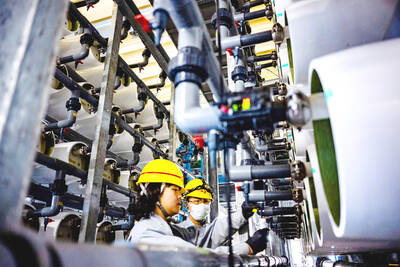
HIGH HOPES: The power source is expected to have a future, as it is not dependent on the weather or light, and could be useful for places with large desalination facilities A Japanese water plant is harnessing the natural process of osmosis to generate renewable energy that could one day become a common power source. The possibility of generating power from osmosis — when water molecules pass from a less salty solution to a more salty one — has long been known. However, actually generating energy from that has proved more complicated, in part due the difficulty of designing the membrane through which the molecules pass. Engineers in Fukuoka, Japan, and their private partners think they might have cracked it, and have opened what is only the world’s second osmotic power plant. It generates

Hundreds of Filipinos and tourists flocked to a sun-bleached field north of Manila yesterday, on Good Friday, to witness one of the country’s most blood-soaked displays of religious fervor, undeterred by rising fuel prices. Scores of bare-chested flagellants with covered faces walked barefoot through the dusty streets of Pampanga Province’s San Fernando as they flogged their backs with bamboo whips in the scorching heat. Agence France-Presse (AFP) journalists said they saw devotees deliberately puncturing their skin with glass shards attached to a small wooden paddle to ensure their bleeding during the ritual, a way to atone for sins and seek miracles from


 RSS
RSS