


US military transport planes have flown out of South Korea in the past few days, flight-tracking data showed, after Seoul confirmed it was discussing the possible redeployment of US military assets as the Iran conflict escalates.
Data from the Flightradar24 Web site indicated that US military transport planes, including C-17 and C-5s, flew out of South Korea’s Osan Air Base in Pyeongtaek, one as recently as Saturday. It was not immediately clear what the aircraft were carrying.
Yonhap News reported earlier that US Forces Korea — which oversees the tens of thousands of US troops and military assets stationed in the South to help deter the nuclear-armed North — had been transferring Patriot missile launchers from across the South to the Osan base, citing government sources it did not identify.
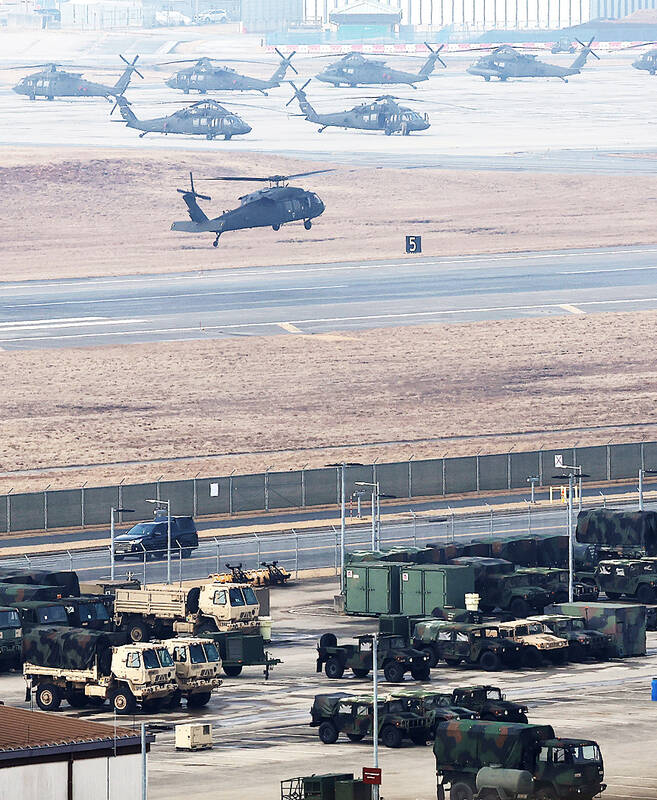
Photo: EPA / Yonhap
It is rare for the C-5, relatively bigger than the C-17 aircraft, to land on the Korean Peninsula, Yonhap said.
The potential redeployment of military assets from South Korea would underscore how the Iran conflict might strain missile-
defense inventories.
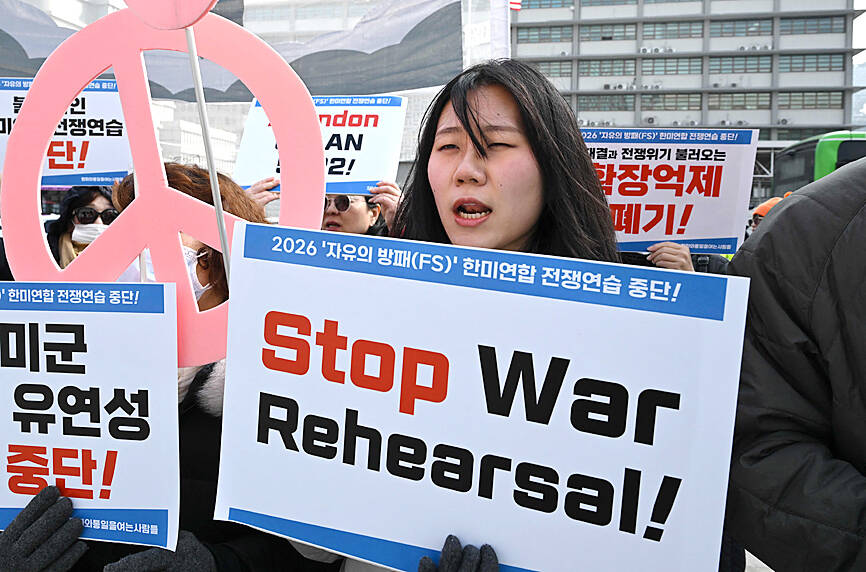
Photo: AFP
The recent flights took place as the US and South Korea began their annual joint military drills.
This year’s drills are to feature less field training maneuvers than last year — in a likely nod to Seoul’s desire to ease tensions with North Korea.
REDUCED US DRILLS
The Freedom Shield exercises that began yesterday are to feature large-scale live training “aimed at enhancing interoperability, reinforcing our combined defense posture, and increasing overall combat readiness,” the US military said.
A South Korean Ministry of National Defense official confirmed that the number of field training maneuvers taking place before the drills conclude on Thursday next week has been more than halved to 22 from 51 last year.
It was not immediately clear if the reduction was in part due to the conflict in Iran. The defense ministry yesterday said that the drills are taking place according to plan “regardless of the situation in the Middle East.” It has also said that the militaries are planning to hold field training in a balanced manner throughout the year.
On Friday, South Korean Minister of Foreign Affairs Cho Hyun confirmed that Seoul was in talks with US Forces Korea over the possible redeployment of weapons systems.
He declined to provide details, saying decisions on deploying weapons and military personnel would be made on a case-by-case basis.
The defense ministry declined to comment on US military operations when reached by Bloomberg News. US Forces Korea declined to comment on the report, citing operational security.
“The mission of US Forces Korea is to maintain a strong combined defense posture with our military and thereby contribute to peace and stability on the Korean Peninsula and in the region,” the defense ministry said in a statement.
“South Korea and the US will continue close communication and coordination,” it said.
Last year, US Patriot missile-defense batteries stationed in South Korea were temporarily deployed to the Middle East for “strategic flexibility,” Yonhap reported at the time, before being returned to the Korean Peninsula.
South Korea is also delivering about 30 interceptor missiles to the United Arab Emirates ahead of their agreed procurement schedule at the Middle Eastern country’s request, the Chosun Ilbo newspaper reported, citing a government source it did not identify.
The defense ministry declined to confirm the report
US demand for interceptor missiles and strike munitions has surged following its attack on Iran. Tehran has intensified missile and drone attacks across the region, prompting Washington to bolster air defenses around key bases and allied states.
US-made Patriot air-defense missiles are effective in stopping Iranian drones, as well as the larger missiles they are meant for, but are more expensive than other methods and are in limited supply.
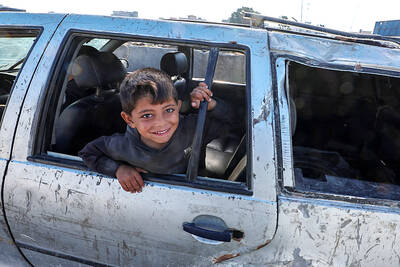
Gaza is rapidly running out of its limited fuel supply and stocks of food staples might become tight, officials said, after Israel blocked the entry of fuel and goods into the war-shattered territory, citing fighting with Iran. The Israeli military closed all Gaza border crossings on Saturday after announcing airstrikes on Iran carried out jointly with the US. Israeli authorities late on Monday night said that they would reopen the Kerem Shalom crossing from Israel to Gaza yesterday, for “gradual entry of humanitarian aid” into the strip, without saying how much. Israeli authorities previously said the crossings could not be operated safely during

Hungarian authorities temporarily detained seven Ukrainian citizens and seized two armored cars carrying tens of millions of euros in cash across Hungary on suspicion of money laundering, officials said on Friday. The Ukrainians were released on Friday, following their detention on Thursday, but Hungarian officials held onto the cash, prompting Ukraine to accuse Hungary’s Russia-friendly government of illegally seizing the money. “We will not tolerate this state banditism,” Ukrainian Minister of Foreign Affairs Andrii Sybiha said. The seven detained Ukrainians were employees of the Ukrainian state-owned Oschadbank, who were traveling in the two armored cars that were carrying the money between Austria and

Kosovar President Vjosa Osmani on Friday after dissolving the Kosovar parliament said a snap election should be held as soon as possible to avoid another prolonged political crisis in the Balkan country at a time of global turmoil. Osmani said it is important for Kosovo to wrap up the upcoming election process and form functional institutions for political stability as the war rages in the Middle East. “Precisely because the geopolitical situation is that complex, it is important to finish this electoral process which is coming up,” she said. “It is very hard now to imagine what will happen next.” Kosovo, which declared
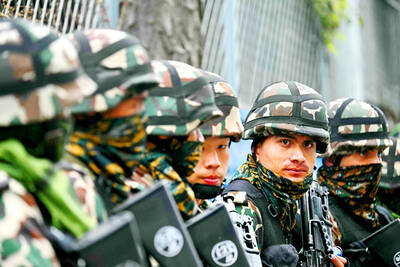
Counting was under way in Nepal yesterday, after a high-stakes parliamentary election to reshape the country’s leadership following protests last year that toppled the government. Key figures vying for power include former Nepalese prime minister K. P. Sharma Oli, rapper-turned-mayor Balendra Shah, who is bidding for the youth vote, and newly elected Nepali Congress party leader Gagan Thapa. In Kathmandu’s tea shops and city squares, people were glued to their phones, checking results as early trends flashed up — suggesting Shah’s centrist Rastriya Swatantra Party (RSP) was ahead. Nepalese Election Commission spokesman Prakash Nyupane said the counting was ongoing “in a peaceful manner”


 RSS
RSS