


Sparks illuminate the soot-covered studio of Japanese swordsmith Akihira Kawasaki as his apprentice hammers red-hot steel, showcasing a millennium-old craft enjoying a resurgence in popularity.
Despite the rapidly graying, shrinking population of blademakers in Japan, their fine steel swords known as katana are amassing a new generation of fans, particularly younger women, on the back of pop culture.
Driving the sword boom of the past decade has been video game Touken Ranbu, where swords take on the form of handsome men, with more recent hits such as the US series Shogun and anime Demon Slayer also feeding the trend.
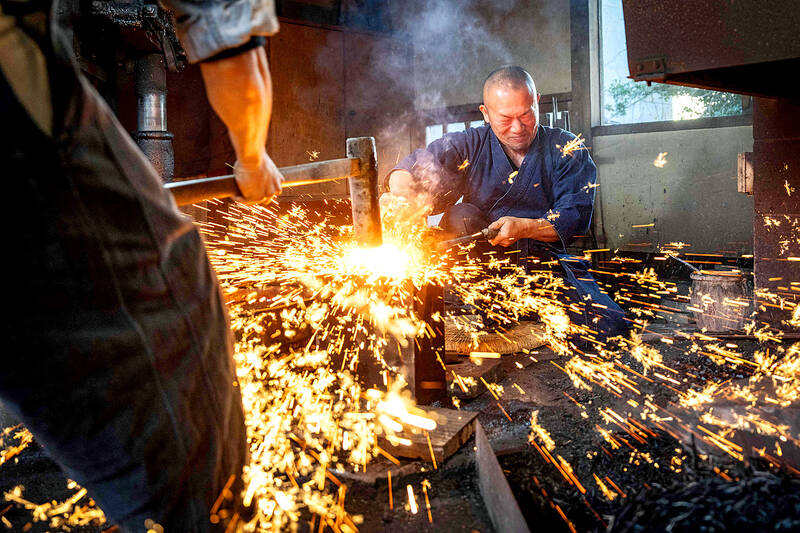
Photo: AFP
“It’s really encouraging to see more young people who genuinely love swords and engage with them so deeply,” 57-year-old Kawasaki said.
Katana buffs “used to be exclusively male,” he said, with “these old men dismissive or quite scornful of younger people showing interest, condescendingly telling them: ‘You don’t know nearly as much about swords as we do.’”
“It was no fun community,” he added.
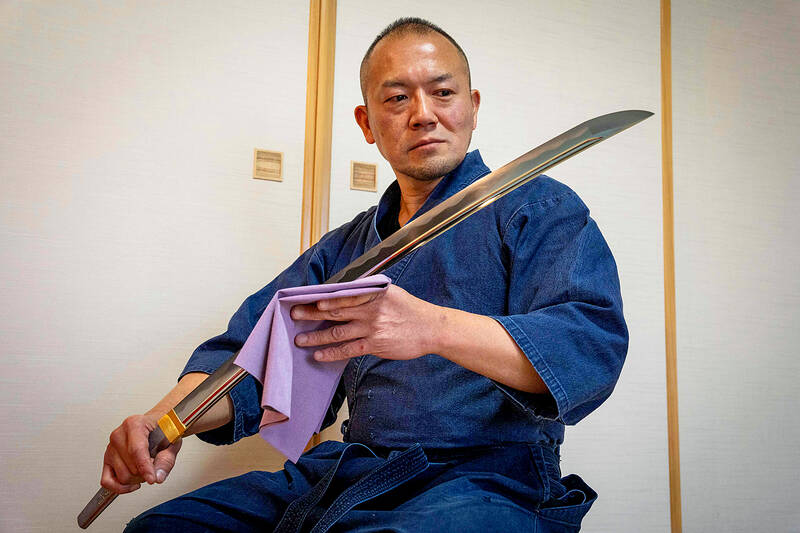
Photo: AFP
The 2015 release of Touken Ranbu has since turned some of its fans into serious admirers of the katana, the name given to the lightweight but extremely sharp Japanese sword with a curved blade.
Among them is Minori Takumi, 25, who began poring over blades showcased at museums after getting into the game as a teen.
“I was interested in finding out what similarities an actual sword has to its matching character” in the game, she said. “I found myself growing absorbed in the craft itself, especially the hamon” — distinctive, milky-white patterns along the hardened edge of a katana.
Her devotion ultimately changed her life when she joined the Bizen Osafune Sword Museum in western Japan’s Setouchi as a full-time curator.
The museum periodically displays the legendary sword Sanchomo, a national treasure purchased by the city in 2020 for more than US$3 million through crowdfunding.
Sanchomo is featured heavily in Touken Ranbu and whenever the museum exhibits it, “our visitor numbers skyrocket,” museum cultural guide Tumi Grendel Marian said, calling their demographic “about 80 percent female.”
“That’s, I think, the biggest impact we’ve seen within Japan,” Marian said, while international shows such as Shogun have helped “introduce a new generation of people to samurai culture and Japanese swords.”
The runaway success of Demon Slayer has also seen DIY buffs and craftsmen worldwide post YouTube videos recreating some of its characters’ outlandish katana, racking up millions of views.
Despite the boom, swordsmiths themselves are far from thriving.
Their numbers nationwide have halved to about 160 from nearly 40 years ago, with many in their 70s or 80s, according to the All Japan Swordsmith Association.
Young recruits are scared away in part by the unpaid, mandatory apprenticeship that lasts at least five years, said Tetsuya Tsubouchi, who heads the association’s business unit.
From repeatedly whacking steel with a heavy hammer to sitting sweat-drenched by a hearth for hours, the daily grind of blademaking is also not for the faint-hearted.
More fundamentally, “you can barely make ends meet” as a swordsmith today, with prices kept low by disdain for newly crafted swords among the industry old guard and collectors, 66-year-old Tsubouchi said.
“The view still exists within our industry that ancient swords are undeniably the best,” he said.
Kawasaki’s work is an exception, with his pieces selling for tens of thousands of dollars.
As well as Touken Ranbu fans seeking replicas of their favorite katana, practitioners of martial arts such as Iaijutsu value their practicality as weapons, he said.
What he really wants is the katana recognized not as an antiquity, but as a “masterpiece” of contemporary art.
Not all of his fellow swordsmiths see their work this way.
Some are content to produce quality products, “but never exercise creativity,” he said.
As long as this mindset prevails, the contemporary katana will continue to be undervalued, Kawasaki said.
“Unless we declare ourselves artists of steel, I doubt swordsmiths will ever be properly recognized,” he said.

Kouri Richins, a Utah mother who published a children’s book about grief after the death of her husband is to serve a life sentence for his murder without the possibility of parole, a judge ruled on Wednesday. Richins was convicted in March of aggravated murder for lacing a cocktail given to her husband, Eric Richins, with five times the lethal dose of fentanyl at their home near Park City in 2022. A jury also found her guilty of four other felonies, including insurance fraud, forgery and attempted murder for trying to poison her husband weeks earlier on Feb. 14, 2022, with a

DELA ROSA CASE: The whereabouts of the senator, who is wanted by the ICC, was unclear, while President Marcos faces a political test over the senate situation Philippine authorities yesterday were seeking confirmation of reports that a top politician wanted by the International Criminal Court (ICC) had fled, a day after gunfire rang out at the Philippine Senate where he had taken refuge fearing his arrest. Senator Ronald “Bato” dela Rosa, the former national police chief and top enforcer of former Philippine president Rodrigo Duterte’s “war on drugs,” has been under Senate protection and is wanted for crimes against humanity, the same charges Duterte is accused of. “Several sources confirmed that the senator, Senator Bato, is no longer in the Senate premises, but we are still getting confirmation,” Presidential

Nauru said it would hold a referendum to change its official name, described as a colonial relic from a time when “foreign tongues” mangled the native language. Nauru would change its name to Naoero to “more faithfully honor our nation’s heritage, our language and our identity,” Nauruan President David Adeang said in a statement on Tuesday. The Pacific island nation’s native language is Dorerin Naoero, which is spoken by the vast majority of its approximately 10,000 inhabitants. “Nauru emerged because Naoero could not be properly pronounced by foreign tongues, and was changed not by our choice, but for convenience,” the government said in

HELP DENIED? The US Department of State said that the Cuban leadership refuses to allow the US to provide aid to Cubans, ‘who are in desperate need of assistance’ US Secretary of State Marco Rubio on Wednesday said that Cuba’s leadership must change, as Washington renewed an offer of US$100 million in aid if the communist nation agrees to cooperate. Cuba has been suffering severe economic tumult led by an energy shortage that plunged 65 percent of the country into darkness on Tuesday. Cuba’s leaders have blamed US sanctions, but Rubio, a Cuban American and critic of the government established by Fidel Castro, said the system was to blame, including corruption by the military. “It’s a broken, nonfunctional economy, and it’s impossible to change it. I wish it were different,” he told


 RSS
RSS