


A pedestrian crossing turned viral catwalk has become a site for Jakarta’s young fashionistas to express themselves while attracting the disapproval of police in the traffic-clogged Indonesian capital.
The informal downtown gathering has drawn sartorial adventurists from across the suburbs of the metropolis, including from Citayam, leading it to be dubbed “Citayam Fashion Week.”
With their poses and struts being shared on TikTok and Instagram, some Citayam pioneers have found instant fame, earning modeling jobs, endorsements and an army of adoring fans.
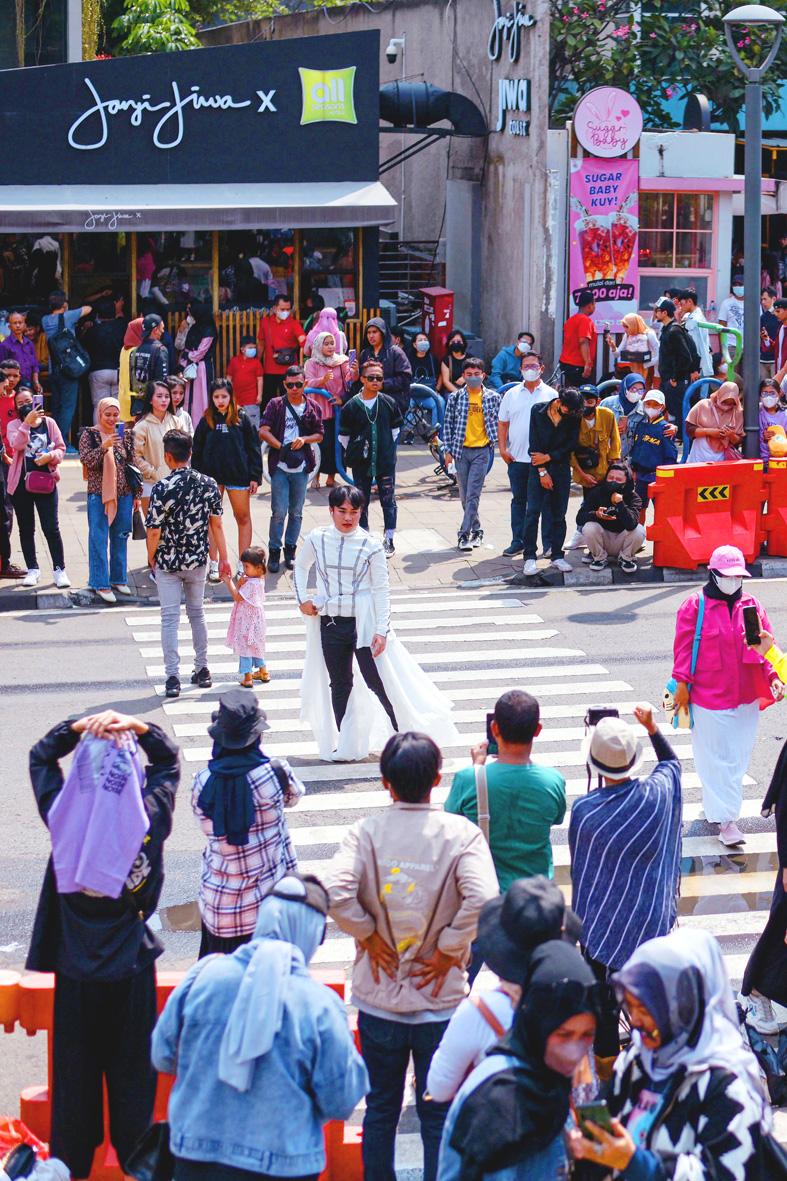
Photo: AFP
“I feel like this is the place where I can express my style and create content. It is so much fun because there are so many people and I can meet new friends here. I don’t even want to go home,” 18-year-old student Ricat al-Fendri told reporters.
He and some friends had taken a morning train to the central meeting spot, tucked between sleek skyscrapers and trendy cafes, to flaunt their outfits for the day.
Police, who previously moved to ban the use of the crosswalk as a runway, now regularly shout through a loudspeaker to ward the crowd off the street.
However, that does not deter girls who don wide-legged jeans and colorful sunglasses — and boys in leather jackets, stylish sneakers and faux-fur coats — from filming their struts for social media.
Some of the more enthusiastic teenagers have been caught sleeping on the area’s sidewalks at night after missing the last train home.
“We have the right to hang out here. It’s a public space and for me, it’s a great stress reliever from school exams,” al-Fendri said.
The outfits on display have begun to draw crowds, with news of the phenomenon spreading by word of mouth in the megacity of 30 million people.
Saera Wulan Sari, a 15-year-old school dropout from North Jakarta who makes a living selling clams, comes to watch the crowds with her friends.
“I am always amazed by other people’s outfits, they are so much cooler than me and their clothes are very stylish,” Sari said.
The gathering has been likened to a smaller version of Tokyo’s famed Harajuku fashion district.
The movement has become so popular that copycat gatherings have spread elsewhere in Java — Indonesia’s most populous island — in cities such as Semarang and Bandung.
And its viral fame has attracted attention from celebrities and influencers, as well as public officials including Indonesian President Joko Widodo, who said young people should be able to express themselves creatively.
Local brands are now starting to take note and capitalize on the momentum by advertising their products and endorsing the “stars” of the movement, providing free clothes, shoes and publicity.
“Teenagers are searching for their identity and they need recognition and validation. These teens saw that the quick and easy way to earn them is through likes and shares,” said Devie Rahmawati, a social affairs expert from the University of Indonesia. “Marginalized teenagers used to resort to violence or illegal racing, now they choose fashion instead. This is a positive thing and I think it’s beautiful.”
For many, the booming street fashion scene has also become an affordable arena for fashionable experimentation, set against the backdrop of the city’s most affluent district.
Teenagers from poor households who cannot afford designer outfits can join the gathering without judgement, said Khairul Badmi, a 22-year-old aspiring actor. “To be a part of Citayam Fashion Week, you don’t have to wear certain outfits or brands that empty your wallet.”

The Bolivian government on Friday struck a deal with protesting miners, but was still grappling with blockades and demonstrations by other workers across La Paz. Other groups are still blocking access roads into the city, which is also the seat of the government. Police on Thursday prevented the miners from entering the main square by using tear gas, while the demonstrators hurled stones and explosives with slingshots. Protests against the policies of Bolivian President Rodrigo Paz have convulsed the Andean nation since early this month, and roadblocks were choking routes into La Paz throughout Friday, the national road authority said. Miners demanded that Paz

The Philippines said it has asked the country’s Supreme Court to allow it to arrest former Philippine president Rodrigo Duterte’s chief drug war enforcer to stand trial in an international tribunal. The International Criminal Court (ICC) last week unsealed an arrest warrant against Philippine Senator Ronald dela Rosa, accusing him along with Duterte and other “coperpetrators” of the “crime against humanity of murder.” Dela Rosa briefly sought refuge in the Philippine Senate last week while asking the Philippine Supreme Court to stop an ongoing attempt by government agents to arrest him. “By his own conduct, he has placed himself outside the protection of

A ship anchored off the United Arab Emirates (UAE) was seized and taken toward Iran and another — a cargo ship near Oman — sank after being attacked, authorities said on Thursday, as tensions escalated near the Strait of Hormuz. It was not immediately clear who was behind these incidents, but they happened as a senior Iranian official reiterated his country’s claim of control over the waterway and another said it had a right to seize oil tankers connected to the US. The turmoil in the strait has been a sticking point for weeks in talks between the US and Iran to

The researchers in Ireland looked at their computer screen, marveling at a medieval book tracked down in a Roman library. They flipped through its digitized pages and found their sought-after treasure: the oldest surviving English poem. “We were extremely surprised. We were speechless. We couldn’t believe our eyes when we first saw that,” said Elisabetta Magnanti, a visiting research fellow at Trinity College Dublin’s school of English. The poem was also within the main body of Latin text, she said, calling it “extraordinary.” Composed in Old English by a Northumbrian agricultural worker in the 7th century, Caedmon’s Hymn appears within some copies of


 RSS
RSS