

Interpol elected an Emirati general accused of torture as its new president on Thursday, despite concerns of human rights organizations that fear the agency would be at risk of exploitation by repressive regimes.
The appointment follows generous funding by the United Arab Emirates (UAE) for the Lyon, France-based body and accusations that Abu Dhabi has abused Interpol’s system of so-called “red notices” for wanted suspects to persecute political dissidents.
Emirati Major General Ahmed Naser al-Raisi was elected following three rounds of voting during which he received 68.9 percent of votes cast by member countries, Interpol said in a statement.
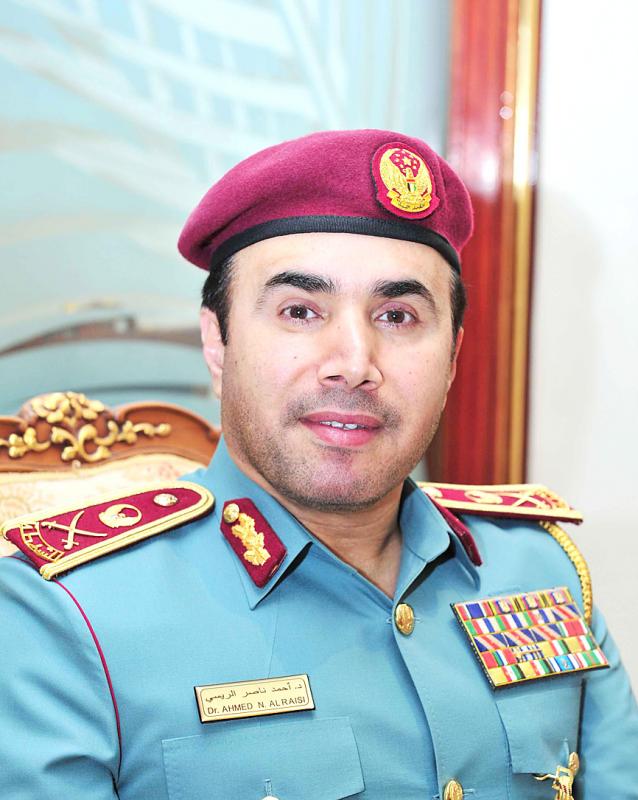
Photo: EPA-EFE
After his election, al-Raisi wrote on Twitter that he would “build a more transparent, diverse and decisive organization that works to ensure safety for all.”
Al-Raisi did not address the accusations, but said that the “UAE has become one of the safest countries in the world.”
Complaints of “torture” were in the past few months filed against the general in France and Turkey, which is hosting Interpol’s general assembly in Istanbul this week.
Al-Raisi, who heads the UAE’s security forces, is to take on a largely ceremonial and part-time voluntary role for a four-year term.
Interpol secretary-general Juergen Stock handles day-to-day running of the organization. He was appointed for a second five-year term in 2019.
Al-Raisi is to take over from Kim Jong-yang, a South Korean police official who has been Interpol president since the 2018 arrest of his predecessor, Meng Hongwei (孟宏偉), in China, where he had served as a vice minister of public security.
The only other candidate for the post was Sarka Havrankova, a veteran Czech police officer overseeing the country’s international cooperation in police matters.
Another appointment to Interpol’s executive committee — Chinese senior public security official Hu Binchen (胡彬郴) — similarly sparked anger.
China has come under increasing criticism from rights groups and some governments amid claims that actions towards Uighurs and other minority groups in the northwestern region of Xinjiang amount to genocide.
The rights group World Uyghur Congress described the election as “very disheartening.”
In a letter this month, 50 lawmakers from 20 countries belonging to the Inter-Parliamentary Alliance on China protested his candidacy.
They warned that his election would have “grave consequences for the safety and well-being of Chinese, Hong Kongers, Taiwanese and Chinese human rights activists living outside China as well as Tibetan and Uyghur diasporas.”
Al-Raisi joined the Emirati police force in 1980 and worked there for several decades.
Hiba Zayadin, a Gulf region researcher for Human Rights Watch, condemned the election of “a representative of arguably the most authoritarian government in the Gulf.”
She wrote on Twitter that it was a “sad day for human rights and the rule of law worldwide.”
One of the complainants against al-Raisi involves British national Matthew Hedges, who said he was detained and tortured between May and November 2018 in the UAE after he was arrested on false charges of espionage during a study trip.
In another complaint, lawyers for the Gulf Center for Human Rights accuse al-Raisi of “acts of torture and barbarism” committed against UAE government critic Ahmed Mansoor.
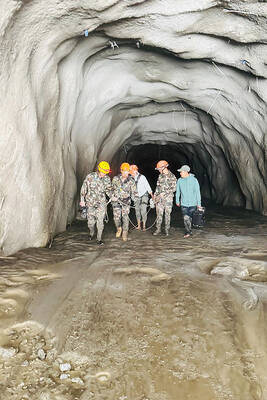
DEATH TOLL 903: More than 900 workers are believe to be trapped in the tunnels and underground areas of several hydropower projects after flash floods in Nepal-Tibet Rescue teams were working to reach more than 900 people thought to be trapped in the tunnels and underground areas of half a dozen hydropower projects in Nepal following the devastating flash floods, ?the National Disaster Risk Reduction and Management Authority said yesterday. The death toll from the unprecedented deluge of ice, rock, mud ?and debris that crashed through valleys of Nepal on Wednesday last week has risen to 903 people, with 16 more dead reported on the Tibet side of the border. More than 4,000 are missing in Nepal, with another 500 in Tibet. Hundreds of bodies, many unidentified, have been
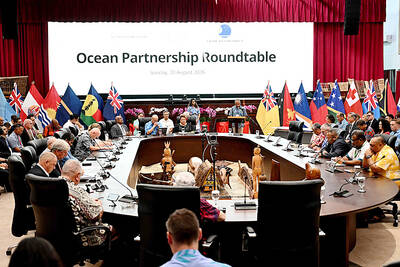
TAIWAN-CHINA ISSUE: Beijing has protested Taiwan’s inclusion in the 18-member state forum, which is being hosted by Palau, an ally of Taiwan At least five leaders would skip the Pacific Island region’s annual summit, officials said yesterday, hours before the opening of talks overshadowed by Taiwan-China tensions. The gathering aims to grapple with challenges such as climate change, drug crime and the Chinese test-firing of a ballistic missile in July that landed in the Pacific Ocean. China’s security and economic influence has added resonance this year, because the 18-member Pacific Islands Forum is being hosted by Palau, a diplomatic ally of Taiwan. Beijing has protested against Taiwan’s inclusion among aid partners invited to attend along with China, Singapore, Japan, the UK and the US. China has
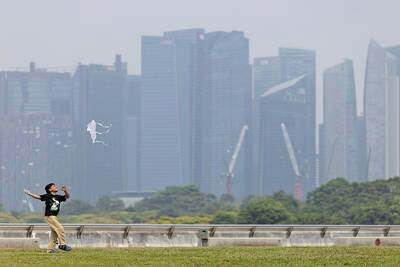
Singapore’s air quality hit an unhealthy level yesterday, as haze from forest fires raging in Indonesia continued to spread across swathes of Southeast Asia. The city-state is currently one of the 10 most-polluted major cities in the world, coming in at third in IQAir’s ranking. Kuching, in the Malaysian part of the island of Borneo, was No. 1. A government taskforce has “activated haze response plans” for schools, workplaces and community centers, Singaporean Minister for Sustainability and the Environment Grace Fu (傅海) said in a video message on Facebook. Most people could continue essential daily activities, but the elderly or vulnerable should
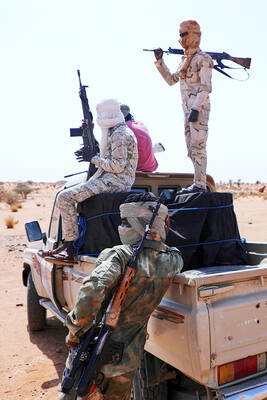
WAR CRIMES? An investigation found that a network of countries are supplying Sudan’s RSF with weapons, including drone blamed for large civilian casualties Foreign weapons, military technology, fighters and logistical networks are helping sustain Sudan’s conflict and expanding the warring parties’ ability to strike deep into civilian areas, a UN fact-finding mission said in a report published yesterday, warning that some attacks might amount to war crimes. Sudan’s war erupted in April 2023 following a power struggle between Sudan’s military and the Rapid Support Forces (RSF) ahead of a planned transition to civilian rule. The conflict has devastated the country, displaced more than 14 million people and created what the UN has described as one of the world’s worst humanitarian crises. The UN mission said


 RSS
RSS