


Against a backdrop of jumbled shacks seemingly piled atop each other, the dancers run in place with studied movements, then collapse to the floor in steady succession.
This is a rehearsal at the Ballet of Paraisopolis, one of the biggest favelas in Sao Paulo.
The dance school is just returning from a four-month hiatus for the COVID-19 pandemic, which has left Brazil with the second-highest death toll worldwide, after the US: nearly 130,000 people killed.
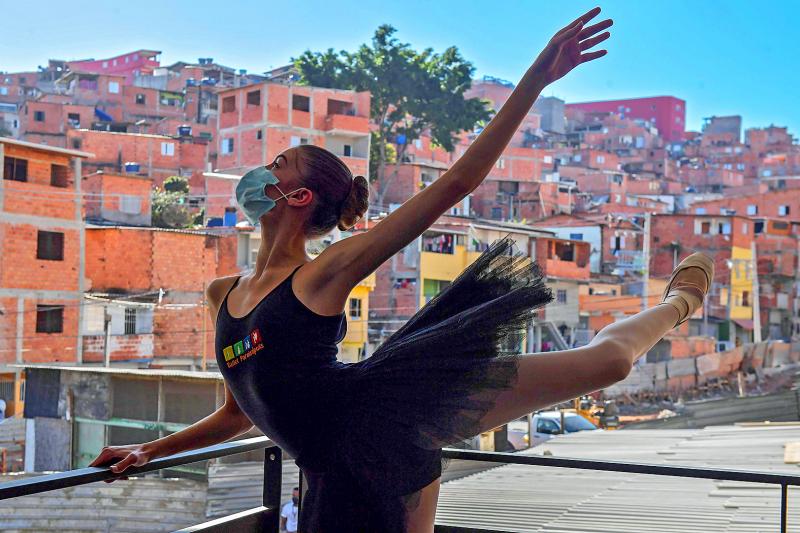
Photo: AFP
COVID-19 has hit hard in the favelas — poor, overcrowded neighborhoods that often lack clean running water, sanitation infrastructure or basic healthcare.
Although the virus is still spreading fast in Sao Paulo, the epicenter of the outbreak in Brazil, students and teachers at the school say they wanted — needed — to dance together again.
“I was really anxious to come back. It felt like my first time,” said 17-year-old dancer and local resident Kemilly Luanda, taking a break from rehearsals in an improvised studio whose ballet barre is a balcony railing — the dividing line that separates this world of graceful leaps and precision pirouettes from the brick shacks it overlooks.
Luanda and her classmates are rehearsing a new ballet with an urgent message: Nine Deaths, a tribute to the victims who died in a stampede when police raided a huge street party in the favela in December last year.
The school had to postpone the debut performance because of the pandemic. Now, the students are working to prepare it as they return from the long interruption.
Getting through lockdown has not been easy for the academy, which was founded in 2012 and provides free training to its 200 students thanks to public funding and private donations.
Luanda, who is in her final year at the school, recounted how difficult it was to keep up with her training through remote classes from the two-room house she shares with her parents, four siblings and dog.
Paraisopolis is a postcard of the inequalities that divide Sao Paulo, Brazil’s sprawling economic capital.
The favela juts up against one of the wealthiest neighborhoods in the city, Morumbi, a privileged reserve of luxury high-rises and mansions that is a world apart from the one where Luanda lives.
“I had to get everyone out of the bedroom, prop the cellphone up on the top bunk and practice in the aisle between our beds,” she said.
Her shaky Internet connection, small phone screen and lack of computer made things harder.
She missed the “sisters” she has studied dance with for the past eight years, she said.
She is one of 22 students who have returned for classes — 10 in the school itself, and 12 on the second floor of a cultural center that was converted into an anti-coronavirus command hub during lockdown.
Wearing masks, they practice for four hours a day, five days a week.
The rest of the school’s students are continuing their classes online, for now.
The academy had to postpone its first-ever graduation ceremony, now planned for next year.
Keeping the school going by remote learning “hasn’t been easy,” founder Monica Tarrago said.
“It was the worst feeling I’ve had in my life. We never stop except for Christmas and New Year’s. We’re like a family,” she said.
However, the school’s six teachers designed an intensive program to keep students engaged.
“We thought of everything we could do via [the videoconference application] Zoom to keep up their physical and mental preparation at home,” Tarrago said.
The program featured classes on nutrition, stretching, exercises and choreography, plus lessons with 10 dancers from around the world, including French ballerina Isabelle Guerin, former danseuse etoile at the Paris Opera Ballet.
The dancers are working hard to ready Nine Deaths. They have the sores on their feet to prove it when they remove their ballet slippers after class.
“We have to feel the characters in our skin. I try to feel their suffering... It has to hurt, body and soul,” Luanda said.
Still, she added: “I can’t live without dance.”

Kouri Richins, a Utah mother who published a children’s book about grief after the death of her husband is to serve a life sentence for his murder without the possibility of parole, a judge ruled on Wednesday. Richins was convicted in March of aggravated murder for lacing a cocktail given to her husband, Eric Richins, with five times the lethal dose of fentanyl at their home near Park City in 2022. A jury also found her guilty of four other felonies, including insurance fraud, forgery and attempted murder for trying to poison her husband weeks earlier on Feb. 14, 2022, with a

DELA ROSA CASE: The whereabouts of the senator, who is wanted by the ICC, was unclear, while President Marcos faces a political test over the senate situation Philippine authorities yesterday were seeking confirmation of reports that a top politician wanted by the International Criminal Court (ICC) had fled, a day after gunfire rang out at the Philippine Senate where he had taken refuge fearing his arrest. Senator Ronald “Bato” dela Rosa, the former national police chief and top enforcer of former Philippine president Rodrigo Duterte’s “war on drugs,” has been under Senate protection and is wanted for crimes against humanity, the same charges Duterte is accused of. “Several sources confirmed that the senator, Senator Bato, is no longer in the Senate premises, but we are still getting confirmation,” Presidential

HELP DENIED? The US Department of State said that the Cuban leadership refuses to allow the US to provide aid to Cubans, ‘who are in desperate need of assistance’ US Secretary of State Marco Rubio on Wednesday said that Cuba’s leadership must change, as Washington renewed an offer of US$100 million in aid if the communist nation agrees to cooperate. Cuba has been suffering severe economic tumult led by an energy shortage that plunged 65 percent of the country into darkness on Tuesday. Cuba’s leaders have blamed US sanctions, but Rubio, a Cuban American and critic of the government established by Fidel Castro, said the system was to blame, including corruption by the military. “It’s a broken, nonfunctional economy, and it’s impossible to change it. I wish it were different,” he told

Nauru said it would hold a referendum to change its official name, described as a colonial relic from a time when “foreign tongues” mangled the native language. Nauru would change its name to Naoero to “more faithfully honor our nation’s heritage, our language and our identity,” Nauruan President David Adeang said in a statement on Tuesday. The Pacific island nation’s native language is Dorerin Naoero, which is spoken by the vast majority of its approximately 10,000 inhabitants. “Nauru emerged because Naoero could not be properly pronounced by foreign tongues, and was changed not by our choice, but for convenience,” the government said in


 RSS
RSS