


Deep in the rainforest of Rwanda’s Volcanoes National Park, a 23-year-old female gorilla named Kurudi feeds on a stand of wild celery. She bends the green stalks and, with long, careful fingers, peels off the exterior skin to expose the succulent inside.
Biologist Jean Paul Hirwa notes her meal on his tablet computer as he peers out from behind a nearby stand of stinging nettles.
The large adult male sitting next to her, known as a silverback, looks at him quizzically.
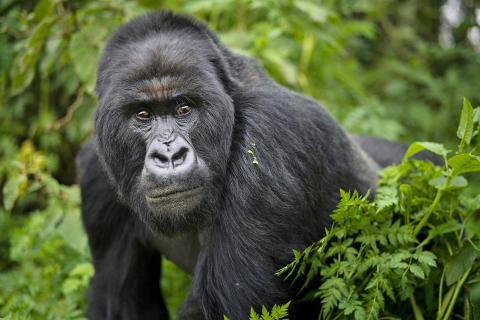
Photo: AP
Hirwa makes a low hum — “Ahh-mmm” — imitating the gorillas’ usual sound of reassurance.
“I’m here,” Hirwa is trying to say. “It’s OK. No reason to worry.”
Hirwa and the two great apes are all part of the world’s longest-running gorilla study — a project begun in 1967 by famed US primatologist Dian Fossey.
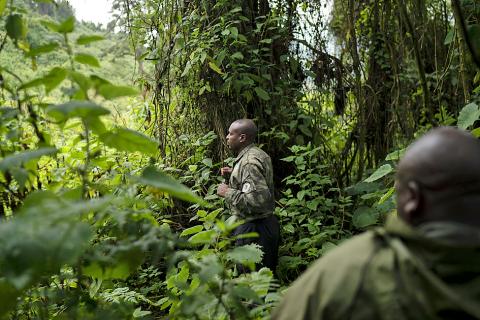
Photo: AP
Yet Fossey herself, who died in 1985, would likely be surprised that any mountain gorillas are still left to study.
Alarmed by rising rates of poaching and deforestation in central Africa, she predicted that the species could go extinct by 2000.
Instead, a concerted and sustained conservation campaign has averted the worst and given a second chance to these great apes, which share about 98 percent of human DNA.
Last fall, the Switzerland-based International Union for Conservation of Nature changed the status of mountain gorillas from “critically endangered” to “endangered,” an improved, if still-fragile designation.
Highly regulated tour groups hike in the Rwandan rainforest to watch gorillas.
Ticket revenue pays for operating costs and outstrips what might have been made from converting the rainforest to potato farms and cattle pastures.
“With tourism, the tension is always not to overexploit,” said Dirck Byler, great ape conservation director at the non-profit Global Wildlife Conservation. “But in Rwanda, so far they’re careful, and it’s working.”
The idea of using tourism to help fund conservation was contentious when conservationists Bill Weber and Amy Vedder first proposed it while living in Rwanda during the 1970s and 1980s. Fossey herself was skeptical.
“The wonder of the gorillas’ lives, their curiosity, their social interactions — that’s something that could be accessible to others through tourism,” Vedder said.
Jean Claude Masengesho lives with his parents and helps them farm potatoes. About once a week, the 21-year-old earns a little extra money helping tourists carry their bags up the mountain, totaling about US$45 a month. He would someday like to become a tour guide, which could earn him about US$320 monthly.
The obstacle is that most tour guides have attended college and Masengesho is not sure how his family can afford tuition.
“It’s my dream, but it’s very hard,” he said. “In this village, every young person’s dream is to work in the park.”

Kouri Richins, a Utah mother who published a children’s book about grief after the death of her husband is to serve a life sentence for his murder without the possibility of parole, a judge ruled on Wednesday. Richins was convicted in March of aggravated murder for lacing a cocktail given to her husband, Eric Richins, with five times the lethal dose of fentanyl at their home near Park City in 2022. A jury also found her guilty of four other felonies, including insurance fraud, forgery and attempted murder for trying to poison her husband weeks earlier on Feb. 14, 2022, with a

DELA ROSA CASE: The whereabouts of the senator, who is wanted by the ICC, was unclear, while President Marcos faces a political test over the senate situation Philippine authorities yesterday were seeking confirmation of reports that a top politician wanted by the International Criminal Court (ICC) had fled, a day after gunfire rang out at the Philippine Senate where he had taken refuge fearing his arrest. Senator Ronald “Bato” dela Rosa, the former national police chief and top enforcer of former Philippine president Rodrigo Duterte’s “war on drugs,” has been under Senate protection and is wanted for crimes against humanity, the same charges Duterte is accused of. “Several sources confirmed that the senator, Senator Bato, is no longer in the Senate premises, but we are still getting confirmation,” Presidential

HELP DENIED? The US Department of State said that the Cuban leadership refuses to allow the US to provide aid to Cubans, ‘who are in desperate need of assistance’ US Secretary of State Marco Rubio on Wednesday said that Cuba’s leadership must change, as Washington renewed an offer of US$100 million in aid if the communist nation agrees to cooperate. Cuba has been suffering severe economic tumult led by an energy shortage that plunged 65 percent of the country into darkness on Tuesday. Cuba’s leaders have blamed US sanctions, but Rubio, a Cuban American and critic of the government established by Fidel Castro, said the system was to blame, including corruption by the military. “It’s a broken, nonfunctional economy, and it’s impossible to change it. I wish it were different,” he told

Nauru said it would hold a referendum to change its official name, described as a colonial relic from a time when “foreign tongues” mangled the native language. Nauru would change its name to Naoero to “more faithfully honor our nation’s heritage, our language and our identity,” Nauruan President David Adeang said in a statement on Tuesday. The Pacific island nation’s native language is Dorerin Naoero, which is spoken by the vast majority of its approximately 10,000 inhabitants. “Nauru emerged because Naoero could not be properly pronounced by foreign tongues, and was changed not by our choice, but for convenience,” the government said in


 RSS
RSS