


Surgeons began a marathon operation yesterday to separate a pair of 29-year-old Iranian twin sisters joined at the head -- a procedure that could kill one or both.
After a lifetime of compromises on everything from when to wake up each day to what career to pursue, Ladan and Laleh Bijani said they preferred to face the dangers of the surgery rather than continue living joined.
"If God wants us to live the rest of our lives as two separate, independent individuals, we will," Ladan said Saturday.
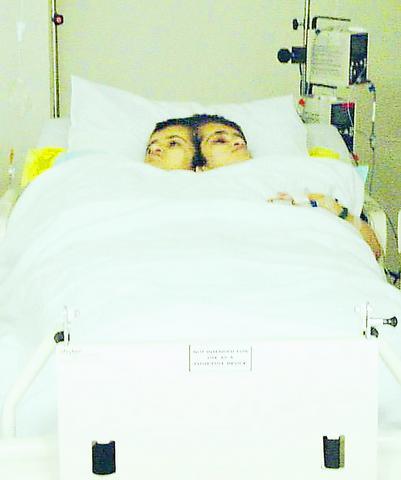
PHOTO: AP
An international team of 28 doctors and about 100 medical assistants will participate in the surgery, which will last at least 48 hours and could take four days.
"The twins were wheeled into the operating theater and the medical team is now administering anesthesia to the twins," said Dr. Prem Kumar, a spokesman at Singapore's Raffles Hospital.
The twins had said they wanted to walk into the operating room as a sign of courage, but they were brought in by wheelchair shortly after 10:00am because they were too tired to stand, Kumar said.
The operation will mark the first time surgeons have tried to separate adult craniopagus twins -- siblings born joined at the head -- since the procedure was first successfully performed in 1952.
"It's going to be a good day," the lead neurosurgeon Dr. Keith Goh told reporters as he arrived at the hospital yesterday morning. He said he and his wife spent the morning praying for the twins.
When asked about his mood as he entered the hospital yesterday, Dr. Benjamin Carson, one of six international experts assisting in the surgery, said one word: "Sunshine."
Ladan said Saturday that she and her sister would spend the hours before the operation reading the Koran and performing ritual Muslim ablutions. "We feel closer to God that way," she said.
The sisters each have a 50-50 chance of survival, said Carson, a Johns Hopkins neurosurgeon from Baltimore, Maryland. But he said he expected the surgery to be a success.
The US$288,000 cost of the surgery is being underwritten by Raffles Hospital, and the doctors' fees are being waived.
The Bijani sisters, born in Firouzabad, southern Iran, in 1974, have separate brains that lie next to each other in a joined skull. Their heads are connected but their bodies are otherwise distinct.
The surgeons' biggest challenge will be dealing with a shared vein that drains blood from the women's brains. German doctors concluded in 1996 that the vein made surgery too dangerous.
The surgeons' first task was to remove a vein from one sister's leg that will be used as a graft to replace the shared vein, Kumar said. He did not say who the vein would be taken from.
Carson compared the veins to a city's road network, and said the surgeons had to identify traffic jams and create detours. The largest vein was the size of a finger, he said.

Kouri Richins, a Utah mother who published a children’s book about grief after the death of her husband is to serve a life sentence for his murder without the possibility of parole, a judge ruled on Wednesday. Richins was convicted in March of aggravated murder for lacing a cocktail given to her husband, Eric Richins, with five times the lethal dose of fentanyl at their home near Park City in 2022. A jury also found her guilty of four other felonies, including insurance fraud, forgery and attempted murder for trying to poison her husband weeks earlier on Feb. 14, 2022, with a

DELA ROSA CASE: The whereabouts of the senator, who is wanted by the ICC, was unclear, while President Marcos faces a political test over the senate situation Philippine authorities yesterday were seeking confirmation of reports that a top politician wanted by the International Criminal Court (ICC) had fled, a day after gunfire rang out at the Philippine Senate where he had taken refuge fearing his arrest. Senator Ronald “Bato” dela Rosa, the former national police chief and top enforcer of former Philippine president Rodrigo Duterte’s “war on drugs,” has been under Senate protection and is wanted for crimes against humanity, the same charges Duterte is accused of. “Several sources confirmed that the senator, Senator Bato, is no longer in the Senate premises, but we are still getting confirmation,” Presidential

HELP DENIED? The US Department of State said that the Cuban leadership refuses to allow the US to provide aid to Cubans, ‘who are in desperate need of assistance’ US Secretary of State Marco Rubio on Wednesday said that Cuba’s leadership must change, as Washington renewed an offer of US$100 million in aid if the communist nation agrees to cooperate. Cuba has been suffering severe economic tumult led by an energy shortage that plunged 65 percent of the country into darkness on Tuesday. Cuba’s leaders have blamed US sanctions, but Rubio, a Cuban American and critic of the government established by Fidel Castro, said the system was to blame, including corruption by the military. “It’s a broken, nonfunctional economy, and it’s impossible to change it. I wish it were different,” he told

Nauru said it would hold a referendum to change its official name, described as a colonial relic from a time when “foreign tongues” mangled the native language. Nauru would change its name to Naoero to “more faithfully honor our nation’s heritage, our language and our identity,” Nauruan President David Adeang said in a statement on Tuesday. The Pacific island nation’s native language is Dorerin Naoero, which is spoken by the vast majority of its approximately 10,000 inhabitants. “Nauru emerged because Naoero could not be properly pronounced by foreign tongues, and was changed not by our choice, but for convenience,” the government said in


 RSS
RSS