


The Ministry of Environment is publicizing a program aimed at helping vulnerable groups shift to a greener lifestyle in line with the net zero trend, with methods related to food and clothing written to appeal to young people.
The brochure is designed to promote information accessibility in the net zero transition, combining easy-to-read language with illustrations to make it accessible to everyone, Department of Comprehensive Planning Director Hung Shu-sing (洪淑幸) said.
Experts with knowledge of easy-to-read techniques or net zero developments and more than 40 interviewees with special needs were invited to provide advice and help write the brochure, she said.
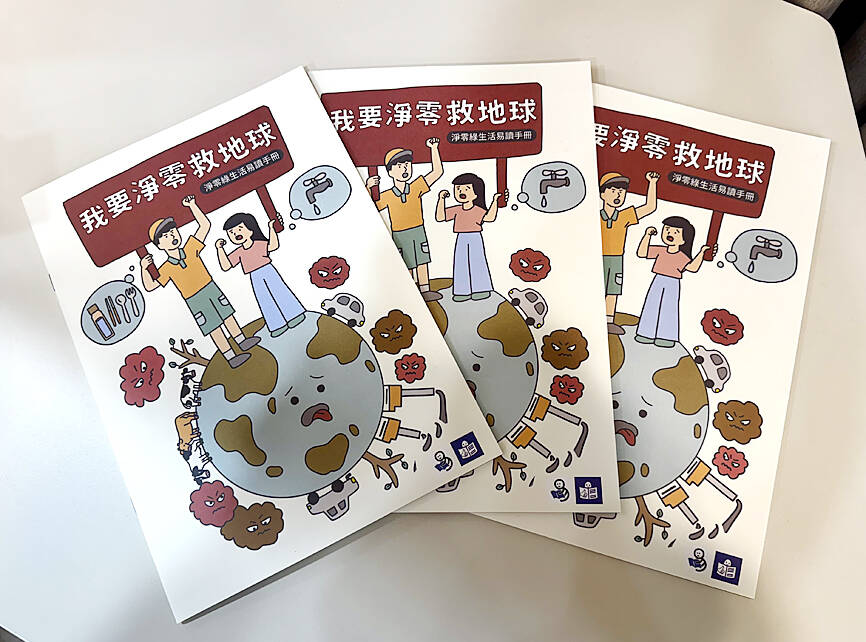
Photo: Hunag Yi-ching, Taipei Times
Through discussions, the team found that interviewees were highly interested in net zero information, but the current Net Zero Green Lifestyle Action Guidelines published by the ministry contain too many QR codes, making it difficult to read for many of them, Hung said.
Interviewees also showed interest in learning more about green actions in terms of food, transportation, home life and clothing, especially innovations such as food apps, clothing and green restaurants, she said.
The streamlined brochure prioritizes the issues they are more concerned about while removing all QR codes except the one for the “Zero Waste Taiwan” map, Hung said.
Audio versions were published alongside the brochure to make the content available to people within educational, long-term care and disability service systems, she said, adding that the brochure would be supplied to 173 public libraries and 267 disability welfare institutions.
Taiwan Foundation for the Blind research and development director Lee Ying-chi (李英琪), an easy-reading advisor on the team, said the brochure’s content was designed based on the principle of “information for all” in accordance with the EU’s easy-to-read guidelines.
Only language comprehensible at least to a fourth-grade student was used, she said, adding that the content is also comprehensible simply through the illustrations or audiobooks, which suits the needs of the elderly and children.
In related news, the Ministry of Agriculture’s Taiwan Forestry Research Institute on Friday said extending the product lifespan of wood-derived products can delay such products’ carbon emissions.
Wood-derived products such as paper, furniture or timber are hidden carbon pools, as carbon captured via photosynthesis by trees would not be released immediately after trees are chopped and made into products, it said.
Given that such carbon would remain in the products until they are rotten or burned, extending their lifespan or repurposing such products would lengthen the carbon storage and lessen climate impact, the institute said.
Lifespans vary between different wood-derived products, it said.
For example, most paper would be recycled or discarded months later, while wooden flooring or furniture would be used for 20 to 40 years, the institute said, adding that wooden construction can last more than a century.
However, the institute’s research showed that product lifespans of wood-derived products in Taiwan were slightly shorter than international standards, it said.
Most wooden furniture and decorative materials in Taiwan have a product lifespan of six to 15 years, while wooden doors, windows or flooring have a lifespan of six to 20 years, the institute said, adding that lifespans could be affected by environmental conditions, material quality, usage habits or maintenance frequency.
People are advised to choose robust, endurable products to reduce their frequency of replacement, or recycle and reuse second-hand wooden furniture to prevent them from becoming waste ahead of time, it said.

FUKUOKA SITUATION: Japanese media reported that the pathogen is expected to be identified by the summer, while the CDC downplayed the idea that it was hMPV A “mysterious cold-like illness” reported in Japan’s Fukuoka Prefecture does not seem to be a new disease, but Japanese authorities have been asked about the situation, the Centers for Disease Control (CDC) said yesterday. The Fukuoka Prefectural Medical Association on Wednesday told a news conference that a “mystery cold” that has become a hot topic on social media is “highly likely to be caused by some kind of viral infection,” Japan’s KBC News reported. “Many people are experiencing symptoms starting with a sore throat, followed by a runny nose, phlegm and a severe cough,” KBC News reported, citing association officials. Health authorities are

Nvidia Corp CEO Jensen Huang (黃仁勳) arrived in Taiwan yesterday ahead of upcoming AI and technology events, saying he plans to meet with clients and Taiwan Semiconductor Manufacturing Co Chairman C.C. Wei (魏哲家) during his visit. After landing at Taipei Songshan Airport, Huang posed for photos with fans and handed out Yakult drinks to reporters and supporters waiting at the scene, saying he has “a lot to do” during the trip. Asked about reports that Nvidia’s planned headquarters site in Taipei’s Beitou Shilin Technology Park could break ground on May 27, Huang said that if the company holds an event, he would

The Ministry of Finance this afternoon announced the winning numbers for the March-April uniform invoice lottery. The winning number for the NT$10 million (US$318,060) special prize is 19531471, and the winning number for the NT$2 million grand prize is 85941329. Three numbers were drawn for the NT$200,000 first prize: 07225810, 20231230 and 83518781. Those with receipts matching the last seven digits of any of the first-prize numbers will win the NT$40,000 second prize, while those matching the last six digits will win the NT$10,000 third prize. Those whose receipts match the last five digits of the first-prize numbers can claim the NT$4,000 fourth prize,

SIX SUBSIDIES: The monthly allowance for older farmers is to increase to NT$10,000, and NT$5,000 is to be given to homemakers under the national pension system, Lai said The government is to implement major welfare policies for disadvantaged groups, including raising the monthly allowance for older farmers to NT$10,000 and providing homemakers with NT$5,000 per month, President William Lai (賴清德) said yesterday. Lai made the remarks during a visit to Wangling Temple in Chiayi County, saying that the planned increases were being introduced amid economic growth and an increase in tax revenue. Touting a policy, in which the government plans to provide a monthly allowance of NT$5,000 for every child under the age of 18 in a bid to address Taiwan’s low birthrate, Lai said that if received for the


 RSS
RSS