


China’s requirement that the Dalai Lama’s reincarnation to be born in China and approved by Beijing has drawn criticism, with experts at a forum in Taipei yesterday saying that if Beijing were to put forth its own Dalai Lama, the person would not be recognized by the Tibetan Buddhist community.
The experts made a remarks at the two-day forum hosted by the Tibet Religious Foundation of His Holiness the Dalai Lama titled: “The Snow Land Forum: Finding Common Ground on Tibet.”
China says it has the right to determine the Dalai Lama’s reincarnation, as it claims sovereignty over Tibet since ancient times, Liu Han-cheng (劉漢城), author of Tibet Has Never Been a Part of China, said at the forum.
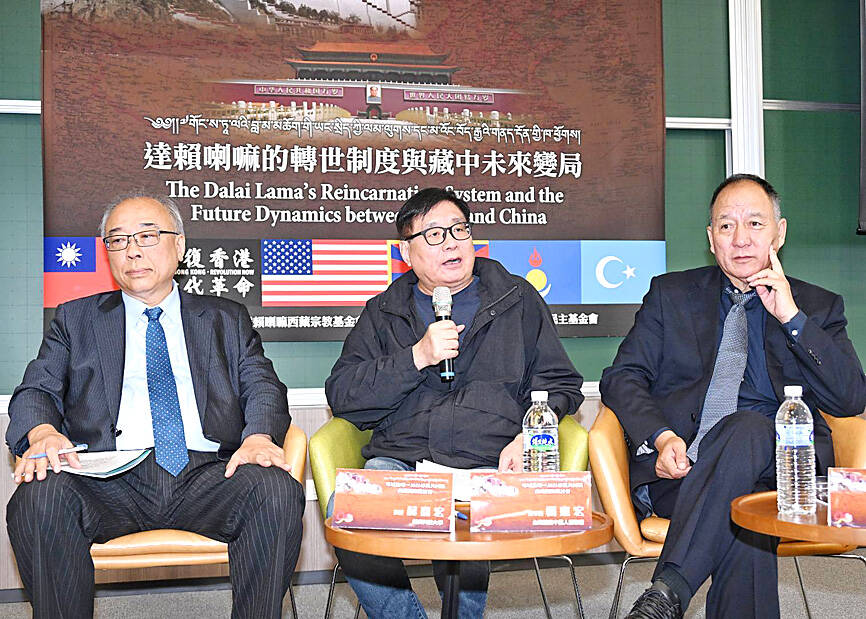
Photo: Fang Pin-chao, Taipei Times
Before 1949, China never exercised sovereignty over Tibet, so it has no right to decide the Dalai Lama’s reincarnation, Liu said, citing sources from China.
The process for the Dalai Lama’s reincarnation does not originate from religious rituals or laws in China, so Beijing has no historical, legal or moral basis for interfering in how Tibetans select the newest person to bear the title, he said.
He said that the early Republic of China (ROC) was too consumed by internal turmoil and wars to exert control over Tibet, and that after the Qing Dynasty fell, British support enabled Tibetans to expel remaining Qing forces.
Before the People’s Republic of China (PRC) was established in 1949, the ROC had virtually no influence in Tibet, Liu said.
Hu Ping (胡平), editor of the New York-based Chinese-language magazine Beijing Spring, said that none of China’s three requirements in its regulations on the reincarnations of Tibetan Buddhist living Buddhas are tenable.
The requirement that the Dalai Lama must be found in China is a nonstarter because there is a historical precedent of choosing a Dalai Lama from outside the country’s borders, he said, adding that the fourth Dalai Lama, Yonten Gyatso, was born in Mongolia.
The search for reincarnated living Buddhas is based on the spread of Tibetan Buddhism and the spread of its followers, which is not limited by countries’ borders, he said.
The second requirement, that the “Golden Urn” lottery method should be used, lacks significant historical precedent, as this method was only used during the Qing Dynasty to identify one or two Dalai Lamas, he said.
Lastly, the requirement that the Dalai Lama be approved by the Chinese government, as if the Dalai Lama were an “official” appointed by Beijing, does not work because the appointee would be rejected by most Tibetan Buddhists and ultimately become a historical embarrassment, Hu said.
Fooyin University professor Su Chia-hung (蘇嘉宏) said that there could eventually be two Dalai Lamas, one selected by the overseas Tibetan Buddhist community and another by the Chinese government.
If the Dalai Lama was reincarnated in Taiwan, which China claims as its territory, Beijing’s position that the reincarnation must occur within China would collapse, as any political justifications it has would backfire, said Kelsang Gyalsten Bawa, chair of the Tibet Religious Foundation of His Holiness the Dalai Lama.
Bawa reiterated that Dalai Lama Tenzin Gyatso said in July that the highest authority on his reincarnation is the Gaden Phodrang Foundation of the Dalai Lama.
National Medical University professor Chang Kuo-cheng (張國城) echoed Bawa’s viewpoint, saying that China would face a narrative contradiction if the Dalai Lama was reincarnated in Taiwan.
If Taiwan were ever to fall under Beijing’s control, it would suffer repression worse than Tibet, Chang said, emphasizing that by supporting Tibet, Taiwan is supporting itself.
Additional reporting by Fang Wei-li

NATIONAL SECURITY: Authorities are working to confirm the identities of the military personnel involved and investigating possible illegal conduct and regulatory violations Authorities are probing possible national security implications after Kinmen police and immigration officers on Sunday found a Chinese woman allegedly posing as a tourist while engaging in prostitution involving more than 10 military personnel. The woman, surnamed Chen (陳), has since been deported, authorities said, adding that investigators are still working to confirm the identities of those implicated, as the records only listed code names and aliases. The case stemmed from a report received by the Kinmen District Prosecutors’ Office on Friday last week from the Jinhu Precinct of the Kinmen County Police Bureau. On Sunday, police, along with the National Immigration

GLOBALGIVING: ‘ Caving to external pressure is not acceptable for an organization that has cultivated justice reform and human rights for 30 years,’ one NGO said A slew of non-government organizations (NGOs) have withdrawn from the GlobalGiving fundraising platform after it announced it would use “Chinese Taipei” instead of “Taiwan” from next month. The Taiwan Good Rice Association wrote on Facebook on Friday that it was informed on April 28 via a teleconference call of the change, which was made because the platform wanted to operate in China. Taiwan Good Rice is to terminate all cooperative relationships with GlobalGiving in response to the platform’s “unilateral and non-negotiable” decision to remove references to Taiwan, the NGO said. “Taiwan is in the official name of Taiwan Good Rice Association and the

HEAVY WEATHER: Typhoon Jangmi is due to crash straight into the Ryukyus as airlines look to shift flights to larger aircraft or cancel flights to Okinawa entirely Taiwan’s international air carriers announced flight adjustments over the weekend as Typhoon Jangmi is forecast to hit the Ryukyu Islands today and tomorrow. The Central Weather Administration (CWA) upgraded Jangmi from a tropical storm to a typhoon at 8am yesterday, with the eye located 580km south of Naha city. It was moving north at 19kph. Today, China Airlines’ CI-120, CI-121, CI-122 and CI-123 flights between Taoyuan and Naha, Okinawa, have been canceled as well as CI-132 and CI-133 between Kaohsiung and Naha. EVA Air’s BR-112, BR-113, BR-186 and BR-185 flights between Taoyuan and Naha are also canceled. Low-cost carrier Tigerair Taiwan canceled IT-230,

Chinese Nationalist Party (KMT) Chairwoman Cheng Li-wun (鄭麗文) yesterday briefed her party’s Central Standing Committee regarding her scheduled visit to the US between Monday next week and June 16, saying that her purpose would be to persuade the US that the Republic of China (ROC) Constitution was a “one China” constitution that would foster stable and peaceful cross-strait relations. The ROC Constitution is the most important defense for all Taiwanese citizens, as it upholds our democracy and has contributed to our robust economy, which aligns with international and US interests, she said. “We would not be troublemakers and drag the US under,”


 RSS
RSS