


Taiwanese singer Jay Chou (周杰倫) plans to take to the courts of the Australian Open for the first time as a competitor in the high-stakes 1 Point Slam.
The Australian Open yesterday afternoon announced the news on its official Instagram account, welcoming Chou — who celebrates his 47th birthday on Sunday — to the star-studded lineup of the tournament’s signature warm-up event.
“From being the King of Mandarin Pop filling stadiums with his music to being Kato from The Green Hornet and now shifting focus to being a dedicated tennis player — welcome @jaychou to the 1 Point Slam and #AusOpen,” the post read.

Photo: Screen grab from the Australian Open’s Instagram
Chou shared the announcement on Instagram, saying: “I’m going to compete in the Australian Open. I will donate it all if I win the championship and the A$1 million (US$671,200) prize money.”
“Remember to watch the Australian Open on Jan. 14. It’s just a one-point game, so I may get knocked out without even touching the ball,” he wrote in a subsequent story, adding that he would prefer to serve the point, so that “at least I can touch the ball.”
The Australian Open post also drew a comment from Chou’s close friend, retired basketball star Jeremy Lin (林書豪).
“You can beat them because you beat me. You should thank me for providing training as an opponent who is stronger than the ones you’ll face in the competition,” Lin said, jokingly.
Inaugurated by Tennis Australia last year, the 1 Point Slam is a cornerstone of the Grand Slam’s Opening Week entertainment festival. Australian professional tennis player Omar Jasika won the inaugural edition, taking home A$60,000.
For this year’s edition, the prize pool has been massively increased. The 48-player “flash” draw features 24 professionals — including world No. 1 Carlos Alcaraz, defending champion Jannik Sinner and Naomi Osaka — competing alongside celebrities and amateur qualifiers.
To add to the unpredictability, players use a game of rock-paper-scissors to determine who serves the single deciding point.
Chou took up tennis a few years ago to support his son’s interest in the sport and has since earned a reputation among his celebrity peers for his skill.

NATIONAL SECURITY: Authorities are working to confirm the identities of the military personnel involved and investigating possible illegal conduct and regulatory violations Authorities are probing possible national security implications after Kinmen police and immigration officers on Sunday found a Chinese woman allegedly posing as a tourist while engaging in prostitution involving more than 10 military personnel. The woman, surnamed Chen (陳), has since been deported, authorities said, adding that investigators are still working to confirm the identities of those implicated, as the records only listed code names and aliases. The case stemmed from a report received by the Kinmen District Prosecutors’ Office on Friday last week from the Jinhu Precinct of the Kinmen County Police Bureau. On Sunday, police, along with the National Immigration

GLOBALGIVING: ‘ Caving to external pressure is not acceptable for an organization that has cultivated justice reform and human rights for 30 years,’ one NGO said A slew of non-government organizations (NGOs) have withdrawn from the GlobalGiving fundraising platform after it announced it would use “Chinese Taipei” instead of “Taiwan” from next month. The Taiwan Good Rice Association wrote on Facebook on Friday that it was informed on April 28 via a teleconference call of the change, which was made because the platform wanted to operate in China. Taiwan Good Rice is to terminate all cooperative relationships with GlobalGiving in response to the platform’s “unilateral and non-negotiable” decision to remove references to Taiwan, the NGO said. “Taiwan is in the official name of Taiwan Good Rice Association and the

HEAVY WEATHER: Typhoon Jangmi is due to crash straight into the Ryukyus as airlines look to shift flights to larger aircraft or cancel flights to Okinawa entirely Taiwan’s international air carriers announced flight adjustments over the weekend as Typhoon Jangmi is forecast to hit the Ryukyu Islands today and tomorrow. The Central Weather Administration (CWA) upgraded Jangmi from a tropical storm to a typhoon at 8am yesterday, with the eye located 580km south of Naha city. It was moving north at 19kph. Today, China Airlines’ CI-120, CI-121, CI-122 and CI-123 flights between Taoyuan and Naha, Okinawa, have been canceled as well as CI-132 and CI-133 between Kaohsiung and Naha. EVA Air’s BR-112, BR-113, BR-186 and BR-185 flights between Taoyuan and Naha are also canceled. Low-cost carrier Tigerair Taiwan canceled IT-230,
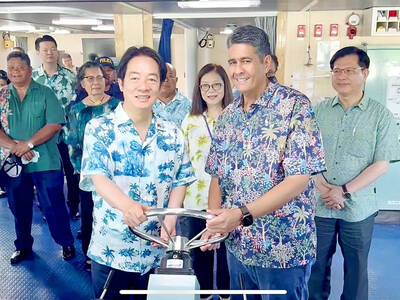
MULTIPRONGED APPROACH: China has sought to pressure Palau across a number of fronts, but the island nation has staunchly resisted overtures to ditch Taiwan Palau has been firm in backing Taiwan despite Chinese pressure that uses tourism economics, cyberattacks and criminal infiltration as tools to threaten the Pacific ally into renouncing its recognition of Taiwan as a sovereign state. The Presidential Office yesterday announced that Vice President Hsiao Bi-khim (蕭美琴) would visit Palau from Saturday to Wednesday next week at the invitation of Palauan President Surangel Whipps Jr. Whipps in April said in an interview that China had outspokenly asked Palau to “denounce Taiwan.” “And we have said: ‘We have no enemies, but nobody tells us who our friends are,’” he said. Whipps has told reporters multiple times


 RSS
RSS