


Taiwanese paleontologists have discovered fossil evidence that pythons up to 4m long inhabited Taiwan during the Pleistocene epoch, reporting their findings in the international scientific journal Historical Biology.
National Taiwan University (NTU) Institute of Ecology and Evolutionary Biology associate professor Tsai Cheng-hsiu (蔡政修) led the team that discovered the largest snake fossil ever found in Taiwan.
A single trunk vertebra was discovered in Tainan at the Chiting Formation, dated to between 800,000 to 400,000 years ago in the Middle Pleistocene, the paper said.
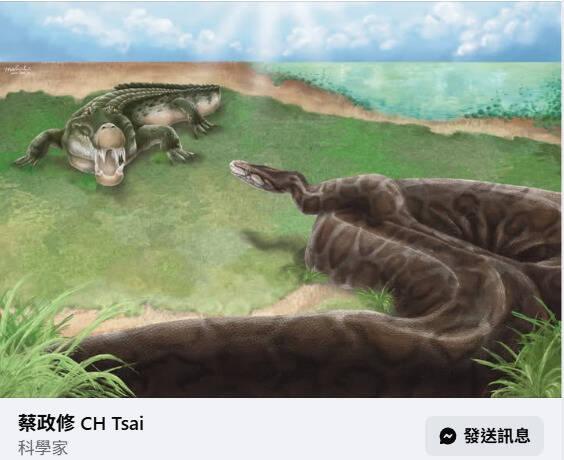
Photo courtesy of Tsai Cheng-hsiu
The area also produced Taiwan’s first avian fossil, as well as crocodile, mammoth, sabre-toothed cat and rhinoceros fossils, it said.
Discoveries of apex predator fossils suggest the presence of a “fairly complex, well-established and stable ecosystem” during the Middle Pleistocene in Taiwan, it added.
No members of the Python genus inhabit the main island today, with the Burmese python in Kinmen County the closest extant population, it said.
The largest snakes on the Taiwanese mainland today are the king ratsnake and the oriental ratsnake, neither of which exceeds 3m in length.
As Taiwan has no living crocodile species, these snakes are also the nation’s largest reptiles.
Tsai’s research previously described a giant crocodile measuring up to 7m long, which also lived during the Pleistocene era alongside the large pythons.
The python fossil was donated to Tsai by private collector L.R. Hou (侯立仁) for research at the NTU laboratory of evolution and diversity of fossil vertebrates.
Tsai returned to Taiwan in 2018 to establish the lab and became the first Taiwanese to discover dinosaur fossils, finding the first Pleistocene-era bird specimen in 2021.
The paper, “An Unexpected Snake Fossil,” was published in Historical Biology in January.
It was coauthored by PhD candidates Liao Yi-lu (廖翊如) and Cho Yi-yang (卓義揚), plus additional coauthors Sun Cheng-han (孫正涵) and Deep Shubhra Biswas from India.
The paper suggests that the modern ecosystem of Taiwan, which is devoid of top predators, may have yet to recover from the Pleistocene extinction event.
It also supports his hypothesis that large-scale extinction events occurred across island ecosystems worldwide, Tsai said, adding that local extinction events in Taiwan require further research.

LOUD AND PROUD Taiwan might have taken a drubbing against Australia and Japan, but you might not know it from the enthusiasm and numbers of the fans Taiwan might not be expected to win the World Baseball Classic (WBC) but their fans are making their presence felt in Tokyo, with tens of thousands decked out in the team’s blue, blowing horns and singing songs. Taiwanese fans have packed out the Tokyo Dome for all three of their games so far and even threatened to drown out home team supporters when their team played Japan on Friday. They blew trumpets, chanted for their favorite players and had their own cheerleading squad who dance on a stage during the game. The team struggled to match that exuberance on the field, with
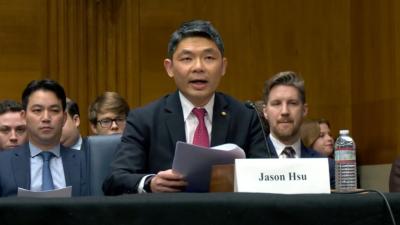
If China chose to invade Taiwan tomorrow, it would only have to sever three undersea fiber-optic cable clusters to cause a data blackout, Jason Hsu (許毓仁), a senior fellow at the Hudson Institute and former Chinese Nationalist Party (KMT) legislator, told a US security panel yesterday. In a Taiwan contingency, cable disruption would be one of the earliest preinvasion actions and the signal that escalation had begun, he said, adding that Taiwan’s current cable repair capabilities are insufficient. The US-China Economic and Security Review Commission (USCC) yesterday held a hearing on US-China Competition Under the Sea, with Hsu speaking on
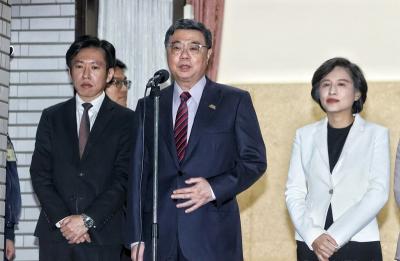
Taiwan is awaiting official notification from the US regarding the status of the Agreement on Reciprocal Trade (ART) after the US Supreme Court ruled US President Donald Trump's global tariffs unconstitutional. Speaking to reporters before a legislative hearing today, Premier Cho Jung-tai (卓榮泰) said that Taiwan's negotiation team remains focused on ensuring that the bilateral trade deal remains intact despite the legal challenge to Trump's tariff policy. "The US has pledged to notify its trade partners once the subsequent administrative and legal processes are finalized, and that certainly includes Taiwan," Cho said when asked about opposition parties’ doubts that the ART was
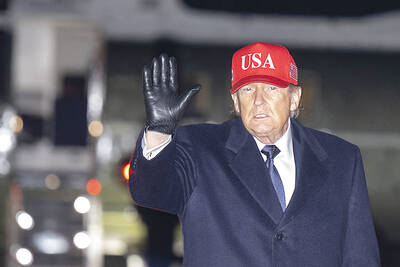
The US’ joint strikes with Israel on Iran dismantled a key pillar of China’s regional strategy, removing an important piece in Beijing’s potential Taiwan Strait scenario, said Zineb Riboua, a senior researcher at the Hudson Institute’s Center for Middle East Peace and Security. In an article titled: “The Iran Question Is All About China,” Riboua said that understanding the Iran issue in the context of China’s “grand strategy” is essential to fully grasp the complexity of the situation. Beijing has spent billions of dollars over the years turning Iran into a “structural strategic asset,” diverting US military resources in the


 RSS
RSS