


Whether Japan would help defend Taiwan in case of a cross-strait conflict would depend on the US and the extent to which Japan would be allowed to act under the US-Japan Security Treaty, former Japanese minister of defense Satoshi Morimoto said.
As China has not given up on the idea of invading Taiwan by force, to what extent Japan could support US military action would hinge on Washington’s intention and its negotiation with Tokyo, Morimoto said in an interview with the Liberty Times (sister paper of the Taipei Times) yesterday.
There has to be sufficient mutual recognition of how Japan could provide assistance under the US-Japan Treaty of Mutual Cooperation and Security in case of a Chinese invasion, he said.
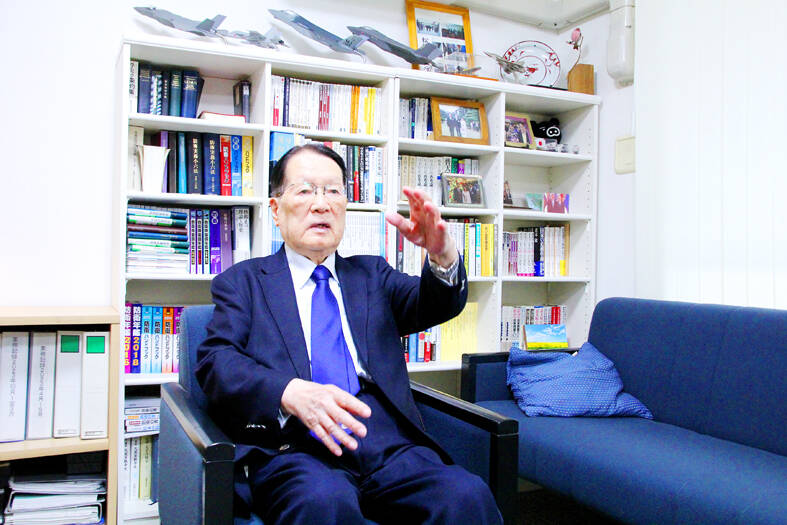
Photo: Chen Yu-fu, Taipei Times
Any response would first require an assessment of the specific scenario to determine what actions Japan could legally take under international and domestic law, he said.
For example, deploying the Japan Self-Defense Forces (JSDF) onto Taiwanese soil or directly taking up responsibility of defending Taiwan is not envisioned under the law, nor is it an anticipated goal, he said.
The possibility of the JSDF landing in Taiwan to conduct joint defense operations with the US and Taiwanese forces is not allowed for in Japanese law, he added.
If the US conducts operations around Taiwan, Japan could provide support and cooperation, such as maritime transport, patrol and surveillance missions, protection of undersea cables and logistical supply operations, he said.
This would require determining in advance what kind of strategy the US might adopt and how far it would be willing to go, while considering how a US-Japan cooperation framework should be established, he said.
The next important question would be which countries besides the US would provide support and cooperation, he said.
Tokyo believes Australia and the Philippines are likely to offer support, while European countries are geographically distant and would face difficulties deploying naval or air forces immediately, he said.
South Korea would be in a complicated situation, as tensions could rise on the Korean Peninsula if there were a contingency in the Taiwan Strait, he said.
If Russia and North Korea were to take action on the Korean Peninsula under China’s request, South Korea would likely be unable to take part in supporting Taiwan, he added.
South Korean polls showed that more than 60 percent of respondents supported providing all sorts of assistance to Taiwan in such a situation, but they did not expect deploying South Korean troops Korea-
based US forces to Taiwan, he said.
Seoul would likely not be a highly reliable source of help in case of a Taiwan contingency, he added.
The key would be to what extent the US would be willing to help Taiwan, he said, adding the White House has not clearly elaborated its stance in public.
US skeptics’ belief that Washington would not come to Taiwan’s aid in a crisis is likely fueled in part by Chinese information manipulation, he said.
Regarding the purge and reshuffle of senior officials in the Chinese Communist Party (CCP), he said two scenarios could emerge.
One possibility is that the purge could consolidate Chinese President Xi Jinping’s (習近平) power and make it easier for him to resort to military action against Taiwan, he said.
Documents disclosed online showed that Xi had considered invading Taiwan after the CCP’s third plenary session in 2024, he said.
Xi’s plan was thwarted by Central Military Commission vice chairman Zhang Youxia (張又俠), who was under investigation for suspected serious contraventions of discipline and law, and other senior officials, he said.
The revelation was startling because it showed that Xi considered taking military action earlier than the timeline given by US intelligence, which said that Xi instructed the People’s Liberation Army to be ready for action by 2027, he said.
In the past, many Japanese experts believed that if China were to use force against Taiwan, it would be enormously costly and risk heavy losses and the possibility of failure, he said.
Pursuing unification through non-military means, such as political, economic and information-based measures without resorting to war would be Beijing’s other option, he said.
Despite taking more time, such an approach would involve fewer risks and a possible higher chance of success for China, while making it more difficult for the US and other countries to intervene, he said.
If that proves to be the case, Taiwan’s presidential election in January 2028 could become an important turning point in cross-strait relations, he added.
Another scenario could involve a sudden development, such as Taiwan unexpectedly declaring independence or the US making a clear commitment to militarily intervene in support of Taiwan, he said.
Under such circumstances, China might decide to use force without hesitation, he said.
“Xi has clearly considered military unification and that intention may not have changed,” he said, warning that China could simultaneously intensify military pressure while attempting to achieve political objectives without launching a full-scale war.
If the Taiwan Strait were to fall under China’s effective control, freedom of navigation for Japan and the US would be severely restricted, potentially disrupting maritime supply routes and affecting the flow of energy, goods and trade, he said.
While it is difficult to determine which scenario is more likely to emerge, he believes that Xi is likely to consolidate his authority and reorganize the CCP’s power structure, he said.
As Xi is unlikely to immediately resort to military unification, Taiwan’s upcoming presidential election could become the next major turning point, making it essential to closely observe Taiwan’s domestic politics, he said.

The Ministry of Finance this afternoon announced the winning numbers for the March-April uniform invoice lottery. The winning number for the NT$10 million (US$318,060) special prize is 19531471, and the winning number for the NT$2 million grand prize is 85941329. Three numbers were drawn for the NT$200,000 first prize: 07225810, 20231230 and 83518781. Those with receipts matching the last seven digits of any of the first-prize numbers will win the NT$40,000 second prize, while those matching the last six digits will win the NT$10,000 third prize. Those whose receipts match the last five digits of the first-prize numbers can claim the NT$4,000 fourth prize,

SIX SUBSIDIES: The monthly allowance for older farmers is to increase to NT$10,000, and NT$5,000 is to be given to homemakers under the national pension system, Lai said The government is to implement major welfare policies for disadvantaged groups, including raising the monthly allowance for older farmers to NT$10,000 and providing homemakers with NT$5,000 per month, President William Lai (賴清德) said yesterday. Lai made the remarks during a visit to Wangling Temple in Chiayi County, saying that the planned increases were being introduced amid economic growth and an increase in tax revenue. Touting a policy, in which the government plans to provide a monthly allowance of NT$5,000 for every child under the age of 18 in a bid to address Taiwan’s low birthrate, Lai said that if received for the
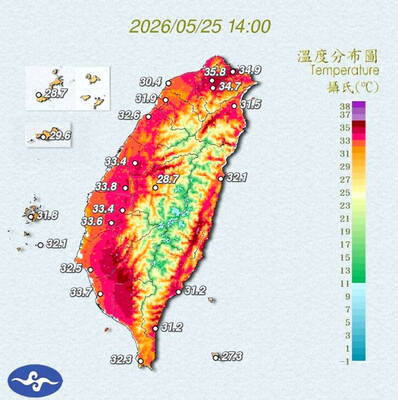
STAY COOL: The HPA recommended that people stay hydrated, use air-conditioning or fans while indoors, wear loose-fitting clothes and walk in the shade while outdoors Employers must implement measures such as installing cooling equipment, and providing drinking water and rest breaks for outdoor workers starting from Monday next week, the Taipei Department of Labor said on Sunday. Employers who fail to comply could face fines of NT$30,000 to NT$300,000 under the Occupational Safety and Health Act (職業安全衛生法), the department said. Businesses in Taipei employing fewer than 100 workers, as well as registered self-employed workers with labor insurance coverage, could receive on-site assessments and guidance from occupational safety consultants to help them apply for central government subsidies to implement or improve heat-protection measures, it said. Under the Ministry of

NATIONAL SECURITY: Authorities are working to confirm the identities of the military personnel involved and investigating possible illegal conduct and regulatory violations Authorities are probing possible national security implications after Kinmen police and immigration officers on Sunday found a Chinese woman allegedly posing as a tourist while engaging in prostitution involving more than 10 military personnel. The woman, surnamed Chen (陳), has since been deported, authorities said, adding that investigators are still working to confirm the identities of those implicated, as the records only listed code names and aliases. The case stemmed from a report received by the Kinmen District Prosecutors’ Office on Friday last week from the Jinhu Precinct of the Kinmen County Police Bureau. On Sunday, police, along with the National Immigration


 RSS
RSS