


An additional budget of more than NT$42.8 billion (US$1.33 billion) has been appropriated for ammunition and pods compatible with F-16 jets, the Ministry of National Defense’s (MND) budget report for next year showed.
The ministry has drawn up a NT$247.2 billion special budget from 2020 to 2026 to procure 66 F-16V Block 70 jets from the US, with the first jet scheduled to be delivered by the end of the year, sources said.
The Executive Yuan’s 2019 review report showed that NT$246.7 billion from the special budget would be spent on the 66 F-16V fighter jets, avionics systems, software and hardware, and system development.
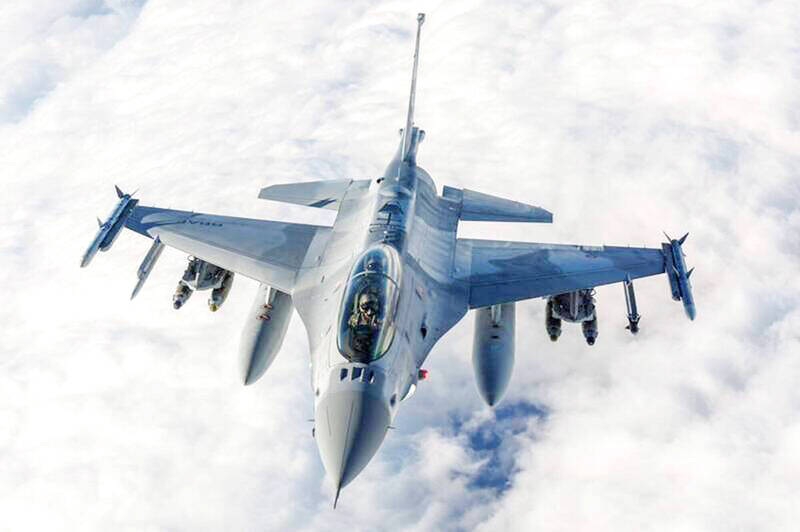
Photo: Screen grab from the US Air Force’s Web site
The remaining NT$500 million would be used for on-site visits, source inspection, project management, assembly training and delivery pickup, along with professional services, matching grants, customs declarations and transportation of the equipment overseas, it said.
The ministry’s budget statement for next year lists several multi-year procurement budgets for the equipment of F-16V jets, including NT$9.82 billion for innovated reconnaissance pods from 2020 to 2029 and NT$47.08 billion for long-range precision weapons from 2022 to 2030.
The long-range precision weapons include AGM-154 glide bombs, AGM-88 anti-radiation missiles and AGM-84H air-launched cruise missiles, it shows.
However, the statement included a budget for “the procurement of warfare support pods and ammunition of F-16V Block 70 jets,” which had not been publicized before.
The ammunition, auxiliary equipment and storage installations would be procured “to enable the maximum combat capacity of the 66 new fighter jets,” thereby enhancing their ability to safeguard Taiwan’s airspace and national security, it states.
The newly revealed budget totals NT$42.83 billion and spans from 2022 to 2030.
The exact models of the pods and ammunition are yet to be clarified, and whether AGM-158 long-range missiles — which Taiwan has wanted to purchase from the US for years — are included remains unknown.
The budget came into practice in 2022, but the ministry had approved its comprehensive procurement plan much earlier, on Aug. 18, 2021, with the latest revisions made on June 21 this year.
The ministry “plans to obtain the warfare support pods and ammunition of F-16V Block 70 jets via military procurement,” the budget statement says.
NT$1.93 billion from the budget has been spent over the past two years, while NT$1.5 billion has been prepared for next year, with NT$39.4 billion left for use from 2026 to 2030, it said.

SPACE VETERAN: Kjell N. Lindgren, who helps lead NASA’s human spaceflight missions, has been on two expeditions on the ISS and has spent 311 days in space Taiwan-born US astronaut Kjell N. Lindgren is to visit Taiwan to promote technological partnerships through one of the programs organized by the US for its 250th national anniversary. Lindgren would be in Taiwan from Tuesday to Saturday next week as part of the US Bureau of Educational and Cultural Affairs’ US Speaker Program, organized to celebrate the 250th anniversary of the signing of the Declaration of Independence, the American Institute in Taiwan (AIT) said in a statement yesterday. Lindgren plans to engage with key leaders across the nation “to advance cutting-edge technological partnerships and inspire the next generation of scientists and engineers,”

The Chinese Nationalist Party (KMT) caucus yesterday said it opposes the introduction of migrant workers from India until a mechanism is in place to prevent workers from absconding. Minister of Labor Hung Sun-han (洪申翰) on Thursday told the Legislative Yuan that the first group of migrant workers from India could be introduced as early as this year, as part of a government program. The caucus’ opposition to the policy is based on the assessment that “the risk is too high,” KMT caucus secretary-general Lin Pei-hsiang (林沛祥) said. Taiwan has a serious and long-standing problem of migrant workers absconding from their contracts, indicating that

UNREASONABLE SURVEILLANCE: A camera targeted on an road by a neighbor captured a man’s habitual unsignaled turn into home, netting him dozens of tickets The Taichung High Administrative Court has canceled all 45 tickets given to a man for failing to use a turn signal while driving, as it considered long-term surveillance of his privacy more problematic than the traffic violations. The man, surnamed Tseng (曾), lives in Changhua County and was reported 45 times within a month for failing to signal while driving when he turned into the alley where his residence is. The reports were filed by his neighbor, who set up security cameras that constantly monitored not only the alley but also the door and yard of Tseng’s house. The surveillance occurred from July

TRADE-OFF: Beijing seeks to trade a bowl of tempura for a Chinese delicacy, an official said, while another said its promises were attempts to interfere in the polls The government must carefully consider the national security implications of building a bridge connecting Kinmen County and Xiamen, China, the Public Construction Commission (PCC) said yesterday. PCC Commissioner Derek Chen (陳金德), who is also a minister without portfolio, made the remarks in a meeting of the legislature’s Transportation Committee, after Democratic Progressive Party Legislator Hsu Fu-kuei (徐富癸) asked about China’s proposal of new infrastructure projects to further connect Kinmen and Lienchiang (Matsu) counties with Xiamen. China unveiled the bridge plan, along with nine other policies for Taiwan, on Sunday, the last day of Chinese Nationalist Party (KMT) Chairwoman Cheng Li-wun’s (鄭麗文) visit


 RSS
RSS