


The Yilan County Government has fired the first shot by imposing land taxes of up to five times the norm on underutilized lots in the county’s industrial parks to support the Cabinet’s effort to ease the land shortage for industrial properties.
Acting Yilan County Commissioner Derek Chen (陳金德) on Thursday said he is taking an inventory of underutilized plots of land under his jurisdiction and will levy additional land taxes on vacant plots at rates two to five times the regular rates to promote land development.
Chen’s move came after the Cabinet made plans on Nov. 6 to free up to 1,422 hectares of underutilized land for industrial use in the next four years as part of an effort to encourage investment in Taiwan.
Business trade groups have said that shortages of land, water, electricity, unskilled workers and talented labor have hindered private investment and GDP growth as a whole.
There are many idle or underused plots of land in Yilan, Chen said, adding that he is first going to target Lize Industrial Park (利澤工業區) and Longte Industrial Park (龍德工業區).
Only 45.15 percent of Lize Industrial Park’s 329.05 hectares have been put to use since a redevelopment bid in 1996, whereas the 235 hectares of Longte Industrial Park have had a utilization rate of 97.4 percent since 1980, government data showed.
The Yilan County Government in 2015 granted the two parks a three-year grace period and asked owners to speed up development and construction or face stiff fines. The grace period is due to expire in March next year.
The two parks are now subjected to vacant land levies equivalent to five times their regular land tax rates until the owners make amends, Chen said, adding that Yilan is the first and only local government to take action to advance the Cabinet’s policy.
China Wire & Cable Co Ltd (中華電信電纜) owns most of the underused plots of land in the area after purchasing 19.24 hectares of land in 1997, but has resold most of it in recent years, the Chinese-language Liberty Times (the Taipei Times’ sister newspaper) reported yesterday.
The company has urged policymakers to put off levying vacant land taxes, saying that it has yet to develop the plots of land because big trucks are not allowed to go through the Hsuehshan Tunnel (雪山隧道), a predicament which has steeply increased estimates for loading and transportation costs.
China Wire & Cable said it is seeking a solution, but needs extra time, the newspaper reported.
The Executive Yuan last month threatened to auction off idle plots of land to demonstrate that it is serious about making Taiwan more business-friendly, and earlier this month the Legislative Yuan passed amendments to the Act for Industrial Innovation (產業創新條例), setting fines levied against owners of disused industrial park land at 10 percent of the assessed value.
However, the government said it would not target state-run Taiwan Sugar Corp (台糖), which owns up to 50,000 hectares, about half of which is designated as farmland.
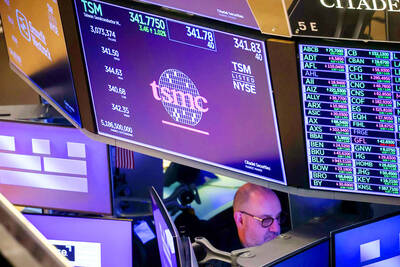
STRONG INTEREST: Analysts have pointed to optimism in TSMC’s growth prospects in the artificial intelligence era as the cause of the rising number of shareholders The number of people holding shares of chipmaker Taiwan Semiconductor Manufacturing Co (TSMC, 台積電) hit a new high last week despite a decline in its stock price, the Taiwan Depository and Clearing Corp (TDCC, 台灣集保) said. The number of TSMC shareholders rose to 2.46 million as of Friday, up 75,536 from a week earlier, TDCC data showed. The stock price fell 1.34 percent during the same week to close at NT$1,840 (US$57.55). The decline in TSMC’s share price resulted from volatility in global tech stocks, driven by rising international crude oil prices as the war against Iran continues. Dealers said
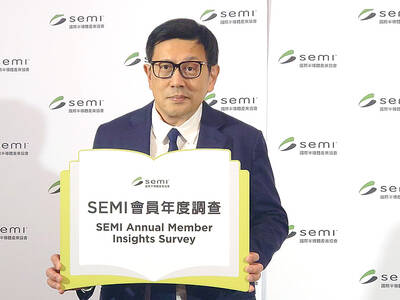
PRICE HIKES: The war in the Middle East would not significantly disrupt supply in the short term, but semiconductor companies are facing price surges for materials Taiwan’s semiconductor companies are not facing imminent supply disruptions of essential chemicals or raw materials due to the war in the Middle East, but surges in material costs loom large, industry association SEMI Taiwan said yesterday. The association’s comments came amid growing concerns that supplies of helium and other key raw materials used in semiconductor production could become a choke point after Qatar shut down its liquefied natural gas (LNG) production and helium output earlier this month due to the conflict. Qatar is the second-largest LNG supplier in the world and accounts for about 33 percent of global helium output. Helium is

DOMESTIC COMPONENT: Huang identified several Taiwanese partners to be a key part of Nvidia’s Vera Rubin supply chain, including Asustek, Hon Hai and Wistron Nvidia Corp chief executive officer Jensen Huang (黃仁勳), addressing crowds at the company’s biggest annual event, unveiled a variety of new products while predicting that its flagship artificial intelligence (AI) processors would help generate US$1 trillion in sales through next year. During a two-and-a-half-hour keynote address, Huang announced plans to push deeper into central processing units (CPUs) — Intel Corp’s home turf — and introduced semiconductors made with technology acquired from start-up Groq Inc. The company even said it was developing chips for data centers in outer space. At the heart of Huang’s speech was the message that demand for computing power
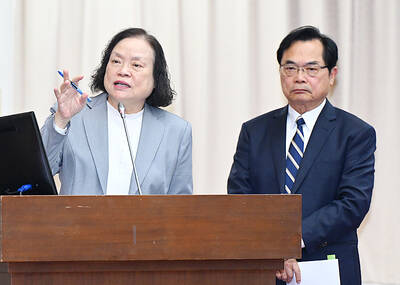
OPTIMISTIC: Inflation still has a chance of remaining below the central bank’s 2 percent alert level, as Taiwan’s economy is resilient with healthy exports, the NDC minister said Taiwan’s inflation could exceed 2 percent this year if oil prices continue to surge amid escalating tensions in the Middle East, prompting the government to reassess its economic outlook, the Directorate-General of Budget, Accounting and Statistics (DGBAS) said yesterday. DGBAS Minister Chen Shu-tzu (陳淑姿) told lawmakers at a meeting of the legislature’s Finance Committee that the agency’s earlier growth forecast of 1.68 percent in the consumer price index (CPI) and 7.71 percent for GDP this year did not account for the ongoing Middle East conflict and would need revision, if tensions persist. The previous forecast assumed an average international crude price of


 RSS
RSS