


Presidential advisor and head of Taiwan's Chi Mei Group (奇美電子) Shi Wen-lung (許文龍) issued a statement yesterday in an attempt to silence the firestorm of criticism over comments he made Sunday that Taiwan's comfort women were not forced into prostitution, but that they "were sold through legal business transactions."
The statement, which only seems to have added to the furor, explains that modern people, unable to fully understand the life of people in Taiwan in the early part of last century, lack a sufficient understanding of historic events, including that involving Taiwan's comfort women, and cannot judge whether they were forced into prostitution or not.
"Modern people are clueless about the historic background of that era [during World War II], neither do [people today] understand the thoughts and concepts of the Taiwanese who were once governed by the Japanese. These factors all triggered a gap of historic interpretation between Taiwan's older and younger generations," Shi said in the statement.
The business tycoon provided the explanation to the Chairman of the Central Daily News Shaw Yu-ming (邵玉銘), who invited Shi to attend a seminar held by the newspaper entitled "To restore the historic reality of comfort women."
Shi failed to appear at the meeting in person, and offered the statement instead.
In the statement, Shi said he thought highly of the longstanding endeavor made by women's groups to fight for the rights of comfort women.
Shi also said, however, that Taiwanese should spend more time and energy solving existing problems -- such as issues concerning child prostitutes as well as Aboriginals who have succumbed to poverty and become prostitutes.
"These are the matters deserving immediate attention from the authorities and public. [We] should not repeatedly aim blame at the Japanese, who obtained comfort women during World War II through lawful avenues," said the statement.
It went on, "Comfort women were part and parcel of the socio-political reality some 60 years ago. It is not possible for contemporaries to completely understand the truth of Taiwanese life at the time, which was characterized by extreme poverty. It is consequently unbelievable for modern people to hear the saying that comfort women were not forced."
But Shi said, in accordance with what he had heard and saw during Taiwan's colonization by Japan, that comfort women were indeed not coerced.
"They became comfort women because their parents sold their daughters to labor brokers so as to cope with their destitution," the statement said.
Shi triggered another wave of fierce protest over the On Taiwan (台灣論) comic from opposition lawmakers and women's groups, who insisted he resign from his post as a presidential advisor, after he said on Sunday that the Japanese military did not force Taiwanese girls to become comfort women, and that it was their own parents who forced them into it.
In the cartoon, the author Yoshinori Kobayashi quotes Shi as saying that many comfort women -- used to entertain Japanese troops -- had been willing to accept their role.
There have also been calls from the opposition, asking the Government Information Office (GIO) to ban the book.
In response, the director of the GIO Su Tzen-ping (
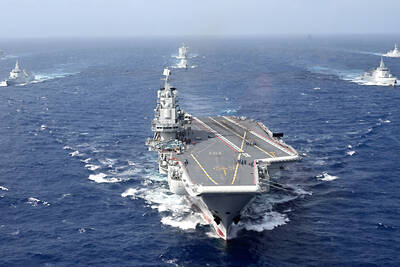
PROVOCATIVE: Chinese Deputy Ambassador to the UN Sun Lei accused Japan of sending military vessels to deliberately provoke tensions in the Taiwan Strait China denounced remarks by Japan and the EU about the South China Sea at a UN Security Council meeting on Monday, and accused Tokyo of provocative behavior in the Taiwan Strait and planning military expansion. Ayano Kunimitsu, a Japanese vice foreign minister, told the Council meeting on maritime security that Tokyo was seriously concerned about the situation in the East China and South China seas, and reiterated Japan’s opposition to any attempt to change the “status quo” by force, and obstruction of freedom of navigation and overflight. Stavros Lambrinidis, head of the EU delegation to the UN, also highlighted South China Sea
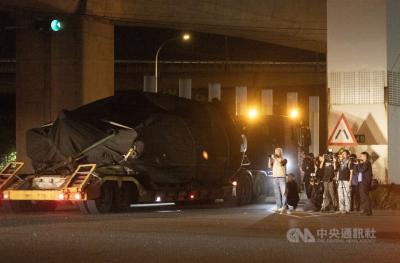
The final batch of 28 M1A2T Abrams tanks purchased from the US arrived at Taipei Port last night and were transported to the Armor Training Command in Hsinchu County’s Hukou Township (湖口), completing the military’s multi-year procurement of 108 of the tanks. Starting at 12:10am today, reporters observed more than a dozen civilian flatbed trailers departing from Taipei Port, each carrying an M1A2T tank covered with black waterproof tarps. Escorted by military vehicles, the convoy traveled via the West Coast Expressway to the Armor Training Command, with police implementing traffic control. The army operates about 1,000 tanks, including CM-11 Brave Tiger
Taiwan Semiconductor Manufacturing Co (TSMC, 台積電), the world’s largest contract chipmaker, said it expects its 2-nanometer (2nm) chip capacity to grow at a compound annual rate of 70 percent from this year to 2028. The projection comes as five fabs begin volume production of 2-nanometer chips this year — two in Hsinchu and three in Kaohsiung — TSMC senior vice president and deputy cochief operating officer Cliff Hou (侯永清) said at the company’s annual technology symposium in Silicon Valley, California, last week. Output in the first year of 2-nanometer production, which began in the fourth quarter of last year, is expected to
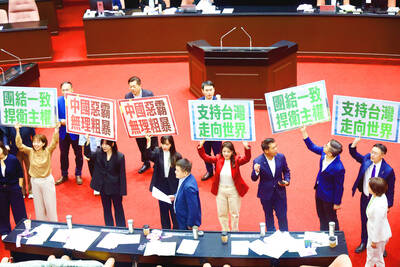
ESWATINI TRIP: The ‘irresponsible actions’ of three African nations set a dangerous precedent and they should be held accountable, a US representative said The US Senate Foreign Relations Committee on Thursday urged Washington not to normalize Chinese pressure, while a US lawmaker called on the US government to hold countries accountable for yielding to Beijing’s pressure to block President William Lai’s (賴清德) planned trip to Eswatini. Lai had been scheduled to visit Eswatini to attend birthday events for King Mswati III of Eswatini this week, but on Tuesday, the eve of his planned departure on Wednesday, the Presidential Office said the trip was “suspended” after the Seychelles, Mauritius and Madagascar unexpectedly withdrew overflight permission. “China reportedly pressured Mauritius, Seychelles, and Madagascar to deny airspace access


 RSS
RSS