


In bustling Taipei where parking spaces are scarce and traffic is perpetually congested, skate scooters have recently emerged as one of commuters' and youngsters' favored ways to get around town and exercise at the same time.
It is not unusual to see riders maneuvering their skate scooters among motor scooters, cars, and buses. The free-wheeling fun and games may come to an end though as the swelling army of scooter riders kicking their way around parks, sidewalks and major boulevards has prompted debate among Taipei City councilors over whether to create regulations for the new transportation device.
"We would like to see the city government take protective measures in advance so there will be rules for the public to follow should any mishaps occur," said KMT city councilor Chen Yu-mei (
KMT councilor Wang Cheng-te (
"Because the city encourages the public to take advantage of the MRT, it has gained tremendous popularity because it's easy to carry and its size is compact."
New Party councilor Chin Li-fang (
Tsao Shou-min (
Therefore, they are regulated under pedestrians laws.
Current traffic regulations stipulate that pedestrians causing traffic inconvenience are subject to NT$360 fine and users obstructing lanes with vehicles face a NT$120 fine.
Tsao said as long as owners try to restrict their usage of skate scooters to sidewalks and do not cause any traffic problems, he doesn't have any problem with seeing it on the streets of Taipei.
Chen Chun-liang (陳椿亮), general manager of the city's Taipei Rapid Transit Company, said announcements will be made or posted at subway stations informing people of the company's stance.
"Owners have to fold [the scooter] before they enter the station. They will receive warnings if they do not, and the equipment may be confiscated and the owner told to leave the station if the person refuses to cooperate," he said.

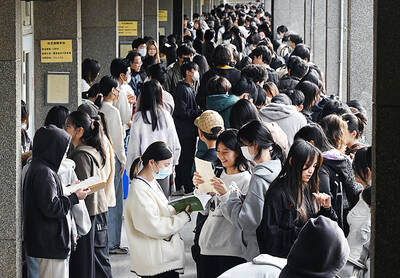
A global survey showed that 60 percent of Taiwanese had attained higher education, second only to Canada, the Ministry of the Interior said. Taiwan easily surpassed the global average of 43 percent and ranked ahead of major economies, including Japan, South Korea and the US, data from the Organisation for Economic Co-operation and Development (OECD) for 2024 showed. Taiwan has a high literacy rate, data released by the ministry showed. As of the end of last year, Taiwan had 20.617 million people aged 15 or older, accounting for 88.5 percent of the total population, with a literacy rate of 99.4 percent, the data

CCP ‘PAWN’? Beijing could use the KMT chairwoman’s visit to signal to the world that many people in Taiwan support the ‘one China’ principle, an academic said Chinese Nationalist Party (KMT) Chairwoman Cheng Li-wun (鄭麗文) yesterday arrived in China for a “peace” mission and potential meeting with Chinese President Xi Jinping (習近平), while a Taiwanese minister detailed the number of Chinese warships currently deployed around the nation. Cheng is visiting at a time of increased Chinese military pressure on Taiwan, as the opposition-dominated Legislative Yuan stalls a government plan for US$40 billion in extra defense spending. Speaking to reporters before going to the airport, Cheng said she was going on a “historic journey for peace,” but added that some people felt uneasy about her trip. “If you truly love Taiwan,

NEW LOW: The council in 2024 based predictions on a pessimistic estimate for the nation’s total fertility rate of 0.84, but last year that rate was 0.69, 17 percent lower An expected National Development Council (NDC) report expects the nation’s population to drop below 12 million by 2065, with the old-age dependency ratio to top 100 percent sooner than 2070, sources said yesterday. The council is slated to release its latest population projections in August, using an ultra-low fertility model, the sources said. The previous report projected that Taiwan’s population would fall to 14.37 million by 2070, but based on a new estimate of the total fertility rate (TFR) — the average number of children born to a woman over her lifetime — the population is expected to reach 12 million by
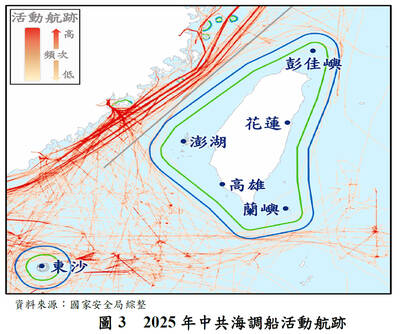
INTENSIFYING THREATS: Beijing’s tactics include massive attacks on the government service network, aircraft and naval vessel incursions and damaging undersea cables China is prepared to interfere in November’s nine-in-one local elections by launching massive attacks on the Taiwanese government’s service network (GSN), a report published by the National Security Bureau showed. The report was submitted to the Legislative Yuan ahead of the bureau’s scheduled briefing at the Foreign Affairs and National Defense Committee tomorrow. The national security team has identified about 13,000 suspicious Internet accounts and 860,000 disputed messages, the bureau said of China’s cognitive warfare against Taiwan. The disputed messages focus on major foreign affairs, national defense and economic issues, which were produced using generative artificial intelligence (AI) and distributed through Chinese


 RSS
RSS