


“Xin chao cac ban!” Looking confidently into the camera lens, first grade student Lin Hsin-yi says “Hello everyone” in fluent Vietnamese, responding to a greeting from a foreign journalist. Lin isn’t a second generation immigrant, she is a child with a keen interest in foreign cultures. “When I’m older I hope I can travel all over Vietnam with my friends,” says Lin.
Another first grader, Sung Tzu-ching, who has a Taiwanese father and Vietnamese mother, says that she speaks Vietnamese with her mother at home and is really happy that she can study her mother tongue together with her friends while at school. Sung says her teacher uses games to teach the spelling of words and they also read Vietnamese children’s books during class. Sung hopes that when she returns to Vietnam for the winter and summer vacations, she will be able to sing Vietnamese nursery rhymes and watch television with her grandparents.
This year has seen the establishment of 253 “new immigrant language” classes in elementary and junior high schools within Taoyuan alone, teaching seven different languages. Vietnamese makes up 70 percent, with a total of 767 students currently studying the language in the city. The unprecedented growth of Vietnamese language learning in Taiwanese schools has attracted the attention of Vietnam’s national state broadcaster. Reporters traveled to Dongan Elementary School in Taoyuan’s Pingjhen District, a forerunner of new immigrant language tuition, to film a program that will document how the mother-tongue language of second-generation Vietnamese immigrants is being taught in Taiwan.
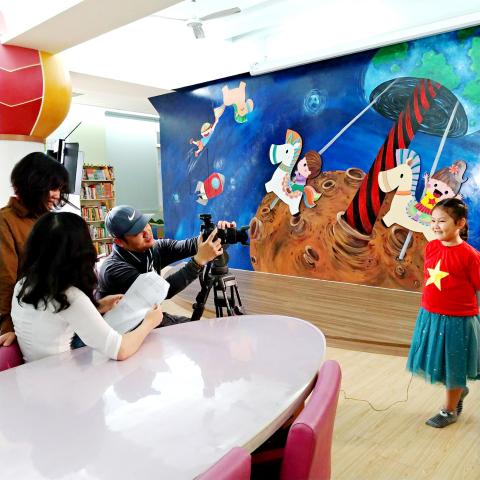
Photo: Hsu Chen-hsun, Liberty Times
照片:自由時報記者許倬勛
School principal Huang Mu-yin says new immigrant language classes were introduced into the school’s curriculum just over two months ago, and many students have already enthusiastically signed up. Huang says the school provides three new immigrant language classes, with over 40 students enrolled across different grades. Huang adds that parents are extremely supportive, not least since they have one eye on the explosive growth of Southeast Asian economies. Many parents believe that if their children possess a second foreign language in addition to English, they will have a more rounded international perspective once they grow up, Huang says.
According to Huang, the Vietnamese journalists were hugely impressed by the children’s amazing spoken Vietnamese. Huang adds they could scarcely believe that in just over two months, most students have gone from zero to mastering a large number of words, including daily expressions and personal introductions.
(Translated by Edward Jones, Taipei Times)
「Xin chao cac ban!(大家好)」一年級的林欣翊面對鏡頭毫不怯場,大方、流利地以越南語向海外記者問好,欣翊雖非新住民二代,卻對異國文化有濃厚興趣,她童言童語地說:「希望長大後能跟好友玩遍越南。」
同樣就讀一年級的宋子青,爸爸是台灣人、媽媽來自越南,她說,在家裡會用越南語和媽媽溝通,很開心可以在學校和好朋友一起學習母語,老師會以遊戲方式教導拼單字、讀童書上的字句,最近的心願是寒暑假回越南時,能與外公外婆一起唱童謠、看電視。
今年桃園市國中小開設七種、二五三班新住民語文課程,其中越南語班級佔七成,共有七六七位學生選讀越南語,空前盛況也吸引越南國家電視台,到桃園新住民語文前導學校、平鎮區東安國小拍攝節目,記錄新二代的母語教學情形。
校長黃木姻表示,校內新住民語文課程上路兩個多月,學生報名相當踴躍,全校共開設三班,不分年級共有四十多位學生選讀,家長們也非常支持,主要是看好東南亞飛快發展,學習英語之外的第三語言,有助於培養孩子的國際觀。
「孩子的口語表達能力讓人驚艷!」黃木姻轉述越南記者的讚嘆,對方驚訝兩個多月的訓練時間,竟讓大多零基礎的孩子學會許多詞彙,包括生活日常用語與自我介紹。
(自由時報記者許倬勛)

詞法—不定詞的誤用 1. 我得記住星期五要把報告寫好。 ˇ I must remember to finish my report by Friday. χ I must remember finishing my report by Friday. 註︰remember 後面跟動名詞或不定詞表示兩種不同的概念,與 forget 相類似。 試比較下列句子: I remember meeting him somewhere.(我記得曾經在某處見過他。) I must remember to meet him at the station at six this evening. (我必須記住今晚六點得去車站接他。) He remembered turning off the light when he left the room. (他記得離開房間時曾先把燈熄了。) Remember to turn off the light when you leave the room. (記住離開房間時要把燈關了。) 2. 他提醒她做好她份內的事。 ˇ He reminded her to do her job. χ He reminded her of doing her job. 註︰remind ... of ... 後面跟動名詞,表示「使人想起做過某事」。若是「提醒某人應做某事」,應用 remind ... to do ...。試比較下列句子: He reminded me of my attending the lecture last Friday. (他讓我想起我上星期五去聽過那次演講。) He

★ Bilingual Story is a fictionalized account. 雙語故事部分內容純屬虛構。 “Any New Year’s resolutions?” he asked. Lena put her coffee down. “Yeah,” she said. “To get in shape.... round is a shape, right?” Mark chuckled. “I support this. Fully achievable. Low risk.” “Thanks,” she smiled and lovingly rubbed her round belly. “I like a resolution I can’t fail.” “Funny thing is, I was thinking about getting round too.” Lena nodded her head in approval, “You could put some meat on those skinny bones of yours.” Mark shook his head, “Not that kind of round. Wheel-of-Life round.” She raised an eyebrow.

A: Apart from Taiwan’s A-mei, Mayday and Jolin Tsai, there are many foreign singers coming to Taiwan early this year. B: The South Korean girl group Babymonster are playing two shows at Taipei Arena starting from tonight. Who else is coming to Taiwan? A: Other artists include Australian band Air Supply, K-pop superstar Rain, boy group Super Junior, TXT, US singers Giveon and Josh Groban, and Irish boy group Westlife. B: Air Supply was the first foreign band to come to Taiwan in 1983, and they’re probably the most frequently visiting group too. A: As the year is beginning

對話 Dialogue 清清:最近天氣越來越冷,感覺很容易感冒,要不要一起去吃薑母鴨或是羊肉爐? Qīngqing: Zuìjìn tiānqì yuèláiyuè lěng, gǎnjué hěn róngyì gǎnmào, yào bú yào yìqǐ qù chī jiāngmǔyā huòshì yángròulú? 華華:最近我覺得有點累,想吃薑母鴨,可是又怕一下子吃太補會上火。 Huáhua: Zuìjìn wǒ juéde yǒudiǎn lèi, xiǎng chī jiāngmǔyā, kěshì yòu pà yíxiàzi chī tài bǔ huì shànghuǒ. 清清:那我們去喝香菇雞湯吧,不太容易上火,喝了也會很暖和。 Qīngqing: Nà wǒmen qù hē xiānggū jītāng ba, bú tài róngyì shànghuǒ, hē le yě huì hěn nuǎnhuo. 華華:聽起來不錯!你們家平常冬天都吃什麼進補? Huáhua: Tīng qǐlái búcuò! Nǐmen jiā píngcháng dōngtiān dōu chī shénme jìnbǔ? 清清:我家都煮麻油雞,吃完整個人手腳都會熱起來。我也很久沒喝香菇雞湯了,正好可以去打打牙祭。 Qīngqing: Wǒ jiā dōu zhǔ máyóujī, chī wán zhěnggè rén shǒujiǎo dōu huì rè qǐlái. Wǒ yě hěn jiǔ méi hē xiānggū jītāng le, zhènghǎo kěyǐ qù dǎ dǎ yájì. 華華:可是我最近在減肥,會不會吃得太補,肉又長回來了? Huáhua: Kěshì wǒ zuìjìn zài jiǎnféi, huì bú


 RSS
RSS