

Taiwan Travelogue (臺灣漫遊錄), a novel by Taiwanese writer Yang Shuang-zi (楊双子) and translated into English by Lin King (金翎), has won this year’s International Booker Prize, becoming the first Taiwanese work to win the award.
The win, announced on Tuesday in London, came after Lin’s translation of the novel received the 2024 US National Book Award for Translated Literature — also a first for Taiwanese literature.
The novel already made history earlier this year when it became the first work by a Taiwanese author to be shortlisted for the International Booker Prize.
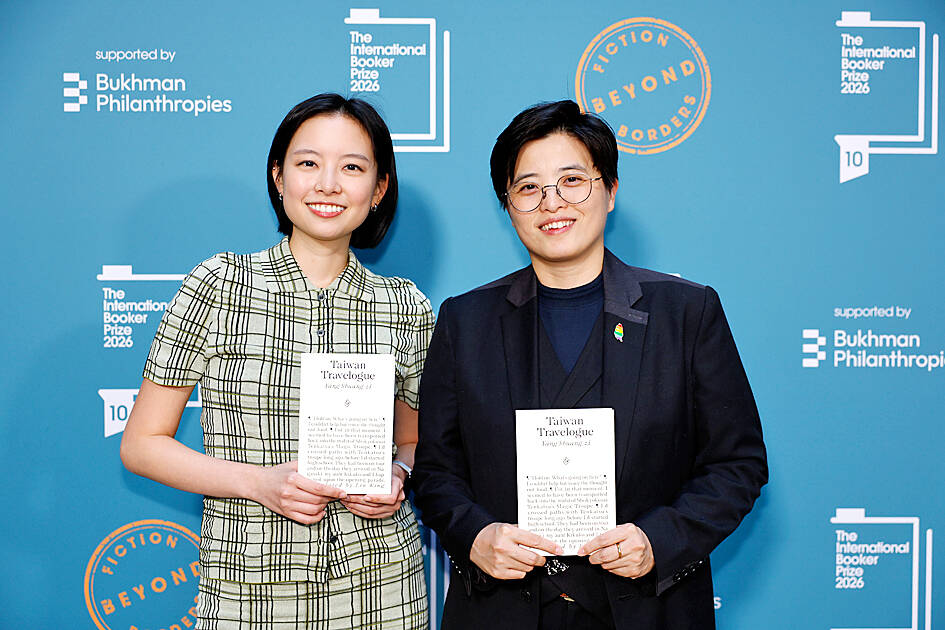
Photo: EPA
Published in 2020, Taiwan Travelogue is a work of historical fiction set during Taiwan’s Japanese colonial era.
The novel follows the relationship between a Japanese writer and her Taiwanese interpreter as they embark on a culinary and railway journey across Taiwan, exploring questions of identity, empire and cultural exchange.
“This is a book that surprises and isn’t perhaps what it seems like on the surface,” said Natasha Brown, chair of this year’s prize jury.
It “pulls off an incredible double feat: It succeeds as both a romance and an incisive postcolonial novel,” Brown said. “It’s a captivating, slyly sophisticated novel.”
The annual International Booker Prize recognizes works of fiction translated into English and published in the UK or Ireland.
Yang and Lin are to split the £50,000 (US$67,009) prize.
According to the Booker Prize Foundation, this year’s shortlist featured writers and translators from eight countries and works originally written in five languages.
The international reach of Taiwan Travelogue has continued to expand, with translation rights sold in more than 20 languages, including English, Japanese, Korean, German and Dutch.
Yang said her book was part of a long tradition of Taiwanese texts asking what kind of future and nation Taiwanese want.
In her acceptance speech, Yang said that, contrary to the view that art and literature must be kept far from politics, she believes literature “cannot be kept separate from the soil in which it has grown.”
“When surveying the modern history of Taiwan’s literature, it is apparent that we writers have been asking the same questions for the past century: What kind of future do the people of Taiwan want? What kind of nation do the people of Taiwan want?” she said, adding that Taiwan Travelogue, too, joins the long list of texts that investigate these questions.
Noting that Taiwanese have endured “geopolitical forces so much greater than our own,” such as colonial regimes and threats of invasion, Yang said she nevertheless believes that literature wields power.
“I believe in literature’s power because in the life of the mind, literature has never ceded ground or given up on the dialogue between people,” she said.
Yang dedicated the closing words of her speech to “my homeland, Taiwan” saying that the centuries-old tradition of inquiry in Taiwan’s literature was “the centuries-old pursuit of freedom and equality by Taiwan’s people.”
“I feel very fortunate to have been born Taiwanese. I am very proud today to stand before you as a writer from Taiwan,” she said.
During a speech marking his second year in office, President William Lai (賴清德) congratulated Yang and King on the award, saying it showed that young Taiwanese “can shine on the world stage.”
Additional reporting by AFP
GEOPOLITICAL SIGNIFICANCE: The CGA’s nonmilitary role makes it a tool to avert diplomatic issues, an official said, while confirming the donation of a ship to Manila Coast Guard Administration (CGA) ships are scheduled to sail to the Philippines bearing the words “Taiwan Coast Guard” in a high-profile visit in October next year, the first such visit by a Taiwanese maritime law enforcement vessel to the Southeast Asian nation, the agency said yesterday. The CGA also confirmed that it had donated one of its decommissioned patrol vessels to the Philippines in a rare transfer of a retired ship to a nondiplomatic ally. The Republic of China (ROC) Navy last made such a visit in 1974, shortly before the Philippines switched diplomatic recognition to the People’s Republic of China in

SOFT TENNIS: Yu Kai-wen and Huang Shih-yuan narrowly defeated their Japanese rivals to capture Taiwan’s first gold at the Asian Games in Nagoya Yu Kai-wen (余凱文) and Huang Shih-yuan (黃詩媛) won Taiwan’s first gold of this year’s Asian Games, defeating a Japanese duo in a nail-biter in the soft tennis mixed doubles final in Nagoya, Japan, while Johnny Sun (孫家閎) won silver in wushu and Shih Cheng-chung (石政中) won bronze in men’s kumite. Yu and Huang narrowly defeated Japan’s Toshiki Uematsu and Rena Temma 5-4 (2-4, 5-3, 4-2, 1-4, 1-4, 4-0, 1-4, 4-1, 7-5) to give Taiwan its first gold in soft tennis mixed doubles at an Asian Games since 2018. Sun secured Taiwan’s first wushu medal at this year’s game, with a combined score
CALL FOR CHANGE: They urged the UN to facilitate Taiwan’s involvement in the body, recognize its peace efforts and to work with members in preventing military conflict Representatives to the UN from five of Taiwan’s diplomatic allies sent a joint letter to UN Secretary-General Antonio Guterres on Friday, calling for the country’s inclusion in the body. Allies in the letter sent ahead of the 81st session of the UN General Assembly General Debate made three demands in support of Taiwan: inclusion, recognition and camaraderie. They implored the UN to seek an appropriate way to facilitate Taiwan’s meaningful involvement in the world governing body, saying that UN Resolution 2758, which accepted the People’s Republic of China (PRC) as a member of the UN, does not exclude Taiwan. Beijing claims that the

‘GLOBAL WARNING’: The infiltration is not just a local problem, as Beijing has been deploying the same tactics worldwide against Western democracies, a report said Between 50,000 and 100,000 Chinese spies are operating in Taiwan, far more than the National Security Bureau’s previous estimate of 5,000, German journalist and author Jurgen Kremb said on Monday. Kremb presented his research, titled “The War of Spies: How China’s Intelligence Services Are Infiltrating Taiwan — and What Europe Must Learn from It,” at a joint event held by the Taiwan offices of the Friedrich Naumann Foundation and the European Values Center for Security Policy. The report was published in June in the Ministry of Justice Investigation Bureau’s Prospect & Exploration Monthly (展望與探索月刊). By spies, he said he was referring to informants,


 RSS
RSS