


President William Lai (賴清德) yesterday announced that the government would provide a NT$5,000 (US$158) monthly allowance for every person aged 18 or younger as part of a new strategic response to the nation’s declining birthrate, along with new subsidies to help small businesses and traditional industries improve their operations and ease their financial burdens.
During his address to mark his second anniversary in office, Lai said that to address demographic challenges, the government would unveil a new national population strategy focused on family support.
A core policy would be the monthly NT$5,000 allowance, which aims to encourage young people to have “the confidence to marry, start families and build happy, fulfilling lives,” he said.
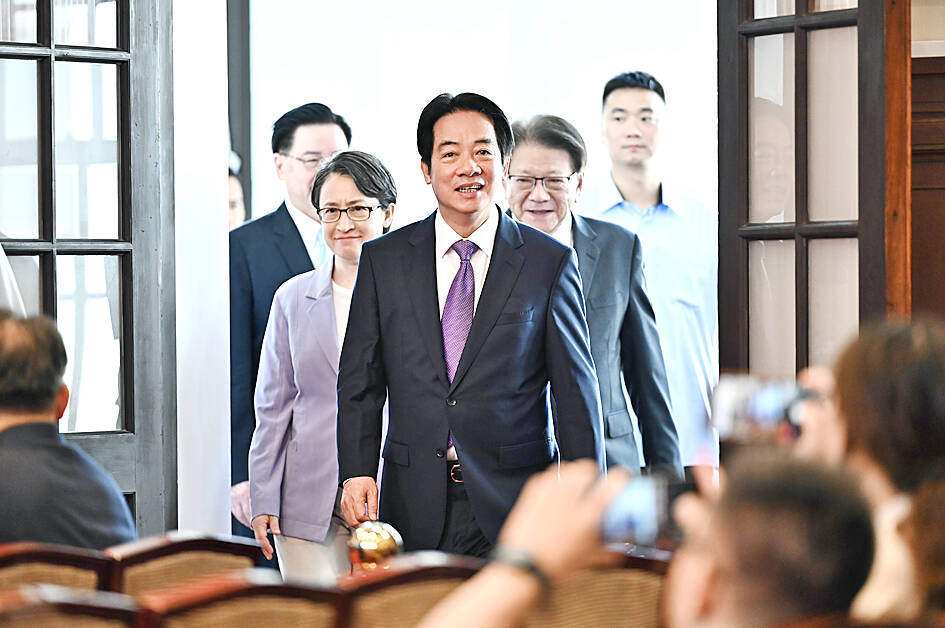
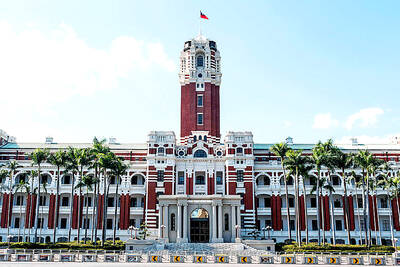
Photo: Tu Chien-jung, Taipei Times
The nation must address demographic, healthcare and social safety-net challenges, Lai said.
The government would continue to invest in health, improve the medical environment and bolster the healthcare workforce, as part of his “Healthy Taiwan” initiative, he said.
That includes implementing standard nurse-to-patient ratios on all three shifts, as well as promoting “smart” healthcare and a tiered medical care system, Lai said.
“Medicine is not just about treating illness, but about ensuring a complete support system for every person, from birth into childhood, and through adult working life into old age,” he said.
The sustainability of the National Health Insurance system and Taiwan’s medical resilience are crucial components of national resilience, he said, adding that “caring for the health of our people is protecting the future of our nation.”
Regarding the population strategy, Lai said that in addition to the new monthly allowance, the government hopes to provide comprehensive assistance covering marriage, pregnancy, child-rearing, family-friendly workplaces and subsidized housing for families.
The measures aim to help people balance their careers and family life, and empower young people to build families with confidence, he said.
Premier Cho Jung-tai (卓榮泰) on Tuesday told reporters at a news conference that the comprehensive family support plan would be discussed at a Cabinet meeting on Thursday next week before an official announcement.
Under the proposal, the government would provide comprehensive support through increased subsidies, reduced financial burdens, greater workplace flexibility and expanded caregiving services, with the aim of creating a more family-friendly ecosystem.
One of the key measures would expand the parental leave system by extending eligibility to parents with children up to six years old, up from the current age limit of three, Cho said.
To encourage parents to share caregiving responsibilities, the government would introduce housing tax incentives for families raising children, and review regulations governing marriage leave, maternity leave and paternity leave, he said.
Lai also announced that the government would propose an eight-year, NT$100 billion (US$3.16 billion) plan to help small businesses and non-tech industries move into the digital age.
“I will propose in the coming days a NT$100 billion acceleration plan to upgrade and transform MSMEs [micro, small and medium-sized enterprises] and traditional industries... The technology sector will drive the traditional industries, helping the nation’s development further extend to all sectors and translate into better lives for every family,” he said.
The government currently allocates about NT$10 billion annually to help MSMEs make digital transitions, access carbon-reduction technologies and expand their international reach, Lai said.
The additional NT$100 billion initiative would “accelerate and expand” such efforts, he added.
Taiwan has about 1.7 million MSMEs, which provide more than 80 percent of jobs, while traditional sectors contribute significantly to Taiwan’s economic growth, he said.
“The benefits of economic development should be shared across all sectors of society, rather than concentrated in the high-tech sector,” he said.
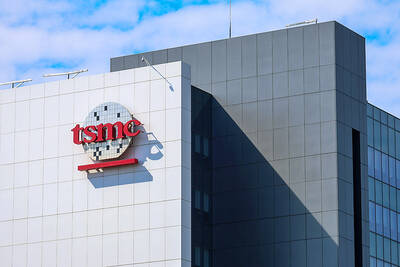
Taiwan Semiconductor Manufacturing Co (TSMC, 台積電), the world’s largest foundry service provider, yesterday said that global semiconductor revenue is projected to hit US$1.5 trillion in 2030, after the figure exceeds US$1 trillion this year, as artificial intelligence (AI) demand boosts consumption of token and compute power. “We are still at the beginning of the AI revolution, but we already see a significant impact across the whole semiconductor ecosystem,” TSMC deputy cochief operating officer Kevin Zhang (張曉強) said at the company’s annual technology symposium in Hsinchu City. “It is fair to say that in the past decade, smartphones and other mobile devices were
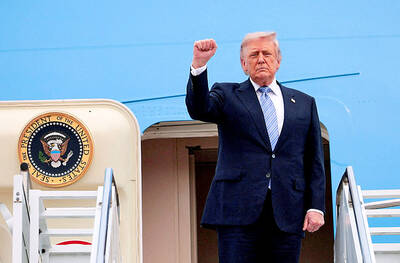
US-CHINA SUMMIT: MOFA welcomed US reassurance of no change in its Taiwan policy; Trump said he did not comment when Xi talked of opposing independence US President Donald Trump yesterday said he has not made a decision on whether to move forward with a major arms package for Taiwan after hearing concerns about it from Chinese President Xi Jinping (習近平). Trump’s comments on Taiwan came as he flew back to Washington after wrapping up critical talks in which both leaders said important progress was made in stabilizing US-China relations even as deep differences persist between the world’s two biggest powers on Iran and Taiwan. “I will make a determination,” Trump said, adding: “I’ll be making decisions. But, you know, I think the last thing we need right
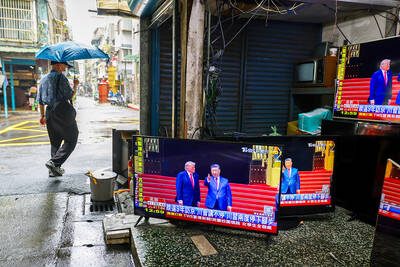
TAIWAN ISSUE: US treasury secretary Scott Bessent said on the first day of meetings that ‘it wouldn’t be a US-China summit without the Taiwan issue coming up’ There were no surprises on the first day of the summit between US President Donald Trump and Chinese President Xi Jinping (習近平), the Mainland Affairs Council (MAC) said yesterday, as the government reiterated that cross-strait stability is crucial to the Asia-Pacific region, as well as the world. As the two presidents met for a highly anticipated summit yesterday, Chinese state media reported that Xi warned Trump that missteps regarding Taiwan could push their two countries into “conflict.” Trump arrived in China with accolades for his host, calling Xi a “great leader” and “friend,” and extending an invitation to visit the White House
SECURITY: Taipei presses the US for arms supplies, saying the arms sales are not only a reflection of the US security commitment to Taiwan but also serve as a mutual deterrent against regional threats Taiwan is committed to preserving the cross-strait “status quo” and contributing to regional peace and stability, the Presidential Office said yesterday. “It is an undeniable fact that the Republic of China is a sovereign and independent democratic nation,” Presidential Office spokeswoman Karen Kuo (郭雅慧) reiterated, adding that Beijing has no right to claim sovereignty over Taiwan. The statements came after US President Donald Trump warned against Taiwanese independence. Trump wrapped up a state visit to Beijing on Friday, during which Chinese President Xi Jinping (習近平) had pressed him not to support Taiwan. Taiwan depends heavily on US security backing to deter China from carrying


 RSS
RSS