


Taiwan dropped four places to 28th in this year’s World Press Freedom Index compared with the previous year, Reporters Without Borders (RSF) said yesterday, warning that global press freedom conditions were at a record low.
Taiwan’s ranking out of 180 countries and territories declined from 24th last year to 28th this year, with its global score falling from 77.04 to 75.44, the index showed.
While the nation’s ranking dropped, its media environment remained “one of the safest” for journalists, even among democracies, Aleksandra Bielakowska, advocacy manager of RSF’s East Asian Bureau, told a news conference in Taipei.
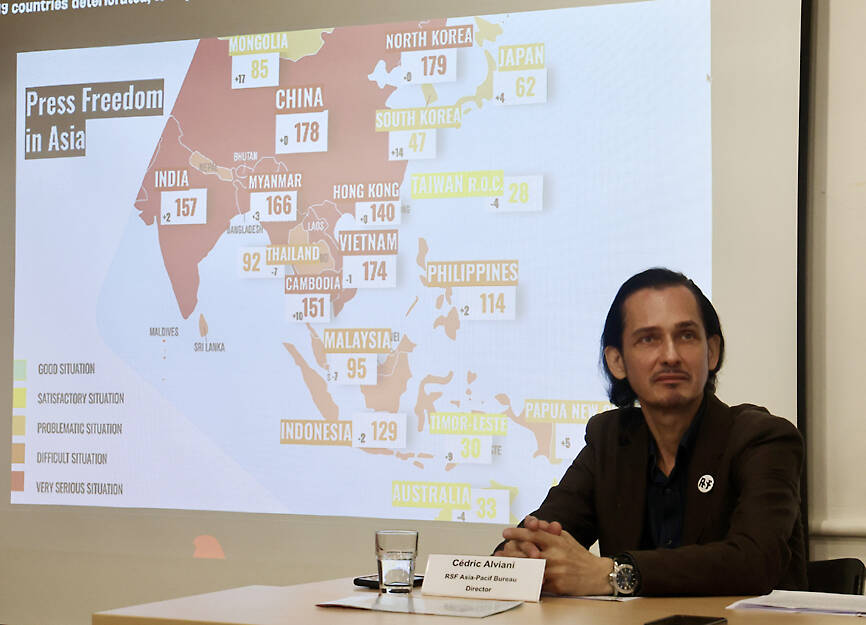
Photo: CNA
There were no reports of harassment or detentions of journalists by authorities, Bielakowska said.
Taiwan placed second in the Asia-Pacific region, trailing New Zealand (22nd), but ahead of others such as Australia (33rd), South Korea (47th) and Japan (62nd).
However, the lack of effective government action over the past decade to improve the quality of news coverage and ensure the public’s right to reliable information had become “a major problem” detrimental to Taiwan’s democratic system, RSF Asia-Pacific Bureau head Cedric Alviani said.
Taiwan’s media firms continued to face economic challenges, such as a slump in advertising revenue and government funding cuts for public media, Bielakowska said.
Across the Taiwan Strait, Hong Kong ranked 140th and China 178th, both unchanged from last year, the index showed.
However, the gap between Hong Kong and China was “closing quickly” because Hong Kong’s National Security Law — imposed in 2020 by Beijing following mass anti-government protests — continued to erode the territory’s press freedom, Bielakowska said.
In February, Apple Daily founder Jimmy Lai (黎智英) was sentenced to 20 years in prison — the harshest punishment to date under the law — after being found guilty of “conspiring to collude with foreign forces” and “publishing seditious articles.”
At least 13 foreign journalists had been denied visas or barred from entering Hong Kong after the promulgation of the national security legislation, RSF said.
While there were no new arrests of journalists or raids on newsrooms in Hong Kong last year, RSF had learned of several cases of journalists being followed and harassed during their work, Bielakowska said.
Countries worldwide, including democracies, have increasingly used national security policies as “weapons” to target journalists and their reporting, she said.
More than half of the countries around the world now fall into “difficult” or “very serious” categories — the bottom two in the five-tier index, RSF said, adding that the press freedom situation was “at a 25-year low.”
When the group first launched the index in 2002, 20 percent of the global population lived in countries where press freedom conditions were categorized as “good,” but now less than 1 percent do, it said.
For the 10th consecutive year, Norway ranked first in the index, which is based on surveys with journalists worldwide. It was followed by the Netherlands and Estonia.
Taiwan Semiconductor Manufacturing Co (TSMC, 台積電), the world’s largest foundry service provider, yesterday said that global semiconductor revenue is projected to hit US$1.5 trillion in 2030, after the figure exceeds US$1 trillion this year, as artificial intelligence (AI) demand boosts consumption of token and compute power. “We are still at the beginning of the AI revolution, but we already see a significant impact across the whole semiconductor ecosystem,” TSMC deputy cochief operating officer Kevin Zhang (張曉強) said at the company’s annual technology symposium in Hsinchu City. “It is fair to say that in the past decade, smartphones and other mobile devices were
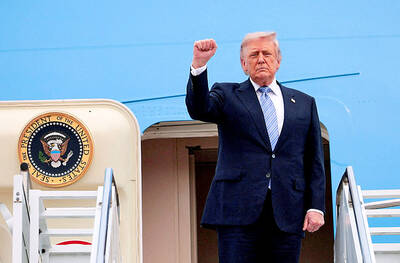
US-CHINA SUMMIT: MOFA welcomed US reassurance of no change in its Taiwan policy; Trump said he did not comment when Xi talked of opposing independence US President Donald Trump yesterday said he has not made a decision on whether to move forward with a major arms package for Taiwan after hearing concerns about it from Chinese President Xi Jinping (習近平). Trump’s comments on Taiwan came as he flew back to Washington after wrapping up critical talks in which both leaders said important progress was made in stabilizing US-China relations even as deep differences persist between the world’s two biggest powers on Iran and Taiwan. “I will make a determination,” Trump said, adding: “I’ll be making decisions. But, you know, I think the last thing we need right
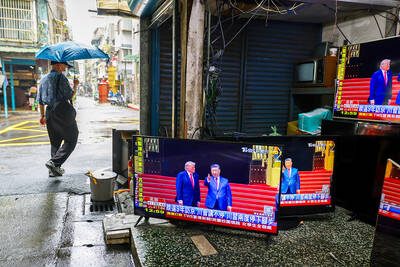
TAIWAN ISSUE: US treasury secretary Scott Bessent said on the first day of meetings that ‘it wouldn’t be a US-China summit without the Taiwan issue coming up’ There were no surprises on the first day of the summit between US President Donald Trump and Chinese President Xi Jinping (習近平), the Mainland Affairs Council (MAC) said yesterday, as the government reiterated that cross-strait stability is crucial to the Asia-Pacific region, as well as the world. As the two presidents met for a highly anticipated summit yesterday, Chinese state media reported that Xi warned Trump that missteps regarding Taiwan could push their two countries into “conflict.” Trump arrived in China with accolades for his host, calling Xi a “great leader” and “friend,” and extending an invitation to visit the White House
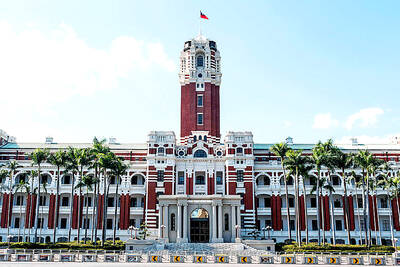
SECURITY: Taipei presses the US for arms supplies, saying the arms sales are not only a reflection of the US security commitment to Taiwan but also serve as a mutual deterrent against regional threats Taiwan is committed to preserving the cross-strait “status quo” and contributing to regional peace and stability, the Presidential Office said yesterday. “It is an undeniable fact that the Republic of China is a sovereign and independent democratic nation,” Presidential Office spokeswoman Karen Kuo (郭雅慧) reiterated, adding that Beijing has no right to claim sovereignty over Taiwan. The statements came after US President Donald Trump warned against Taiwanese independence. Trump wrapped up a state visit to Beijing on Friday, during which Chinese President Xi Jinping (習近平) had pressed him not to support Taiwan. Taiwan depends heavily on US security backing to deter China from carrying


 RSS
RSS