


The United Arab Emirates (UAE) on Tuesday said that it would leave OPEC effective tomorrow, stripping the oil cartel of its third-largest producer, and weakening its leverage over global oil supplies and prices.
In its announcement, made via its state-run WAM news agency, the UAE said it also would leave the wider OPEC+ group, which Russia had led to try to stabilize oil prices.
“This decision reflects the UAE’s long-term strategic and economic vision, and evolving energy profile, including accelerated investment in domestic energy production,” the UAE said, adding that it would bring “additional production to market in a gradual and measured manner, aligned with demand and market conditions.”
Photo: AP
The UAE’s decision had been rumored as a possibility for some time, as it has pushed back against OPEC production quotas it felt had been too low — meaning it was not able to sell as much oil to the world as it had wanted.
“Having invested heavily in expanding energy production capacity in recent years, the bigger picture is that the UAE has been itching to pump more oil,” Capital Economics wrote in an analysis.
“The ties binding OPEC members together have loosened,” it said, particularly after Qatar withdrew from the cartel in 2019.
Regional politics are also likely at play. The UAE has had increasingly frosty relations with Saudi Arabia, OPEC’s largest producer, over political and economic matters in the Middle East, even after both came under attack by fellow OPEC member Iran during the war.
The UAE’s withdrawal from OPEC would not necessarily have any immediate effects on markets, because world oil supplies are sharply constrained by the war in Iran, which has closed off the Strait of Hormuz, a waterway through which one-fifth of global oil supplies — including much of the UAE’s — is transported.
On Tuesday, Brent crude, the international benchmark, traded above US$111 a barrel, more than 50 percent above its prewar price.
OPEC accounts for about 40 percent of the world’s oil output, but its market power had been waning in the past few years as the US ramped up production.
The UAE, which joined OPEC through its emirate of Abu Dhabi in 1967, had been producing about 3.4 million barrels of crude a day just before the US-Israeli war with Iran began on Feb. 28.
In Moscow, the Kremlin yesterday said that Russia planned to stay in OPEC+, despite the UAE decision, and said it hoped that the group would continue to operate.
Kremlin spokesman Dmitry Peskov called OPEC+ an important organization, especially during current turmoil on global markets.
“This format helps to substantially, let’s say, minimize fluctuations in energy markets and makes it possible to stabilize those markets,” Peskov told reporters.
Peskov said that Russia respects the UAE’s decision to leave and hoped Moscow’s energy dialogue with the Gulf state would continue.
Additional reporting by Reuters
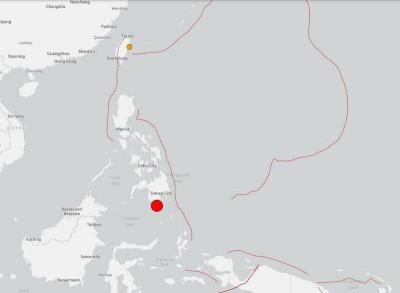
A magnitude 7.8 earthquake struck off the southern coast of Mindanao in the Philippines at 7:38am today, prompting the US Tsunami Warning System to issue an alert for neighboring countries, including Taiwan. The system issued a purple alert indicating a "tsunami threat." The potential threat zone includes Taiwan, the Philippines, Papua New Guinea, Yap and Palau. Philippine authorities were assessing the damage from the quake, with the office of civil defense seeking to verifying initial reports that 15 people had been killed and 129 injured in the region, mostly from falling debris. Arlene Hollero, disaster chief of Maasim town in the Philippines' Sarangani Province,

‘GRAY ZONE’ PRESSURE: Beijing’s activities are intended to create the deceitful impression that China has jurisdiction over the area around Taiwan, the CGA said Taiwan’s rights over its territorial waters and exclusive economic zone must not be violated by any country, the Mainland Affairs Council said yesterday, adding that it will not accept any unprovoked actions. The council issued the remarks in response to the China Coast Guard conducting maritime enforcement drills near eastern Taiwan and claiming to fully exercise China’s maritime administrative law enforcement authority. The Coast Guard Administration (CGA) has been closely monitoring the situation and is taking concrete steps to defend the nation’s sovereignty and secure its waters, the council said. China has no sovereign rights over the waters off eastern

RESILIENCE: Taiwan plays a key role in semiconductors, energy, information infrastructure and advanced manufacturing, AIT Director Raymond Greene said Taiwan’s continued investment in deterrence and resilience remains vital, especially in uncrewed systems and other emerging technologies, American Institute in Taiwan (AIT) Director Raymond Greene said yesterday. Greene made the remarks at the annual National Strategic Summit on Supply Chain Resilience held by the Research Institute for Democracy, Society and Emerging Technology (DSET), a government-backed think tank. As Taiwan last year became the US’ fourth-largest trading partner and supply chain security is becoming more important, cooperation in emerging technologies continues to deepen between the two countries, he said. The US is committed to accelerating innovation, building key infrastructure, strengthening cooperation

RIGHT DIRECTION: Taiwan’s efforts to prevent forced labor include a proposal to ‘fully prohibit’ employers from withholding workers’ documents, an official said Taiwan is to establish a mechanism to restrict imports of goods linked to forced labor, the Executive Yuan said yesterday, after the US proposed imposing additional tariffs on Taiwanese goods over labor concerns. “The Ministry of Labor and the Ministry of Economic Affairs are to establish an interministerial review procedure,” Executive Yuan spokesperson Michelle Lee (李慧芝) said at a news briefing in Taipei. “The government is to use the Foreign Trade Act [貿易法] as the legal basis to restrict imports of goods produced with forced labor” and bring its supply chain governance more in line with international standards on human rights, resilience


 RSS
RSS