


China’s attempts to infiltrate Taiwan are systematic, planned and targeted, with activity shifting from recruiting mid-level military officers to rank-and-file enlisted personnel, National Security Bureau (NSB) Director-General Tsai Ming-yen (蔡明彥) said yesterday.
The Chinese Communist Party’s (CCP) integrates national security, intelligence operations and “united front” efforts into a dense network to conduct intelligence gathering and espionage in Taiwan, Tsai said at a meeting of the legislature’s Foreign Affairs and National Defense Committee.
It uses specific networks to screen targets through exchange activities and recruiting local collaborators to establish intelligence-gathering organizations, he said.
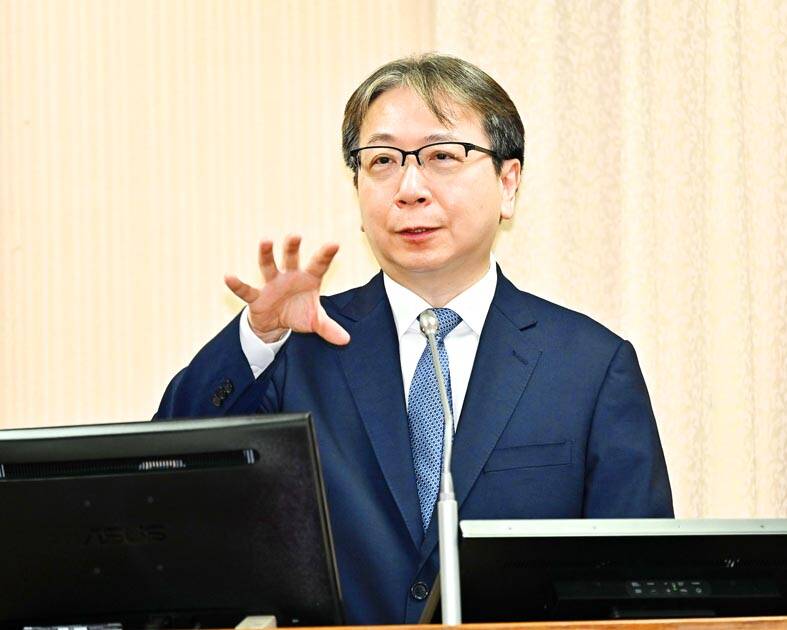
Photo: Tu Chien-jung, Taipei Times
China is also shifting who it targets to lower-ranking military personnel, he added.
The CCP’s early infiltration efforts primarily sought to recruit “mid-level military officers” who have easier access to classified intelligence, but their reach has started to extend to noncommissioned officers and enlisted personnel, he said, citing investigations into suspected espionage cases.
Before the meeting, reporters asked Tsai about China’s reservation of offshore airspace over the Yellow Sea and East China Sea for 40 days from March 27 until May 6.
The alerts, known as notice to air missions, appeared to serve military and political purposes, he said.
Militarily, it is likely intended to test the operations of foreign military aircraft, particularly those of the US, Tsai said.
The alerts would remain in place until almost exactly one week before a planned meeting between US President Donald Trump and Chinese President Xi Jinping (習近平), he added.
The zones stretch south from the Yellow Sea, facing South Korea, to the East China Sea, facing Japan, the Wall Street Journal reported on Monday.
Beijing has not given an official explanation or confirmed military exercises, it said.
A US reconnaissance aircraft on Monday entered one of the reserved airspaces to conduct operations, indicating that China could be using the opportunity to test the US response, Tsai said.
Regarding China’s ongoing “gray zone” activities and Taiwan’s maritime domain awareness, which were also mentioned in the report, he said the activities are a critical threat to national security, and Taiwan has established an interagency coordination mechanism.
The mechanism functions across several tiers, beginning with early warning systems to detect suspicious vessels and moving into real-time reporting protocols, he said.
The framework also facilitates maritime law enforcement to verify activities on-site, and it addresses critical infrastructure protection, ensuring that any damage to undersea cables triggers immediate repairs and formal judicial investigations, he said.
Emphasizing the high level of global concern regarding China’s maritime pressure, Tsai said that maritime domain awareness has become a cornerstone of Taiwan’s intelligence exchanges with international partners.
The NSB would continue to leverage international cooperation and interagency synergy to strengthen the nation’s situational judgement and response capabilities, he added.
Additional reporting by Fang Wei-li

Taiwan Semiconductor Manufacturing Co (TSMC, 台積電), the world’s largest foundry service provider, yesterday said that global semiconductor revenue is projected to hit US$1.5 trillion in 2030, after the figure exceeds US$1 trillion this year, as artificial intelligence (AI) demand boosts consumption of token and compute power. “We are still at the beginning of the AI revolution, but we already see a significant impact across the whole semiconductor ecosystem,” TSMC deputy cochief operating officer Kevin Zhang (張曉強) said at the company’s annual technology symposium in Hsinchu City. “It is fair to say that in the past decade, smartphones and other mobile devices were
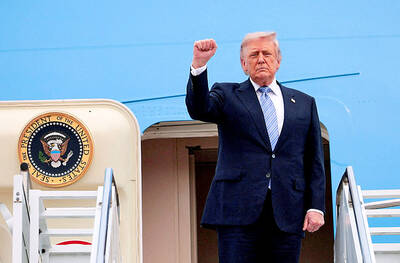
US-CHINA SUMMIT: MOFA welcomed US reassurance of no change in its Taiwan policy; Trump said he did not comment when Xi talked of opposing independence US President Donald Trump yesterday said he has not made a decision on whether to move forward with a major arms package for Taiwan after hearing concerns about it from Chinese President Xi Jinping (習近平). Trump’s comments on Taiwan came as he flew back to Washington after wrapping up critical talks in which both leaders said important progress was made in stabilizing US-China relations even as deep differences persist between the world’s two biggest powers on Iran and Taiwan. “I will make a determination,” Trump said, adding: “I’ll be making decisions. But, you know, I think the last thing we need right

TAIWAN ISSUE: US treasury secretary Scott Bessent said on the first day of meetings that ‘it wouldn’t be a US-China summit without the Taiwan issue coming up’ There were no surprises on the first day of the summit between US President Donald Trump and Chinese President Xi Jinping (習近平), the Mainland Affairs Council (MAC) said yesterday, as the government reiterated that cross-strait stability is crucial to the Asia-Pacific region, as well as the world. As the two presidents met for a highly anticipated summit yesterday, Chinese state media reported that Xi warned Trump that missteps regarding Taiwan could push their two countries into “conflict.” Trump arrived in China with accolades for his host, calling Xi a “great leader” and “friend,” and extending an invitation to visit the White House
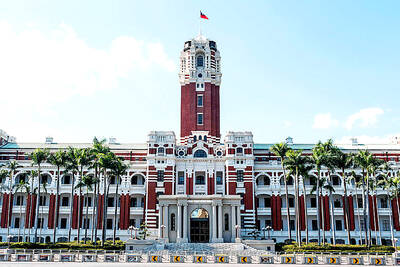
SECURITY: Taipei presses the US for arms supplies, saying the arms sales are not only a reflection of the US security commitment to Taiwan but also serve as a mutual deterrent against regional threats Taiwan is committed to preserving the cross-strait “status quo” and contributing to regional peace and stability, the Presidential Office said yesterday. “It is an undeniable fact that the Republic of China is a sovereign and independent democratic nation,” Presidential Office spokeswoman Karen Kuo (郭雅慧) reiterated, adding that Beijing has no right to claim sovereignty over Taiwan. The statements came after US President Donald Trump warned against Taiwanese independence. Trump wrapped up a state visit to Beijing on Friday, during which Chinese President Xi Jinping (習近平) had pressed him not to support Taiwan. Taiwan depends heavily on US security backing to deter China from carrying


 RSS
RSS