

A Ukrainian drone attacked an oil pipeline near the key Russian port of Primorsk early yesterday, with fuel leaking into the Baltic Sea, a day after Ukrainian President Volodymyr Zelenskiy said he was afraid a prolonged war in the Middle East could further erode US’ support for Ukraine.
Ukraine confirmed it staged the latest strike on the port, near the border with Finland, which plays an important role in Russia’s oil exports.
Russian air defenses shot down 19 drones in the Leningrad region and debris from one “damaged a section of the oil pipeline near the port of Primorsk, and the pipeline is being safely burned out,” Leningrad Oblast Governor Alexander Drozdenko initially said on Telegram, before two hours later saying that the area was not damaged.
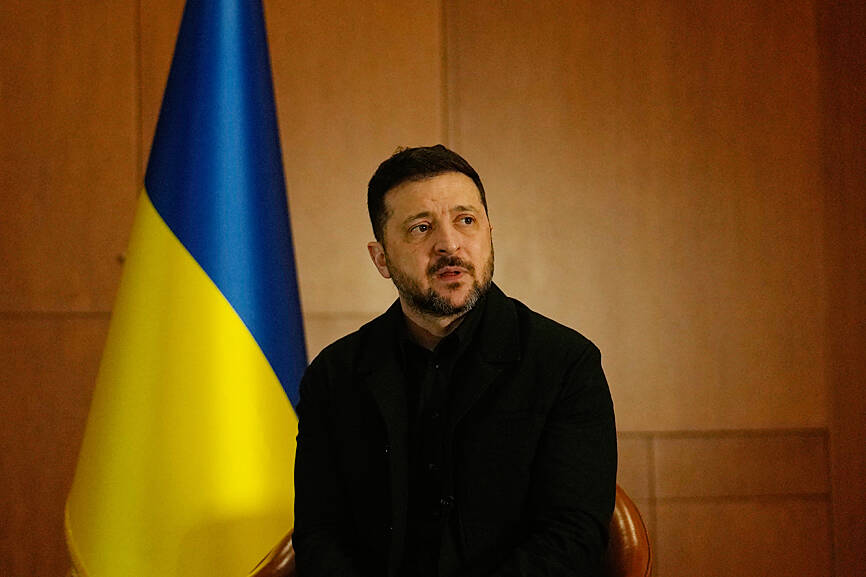
Photo: AP
“The fuel leak occurred due to a shrapnel hit on one of the fuel tanks. The consequences have already been dealt with,” he added.
No casualties were reported.
Ukraine has stepped up attacks on Russian energy infrastructure in the past few weeks in a bid to reduce Moscow’s earnings from oil exports, as the Middle East war pushes up prices.
Meanwhile, Ukraine desperately needs more US-made Patriot air defense systems to help it counter Russia’s daily barrages, Zelenskiy said in an interview late on Saturday in Istanbul.
Russia’s relentless pounding of urban areas behind the front line following its full-scale invasion of Ukraine more than four years ago has killed thousands of civilians. It has also targeted Ukraine’s energy supply to disrupt industrial production of Ukraine’s newly developed drones and missiles, while also denying civilians heat and running water in winter.
“We have to recognize that we are not the priority for today,” Zelenskiy said. “That’s why I am afraid a long [Iran] war will give us less support.”
The latest US-brokered talks between envoys from Moscow and Kyiv ended in February with no sign of a breakthrough.
Zelenskiy, who has accused Russia of “trying to drag out negotiations” while it presses on with its invasion, said Ukraine remains in contact with US negotiators about a potential deal to end the war and has continued to press for stronger security guarantees.
However, even those discussions reflect a broader loss of focus from Ukraine, he said.
His most immediate concern are the Patriots — essential for intercepting Russian ballistic missiles — as Ukraine still lacks an effective alternative, Zelenskiy said.
The US systems were never delivered in sufficient quantities to begin with, and if the Iran war does not end soon, “the package — which is not very big for us — I think will be smaller and smaller day by day,” Zelenskiy said.
“That’s why, of course, we are afraid,” he said.
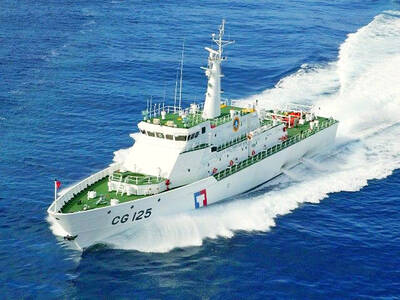
GEOPOLITICAL SIGNIFICANCE: The CGA’s nonmilitary role makes it a tool to avert diplomatic issues, an official said, while confirming the donation of a ship to Manila Coast Guard Administration (CGA) ships are scheduled to sail to the Philippines bearing the words “Taiwan Coast Guard” in a high-profile visit in October next year, the first such visit by a Taiwanese maritime law enforcement vessel to the Southeast Asian nation, the agency said yesterday. The CGA also confirmed that it had donated one of its decommissioned patrol vessels to the Philippines in a rare transfer of a retired ship to a nondiplomatic ally. The Republic of China (ROC) Navy last made such a visit in 1974, shortly before the Philippines switched diplomatic recognition to the People’s Republic of China in

‘GLOBAL WARNING’: The infiltration is not just a local problem, as Beijing has been deploying the same tactics worldwide against Western democracies, a report said Between 50,000 and 100,000 Chinese spies are operating in Taiwan, far more than the National Security Bureau’s previous estimate of 5,000, German journalist and author Jurgen Kremb said on Monday. Kremb presented his research, titled “The War of Spies: How China’s Intelligence Services Are Infiltrating Taiwan — and What Europe Must Learn from It,” at a joint event held by the Taiwan offices of the Friedrich Naumann Foundation and the European Values Center for Security Policy. The report was published in June in the Ministry of Justice Investigation Bureau’s Prospect & Exploration Monthly (展望與探索月刊). By spies, he said he was referring to informants,

PRICE STABILIZATION: The Ministry of Economic Affairs has urged the legislature to support the Cabinet’s supplementary budget for state-owned energy companies State-owned oil supplier CPC Corp, Taiwan (CPC, 台灣中油) on Saturday announced that it would raise domestic gasoline prices by NT$0.7 (US$0.02) per liter and diesel prices by NT$0.6 per liter this week after international crude oil prices rose above US$100 per barrel last week. Formosa Petrochemical Corp (台塑石化) yesterday said that it matched CPC’s price adjustments for this week. The decisions end a six-week period during which CPC and Formosa kept fuel prices in Taiwan unchanged. Retail gasoline prices this week would rise to NT$31.2, NT$32.7 and NT$34.7 per liter for 92, 95 and 98-octane unleaded gasoline respectively at CPC

WASHINGTON MEETING: Japan’s Hirofumi Takinami said participants rejected the idea that the US should limit its defensive perimeter to the Second Island Chain US and Japanese lawmakers agree that the US must defend the First Island Chain, including Taiwan, and should not fall back to the Second Island Chain, while “a Taiwan contingency is a Japan contingency and therefore a US-Japan alliance contingency,” media reported after a meeting between officials of the two nations in Washington on Tuesday. A delegation of Japanese lawmakers from the Liberal Democratic Party met with US Senator Thom Tillis, co-chair of the Senate Taiwan Caucus, and US Representative Ami Bera, co-chair of the US Congressional Taiwan caucus, to discuss issues concerning East Asia and the Taiwan Strait. The Japanese and


 RSS
RSS