


Keith Kellogg, US President Donald Trump’s special envoy to Ukraine, suggested British and French troops could adopt zones of control in the country, in an interview with The Times newspaper published yesterday.
Kellogg suggested they could have areas of responsibility west of the Dnipro River, as part of a “reassurance force,” with a demilitarized zone separating them from Russian-occupied areas in the east.
“You could almost make it look like what happened with Berlin after World War II, when you had a Russian zone, a French zone, and a British zone, a US zone,” he said, later clarifying on X that the US would not be providing troops.

Photo: REUTERS
“You’re west of the [Dnipro], which is a major obstacle,” Kellogg said, adding that the force would therefore “not be provocative at all” to Russia.
He suggested that a demilitarized zone could be implemented along the existing lines of control in eastern Ukraine, The Times said.
A retired lieutenant general and former acting national security adviser during Trump’s first term, Kellogg, 80, said Ukraine was big enough to accommodate several armies enforcing a ceasefire.
To make sure that British, French, Ukrainian and other allied forces do not exchange fire with Russian troops, a buffer zone would be needed, Kellogg said.
“You look at a map and you create, for lack of a better term, a demilitarized zone [DMZ],” he said.
“You have a ... DMZ that you can monitor, and you’ve got this... no-fire zone,” Kellogg said.
However, “now, are there going to be violations? Probably, because there always are, but your ability to monitor that is easy,” he added.
Kellogg admitted that Russian President Vladimir Putin “might not accept” the proposal.
Kellogg later clarified his position on X.
“I was speaking of a post-ceasefire resiliency force in support of Ukraine’s sovereignty. In discussions of partitioning, I was referencing areas or zones of responsibility for an allied force (without US troops). I was NOT referring to a partitioning of Ukraine,” he said.
The UK and France are spearheading talks among a 30-nation “coalition of the willing” on potentially deploying forces to Ukraine to shore up any ceasefire Trump might strike.
London and Paris describe the possible deployment as a “reassurance force” aimed at offering Ukraine some kind of security guarantee.

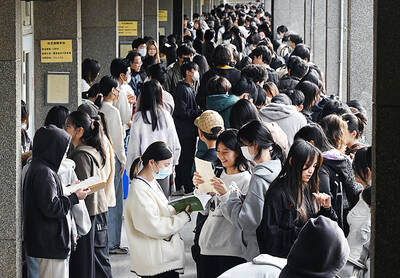
A global survey showed that 60 percent of Taiwanese had attained higher education, second only to Canada, the Ministry of the Interior said. Taiwan easily surpassed the global average of 43 percent and ranked ahead of major economies, including Japan, South Korea and the US, data from the Organisation for Economic Co-operation and Development (OECD) for 2024 showed. Taiwan has a high literacy rate, data released by the ministry showed. As of the end of last year, Taiwan had 20.617 million people aged 15 or older, accounting for 88.5 percent of the total population, with a literacy rate of 99.4 percent, the data

CCP ‘PAWN’? Beijing could use the KMT chairwoman’s visit to signal to the world that many people in Taiwan support the ‘one China’ principle, an academic said Chinese Nationalist Party (KMT) Chairwoman Cheng Li-wun (鄭麗文) yesterday arrived in China for a “peace” mission and potential meeting with Chinese President Xi Jinping (習近平), while a Taiwanese minister detailed the number of Chinese warships currently deployed around the nation. Cheng is visiting at a time of increased Chinese military pressure on Taiwan, as the opposition-dominated Legislative Yuan stalls a government plan for US$40 billion in extra defense spending. Speaking to reporters before going to the airport, Cheng said she was going on a “historic journey for peace,” but added that some people felt uneasy about her trip. “If you truly love Taiwan,

NEW LOW: The council in 2024 based predictions on a pessimistic estimate for the nation’s total fertility rate of 0.84, but last year that rate was 0.69, 17 percent lower An expected National Development Council (NDC) report expects the nation’s population to drop below 12 million by 2065, with the old-age dependency ratio to top 100 percent sooner than 2070, sources said yesterday. The council is slated to release its latest population projections in August, using an ultra-low fertility model, the sources said. The previous report projected that Taiwan’s population would fall to 14.37 million by 2070, but based on a new estimate of the total fertility rate (TFR) — the average number of children born to a woman over her lifetime — the population is expected to reach 12 million by
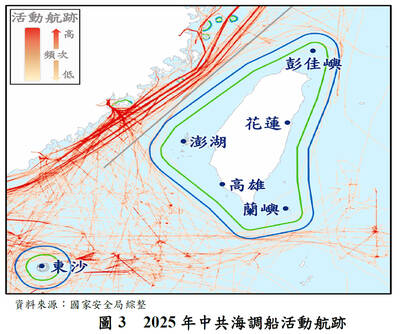
INTENSIFYING THREATS: Beijing’s tactics include massive attacks on the government service network, aircraft and naval vessel incursions and damaging undersea cables China is prepared to interfere in November’s nine-in-one local elections by launching massive attacks on the Taiwanese government’s service network (GSN), a report published by the National Security Bureau showed. The report was submitted to the Legislative Yuan ahead of the bureau’s scheduled briefing at the Foreign Affairs and National Defense Committee tomorrow. The national security team has identified about 13,000 suspicious Internet accounts and 860,000 disputed messages, the bureau said of China’s cognitive warfare against Taiwan. The disputed messages focus on major foreign affairs, national defense and economic issues, which were produced using generative artificial intelligence (AI) and distributed through Chinese


 RSS
RSS