


The UK on Monday accused Beijing-backed groups of targeting “democratic institutions and parliamentarians” in two cybercampaigns, unveiling sanctions and summoning China’s ambassador.
The Chinese embassy in Britain hit back, calling the claim “completely unfounded” and accusing London of “malicious slander.”
With Britain expected to hold a general election within months, London detailed attacks in 2021 and 2022 that targeted the Electoral Commission and UK parliamentary accounts, including those of lawmakers critical of China.
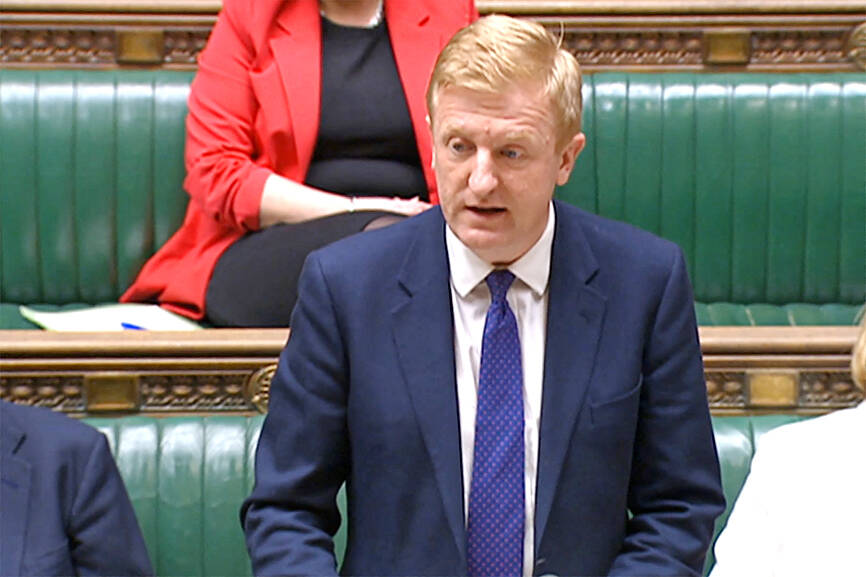
Photo: AFP / Parliamentary Recording Unit
“Chinese state-affiliated actors were responsible for two malicious cybercampaigns targeting both our democratic institutions and parliamentarians,” British Deputy Prime Minister Oliver Dowden told lawmakers.
He said that both campaigns, while a “real and serious threat,” were ultimately thwarted.
Dowden said an unnamed “Chinese state-affiliated entity” likely “compromised” UK Electoral Commission systems, but he insisted election security was not affected.
“It will not impact how people register, vote or otherwise participate in democratic processes,” he said.
Parliament’s cybersecurity measures blocked a second campaign against lawmakers, many of whom are critical of Beijing, he added.
Two individuals and one company linked to the Chinese-backed group suspected of orchestrating the campaign — APT31 — have been hit with sanctions over the latter case.
The Chinese ambassador to the UK has been summoned “to account for China’s conduct,” Dowden said.
Conservative lawmaker Iain Duncan Smith, one of those targeted, said Beijing should be labeled a threat to the UK.
He was one of several British lawmakers sanctioned by China in 2021 because of criticisms of human rights abuses against China’s Uighur minority and in Hong Kong.
China’s embassy slammed the accusations as “sinister action” by the UK.
Blaming China for the attacks “is completely unfounded and constitutes malicious slander,” it said in a statement released on its Web site, adding that it had made a complaint to the UK.
The British announcement came as Washington said it had charged seven Chinese nationals in connection with a 14-year campaign against critics of Beijing.
US Deputy Attorney General Lisa Monaco said more than 10,000 e-mails were sent as part of a “prolific global hacking operation” targeting US and foreign-based businesses, politicians and journalists.
New Zealand late on Monday also revealed that its parliamentary system was hacked by a Chinese state-backed group in 2021.
The nation’s counterespionage agency in Wellington said a state-backed group known as APT40 compromised computers linked to the Parliamentary Counsel Office, which drafts and publishes laws.
New Zealand Minister of Foreign Affairs Winston Peters said he had instructed diplomats to “speak today to the Chinese ambassador, to lay out our position and express our concerns.”
“That conversation has now taken place,” he said.

Taiwan Semiconductor Manufacturing Co (TSMC, 台積電), the world’s largest foundry service provider, yesterday said that global semiconductor revenue is projected to hit US$1.5 trillion in 2030, after the figure exceeds US$1 trillion this year, as artificial intelligence (AI) demand boosts consumption of token and compute power. “We are still at the beginning of the AI revolution, but we already see a significant impact across the whole semiconductor ecosystem,” TSMC deputy cochief operating officer Kevin Zhang (張曉強) said at the company’s annual technology symposium in Hsinchu City. “It is fair to say that in the past decade, smartphones and other mobile devices were
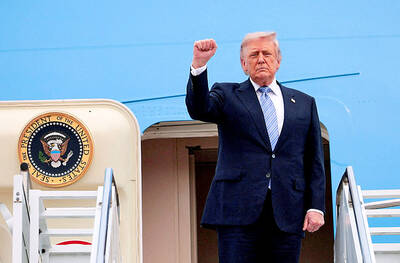
US-CHINA SUMMIT: MOFA welcomed US reassurance of no change in its Taiwan policy; Trump said he did not comment when Xi talked of opposing independence US President Donald Trump yesterday said he has not made a decision on whether to move forward with a major arms package for Taiwan after hearing concerns about it from Chinese President Xi Jinping (習近平). Trump’s comments on Taiwan came as he flew back to Washington after wrapping up critical talks in which both leaders said important progress was made in stabilizing US-China relations even as deep differences persist between the world’s two biggest powers on Iran and Taiwan. “I will make a determination,” Trump said, adding: “I’ll be making decisions. But, you know, I think the last thing we need right

TAIWAN ISSUE: US treasury secretary Scott Bessent said on the first day of meetings that ‘it wouldn’t be a US-China summit without the Taiwan issue coming up’ There were no surprises on the first day of the summit between US President Donald Trump and Chinese President Xi Jinping (習近平), the Mainland Affairs Council (MAC) said yesterday, as the government reiterated that cross-strait stability is crucial to the Asia-Pacific region, as well as the world. As the two presidents met for a highly anticipated summit yesterday, Chinese state media reported that Xi warned Trump that missteps regarding Taiwan could push their two countries into “conflict.” Trump arrived in China with accolades for his host, calling Xi a “great leader” and “friend,” and extending an invitation to visit the White House
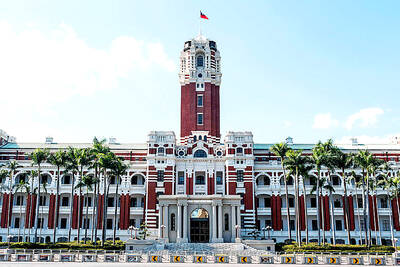
SECURITY: Taipei presses the US for arms supplies, saying the arms sales are not only a reflection of the US security commitment to Taiwan but also serve as a mutual deterrent against regional threats Taiwan is committed to preserving the cross-strait “status quo” and contributing to regional peace and stability, the Presidential Office said yesterday. “It is an undeniable fact that the Republic of China is a sovereign and independent democratic nation,” Presidential Office spokeswoman Karen Kuo (郭雅慧) reiterated, adding that Beijing has no right to claim sovereignty over Taiwan. The statements came after US President Donald Trump warned against Taiwanese independence. Trump wrapped up a state visit to Beijing on Friday, during which Chinese President Xi Jinping (習近平) had pressed him not to support Taiwan. Taiwan depends heavily on US security backing to deter China from carrying


 RSS
RSS