


The nation’s top police officer, Wang Cho-chiun (王卓鈞), has been accused by legislators of covering up police assaults on people who took part in the Sunflower movement in March and April.
Legislators at a meeting of the legislature’s Internal Administration committee in Taipei grilled Wang, director-general of the National Police Agency, on why no progress had been made on investigations into alleged violent attacks by police officers on unarmed protesters.
Pointed questions were raised by Taiwan Solidarity Union (TSU) Legislator Chou Ni-an (周倪安), who was hospitalized for weeks after allegedly being beaten and injured by police officers as she tried to protect students on the night of March 23, during an attempt by factions of the Sunflower movement to occupy the Executive Yuan.

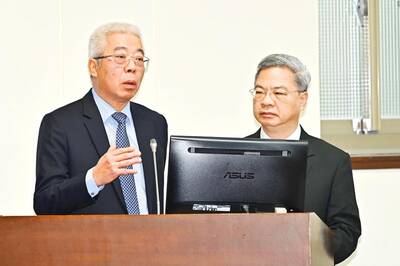
Photo: Lo Pei-der, Taipei Times
Chou asked Wang if he had found out who had attacked her, to which Wang said he had not, saying he was unable to do so.
“I believe you did not try to find out who was responsible for the assault on me,” Chou said, accusing Wang and his force of covering up the matter and applying double standards to incidents involving police officers.
“The assault against me by the police caused serious injuries and now, half a year later, I am still suffering from the effects and have to take medicine everyday,” she said.
“However, let’s look at the case of the gang attack on the police detective [at Taipei’s Spark ATT nightclub]. The surveillance camera captured pictures of the crowd with many unknown persons at the scene, but the police were able to identify the individuals and apprehend them within a short time,” Chou said.
She said that Wang was covering up the alleged March assaults and harboring the alleged perpetrators from prosecution.
“At least five police officers attacked me that night, but Wang and the National Police Agency want to whitewash the whole thing, as though nothing happened,” she said.
Chou then demanded the agency act within 24 hours to identify those responsible and have them apologize to her and the TSU.
Wang responded by promising to find out within a week, adding that he had already made an apology to Chou.
However, the TSU legislator was not satisfied.
“The police agencies are always protecting their own men and they seldom face up to the real issues,” she said.
Also yesterday, the Taipei District Prosecutors’ Office summoned two protesters from the night of March 23, who face charges of obstructing a police officer.
Democratic Progressive Party (DPP) spokesperson Huang Di-ying (黃帝穎) condemned the judiciary for bullying people, while sparing police officers who allegedly commit assault.
“It is selected prosecution against citizens. It is unjust and an abuse of authority’s privilege and negligence of their official duties,” Huang said.
Huang said the images of police officers wielding truncheons in attacking peaceful protesters and leaving them bleeding and injured that night were shown around the world, horrifying many people.
“Wang said that due to his inability, he could not find those who perpetrated the assault, yet the injured citizens are now being charged by the judiciary. This is a case of the authorities oppressing the citizens, while shrugging off any responsibility for police officers who violently attacked and injured citizens. It is unethical and a miscarriage of justice,” Huang said.

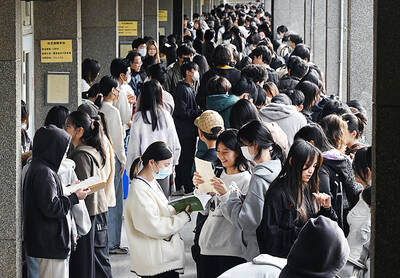
A global survey showed that 60 percent of Taiwanese had attained higher education, second only to Canada, the Ministry of the Interior said. Taiwan easily surpassed the global average of 43 percent and ranked ahead of major economies, including Japan, South Korea and the US, data from the Organisation for Economic Co-operation and Development (OECD) for 2024 showed. Taiwan has a high literacy rate, data released by the ministry showed. As of the end of last year, Taiwan had 20.617 million people aged 15 or older, accounting for 88.5 percent of the total population, with a literacy rate of 99.4 percent, the data

CCP ‘PAWN’? Beijing could use the KMT chairwoman’s visit to signal to the world that many people in Taiwan support the ‘one China’ principle, an academic said Chinese Nationalist Party (KMT) Chairwoman Cheng Li-wun (鄭麗文) yesterday arrived in China for a “peace” mission and potential meeting with Chinese President Xi Jinping (習近平), while a Taiwanese minister detailed the number of Chinese warships currently deployed around the nation. Cheng is visiting at a time of increased Chinese military pressure on Taiwan, as the opposition-dominated Legislative Yuan stalls a government plan for US$40 billion in extra defense spending. Speaking to reporters before going to the airport, Cheng said she was going on a “historic journey for peace,” but added that some people felt uneasy about her trip. “If you truly love Taiwan,
Taiwan has arranged for about 8 million barrels of crude oil, or about one-third of its monthly needs, to be shipped from the Red Sea this month to bypass the Strait of Hormuz and ease domestic supply pressures, CPC Corp, Taiwan (CPC, 台灣中油) said yesterday. The state-run oil company has worked with Middle Eastern suppliers to secure routes other than the Strait of Hormuz, through which about 20 percent of the world’s oil and liquefied natural gas typically passes, CPC chairman Fang Jeng-zen (方振仁) said at a meeting of the legislature’s Economics Committee in Taipei. Suppliers in Saudi Arabia have indicated they

NEW LOW: The council in 2024 based predictions on a pessimistic estimate for the nation’s total fertility rate of 0.84, but last year that rate was 0.69, 17 percent lower An expected National Development Council (NDC) report expects the nation’s population to drop below 12 million by 2065, with the old-age dependency ratio to top 100 percent sooner than 2070, sources said yesterday. The council is slated to release its latest population projections in August, using an ultra-low fertility model, the sources said. The previous report projected that Taiwan’s population would fall to 14.37 million by 2070, but based on a new estimate of the total fertility rate (TFR) — the average number of children born to a woman over her lifetime — the population is expected to reach 12 million by


 RSS
RSS