


The controversy over the disputed Diaoyutai Islands (釣魚台) should be viewed from an historical perspective and as an act of invasion by Japan against Chinese territory rather than an issue related to political and economic interests, a government official said yesterday.
“In the eyes of the people of China, it was an incident that cannot be compartmentalized from the history of intrusion into China by Japan. Japan should look at the issue from this perspective,” said Shaw Yu-ming (邵玉銘), chairman of the Coordination Council of North American Affairs (CCNAA).
The CCNAA, the headquarters of the Taipei Economic and Cultural Representative Office in the US, was established as a counterpart to the American Institute in Taiwan (AIT) after the termination of diplomatic ties between the US and the Republic of China (ROC).
Addressing a forum on the Diaoyutais, Shaw suggested Japan and China utilize international arbitration to resolve the dispute over the islands because they are both UN members subject to the UN convention that calls for parties to to resolve territorial issues peacefully.
Judging from the tension between Japan and China surrounding the Diaoyutais in the past, “the issue may well become a flash point,” and therefore, bringing the issue to an international court would be the only way to prevent military conflicts between the two countries, he said.
In response to questions from the Taipei Times on whether his suggestion would leave Taiwan no say in the matter given that the country has no access to international courts, he said that was less important than the fact that the Diaoyutais are currently controlled and administered by Japan.
If the international court rules that the islands belong to China and not Japan, “it would be good for us because China would agree that Taiwan owns the Diaoyutai Islands,” as it did in 1871 when the islands belonged to the Kavalan Prefecture administration office, now Yilan County, which was then incorporated into Fujian Province during the Qing dynasty, he said.
Earlier at the forum, Wu Jinan (吳寄南), director and senior fellow of the Department of Japanese Studies at Shanghai Institutes for International Studies, Shaw Han-yi (紹漢儀), a research fellow at the Research Center for the International Legal Studies at National Chengchi University, as well as other Chinese and Taiwanese academics, presented papers to rebut Japan’s claims to sovereignty over the islands.
Examining related legal claims and historical evidence under international law and traditional East Asian order, the academics concluded that the Diaoyutais belong to “China.”
Asked to comment on the conclusion, Shaw Yu-ming said he did not find it problematic saying the islands belong to China as opposed to the ROC.
“Like I said, the Diaoyutai Islands were incorporated into the Kavalan Prefecture administration office in 1837. At that time, the ROC had not been established. Furthermore, the ROC is also part of China. China is the generic term for the ROC and the People’s Republic of China [PRC]. This case shows why the ‘1992 consensus’ is necessary. For us, it’s the ROC, and for the mainland, it’s the PRC. Together, it’s China,” he said.
Shaw Yu-ming said he agreed to the suggestion made by several Chinese academics at the forum that “China shall publicly declare its position that the Diaoyutai Islands belong to Taiwan.”
“If we say that the Diaoyutais belong to ‘China,’ it would lead some people in Taiwan to wonder why they need to fight for sovereignty of the islands. But if China declares that the Diaoyutai Islands belong to Taiwan, which I think it would not oppose because Taiwan is part of its territory in China’s view, the problem would be solved,” Shaw Yu-ming said.
Shaw Yu-ming said he did not see his statement as being against the position of President Ma Ying-jeou (馬英九) who, in an interview with two Japanese newspapers, the Yomiuri Shimbun and Nihon Keizai Shimbun in July, ruled out aligning Taiwan with China in dealing with issues related to the disputed islands.
“If China makes the declaration, it is just a statement, not collaboration whatsoever,” Shaw Yu-ming said.
Yesterday’s forum, the third of its kind following two held by Soochow University, was co-hosted by the Ministry of Foreign Affairs (MOFA) and National Chengchi University.
It was the first time MOFA has participated in the forum.
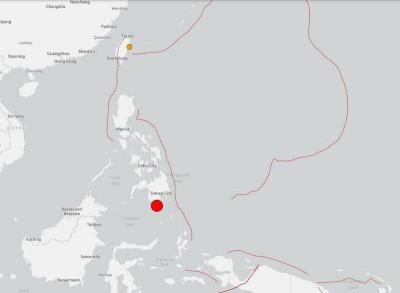
A magnitude 7.8 earthquake struck off the southern coast of Mindanao in the Philippines at 7:38am today, prompting the US Tsunami Warning System to issue an alert for neighboring countries, including Taiwan. The system issued a purple alert indicating a "tsunami threat." The potential threat zone includes Taiwan, the Philippines, Papua New Guinea, Yap and Palau. Philippine authorities were assessing the damage from the quake, with the office of civil defense seeking to verifying initial reports that 15 people had been killed and 129 injured in the region, mostly from falling debris. Arlene Hollero, disaster chief of Maasim town in the Philippines' Sarangani Province,
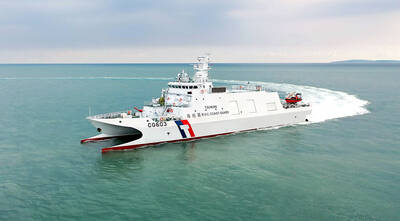
‘GRAY ZONE’ PRESSURE: Beijing’s activities are intended to create the deceitful impression that China has jurisdiction over the area around Taiwan, the CGA said Taiwan’s rights over its territorial waters and exclusive economic zone must not be violated by any country, the Mainland Affairs Council said yesterday, adding that it will not accept any unprovoked actions. The council issued the remarks in response to the China Coast Guard conducting maritime enforcement drills near eastern Taiwan and claiming to fully exercise China’s maritime administrative law enforcement authority. The Coast Guard Administration (CGA) has been closely monitoring the situation and is taking concrete steps to defend the nation’s sovereignty and secure its waters, the council said. China has no sovereign rights over the waters off eastern

RESILIENCE: Taiwan plays a key role in semiconductors, energy, information infrastructure and advanced manufacturing, AIT Director Raymond Greene said Taiwan’s continued investment in deterrence and resilience remains vital, especially in uncrewed systems and other emerging technologies, American Institute in Taiwan (AIT) Director Raymond Greene said yesterday. Greene made the remarks at the annual National Strategic Summit on Supply Chain Resilience held by the Research Institute for Democracy, Society and Emerging Technology (DSET), a government-backed think tank. As Taiwan last year became the US’ fourth-largest trading partner and supply chain security is becoming more important, cooperation in emerging technologies continues to deepen between the two countries, he said. The US is committed to accelerating innovation, building key infrastructure, strengthening cooperation

The National Chungshan Institute of Science and Technology yesterday showcased its locally developed variants of the Vision 60 robotic patrol dog, which it plans to deploy on the nation’s outlying territories in the South China Sea. The variants were produced under the Joint Lab project — created by the institute and domestic companies — and assembled with domestically produced motors, lenses and artificial intelligence (AI) systems alongside licensed tech from the US, Missile and Rocket Systems Research Division deputy director Jen Kuo-kang (任國光) told the media event at a military base in Taipei’s Dazhi (大直) area. Taiwan has built up its strengths


 RSS
RSS