


Piquing China just days before meetings with its leaders, US President George W. Bush yesterday held up Taiwan as a model of freedom "at all levels" that the communist giant should emulate.
Bush's speech opening a four-country tour of Asia amounted to a road map of the coming discussions he was to have on a potential bird-flu outbreak, global trade, North Korea's nuclear ambitions and other issues at a gathering of Pacific Rim economies in South Korea.
Bush arrived in Busan, South Korea, last night for the APEC summit and a one-on-one meeting with South Korean President Roh Moo-hyun. The US president met with his closest Asian ally, Japanese Prime Minister Junichiro Koizumi, in Kyoto, Japan, earlier yesterday and was traveling to China and Mongolia over the weekend.
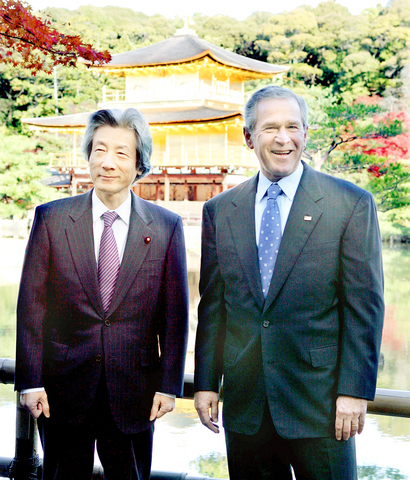
PHOTO: AFP
In remarks sure to irritate his Chinese hosts, Bush prodded the communist nation to grant basic freedoms to its 1.3 billion people and further open its economy.
"We encourage China to continue down the road of reform and openness," Bush told an audience that stayed silent until its polite applause at the end. "By meeting the legitimate demands of its citizens for freedom and openness, China's leaders can help their country grow into a modern, prosperous and confident nation."
His challenge to Beijing immediately followed lavish praise of Taiwan.
"By embracing freedom at all levels, Taiwan has delivered prosperity to its people and created a free and democratic Chinese society," Bush said. Pointing to Taiwan -- as well as South Korea -- Bush said political freedoms are the inevitable product of the kind of economic liberalization China has begun pursuing.
"Men and women who are allowed to control their own wealth will eventually insist on controlling their own lives and their own future. As China reforms its economy, its leaders are finding that once the door to freedom is opened even a crack, it cannot be closed," he said.
Comparing Taiwan and China, even indirectly, raises a major thorn in US-China relations. While US policy recognizes only one China -- including Taiwan -- and opposes Taiwanese independence, Washington is also Taiwan's largest arms benefactor and is bound by the Taiwan Relations Act to help Taiwan defend itself if attacked.
Bush's speech was an attempt to follow through on his inaugural promise to predicate US relations with all nations on their treatment of their citizens -- a pledge that meets its most difficult test with strategic allies such as China, Saudi Arabia and Pakistan.
Still, the call for change in China was not as tough as some on Capitol Hill and among his conservative supporters might want, as it was accompanied by praise on several fronts.
Bush recognized that economic reforms have resulted in a better-housed, better-fed populace, and he lauded China's leadership in the effort to rid North Korea of its nuclear weapons programs.
But while the US president said China should allow people to worship without state control -- a point he hoped to underscore by visiting an officially recognized church while in Beijing -- Bush did not mention China's human rights record.
"The Chinese are not going to like being scolded," said Adam Segal, who studies China at the Council on Foreign Relations in New York. "But if they are of the mind to, they can read it with a positive spin."
Beijing's response was muted.
"Our common points outnumber our differences," Chinese Foreign Minister Li Zhaoxing (
also see stories:
US releases sickening testimony from North Korea
Rice calls for North Koreans to `get serious' at talks
Ho meets with her APEC counterparts in S Korea
South Korea foresees the tech future at APEC summit

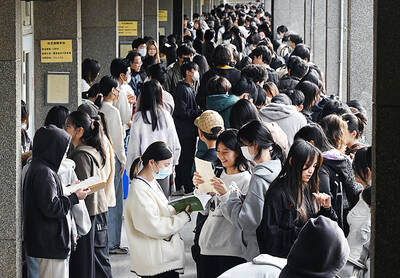
A global survey showed that 60 percent of Taiwanese had attained higher education, second only to Canada, the Ministry of the Interior said. Taiwan easily surpassed the global average of 43 percent and ranked ahead of major economies, including Japan, South Korea and the US, data from the Organisation for Economic Co-operation and Development (OECD) for 2024 showed. Taiwan has a high literacy rate, data released by the ministry showed. As of the end of last year, Taiwan had 20.617 million people aged 15 or older, accounting for 88.5 percent of the total population, with a literacy rate of 99.4 percent, the data
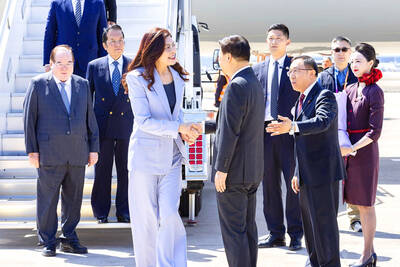
CCP ‘PAWN’? Beijing could use the KMT chairwoman’s visit to signal to the world that many people in Taiwan support the ‘one China’ principle, an academic said Chinese Nationalist Party (KMT) Chairwoman Cheng Li-wun (鄭麗文) yesterday arrived in China for a “peace” mission and potential meeting with Chinese President Xi Jinping (習近平), while a Taiwanese minister detailed the number of Chinese warships currently deployed around the nation. Cheng is visiting at a time of increased Chinese military pressure on Taiwan, as the opposition-dominated Legislative Yuan stalls a government plan for US$40 billion in extra defense spending. Speaking to reporters before going to the airport, Cheng said she was going on a “historic journey for peace,” but added that some people felt uneasy about her trip. “If you truly love Taiwan,
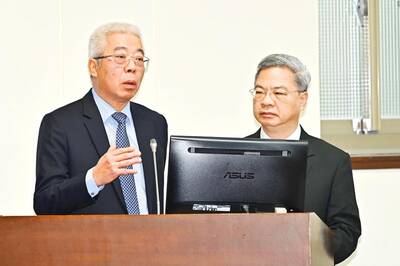
Taiwan has arranged for about 8 million barrels of crude oil, or about one-third of its monthly needs, to be shipped from the Red Sea this month to bypass the Strait of Hormuz and ease domestic supply pressures, CPC Corp, Taiwan (CPC, 台灣中油) said yesterday. The state-run oil company has worked with Middle Eastern suppliers to secure routes other than the Strait of Hormuz, through which about 20 percent of the world’s oil and liquefied natural gas typically passes, CPC chairman Fang Jeng-zen (方振仁) said at a meeting of the legislature’s Economics Committee in Taipei. Suppliers in Saudi Arabia have indicated they

NEW LOW: The council in 2024 based predictions on a pessimistic estimate for the nation’s total fertility rate of 0.84, but last year that rate was 0.69, 17 percent lower An expected National Development Council (NDC) report expects the nation’s population to drop below 12 million by 2065, with the old-age dependency ratio to top 100 percent sooner than 2070, sources said yesterday. The council is slated to release its latest population projections in August, using an ultra-low fertility model, the sources said. The previous report projected that Taiwan’s population would fall to 14.37 million by 2070, but based on a new estimate of the total fertility rate (TFR) — the average number of children born to a woman over her lifetime — the population is expected to reach 12 million by


 RSS
RSS