


Taipei Mayor Ma Ying-jeou (
While the ministry made public a draft outline for high school history books on Tuesday to include two international treaties to rebuff the previous administration's argument that Taiwan is part of China and that the ROC is the legitimate ruler of Taiwan, Ma said that the government should be consistent in its stance over the politically sensitive issue.
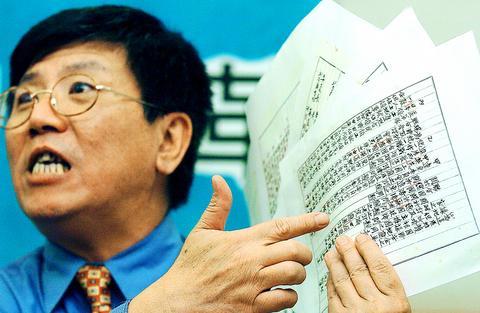
PHOTO: CHIEN JUNG-FENG, TAIPEI TIMES
"There're at least 11 official documents related to Taiwan's political status when I come to think of it," Ma said. "The education ministry should be impartial in presenting the facts and be consistent in addressing the issue with other government agencies."
Ma was referring to the different stances taken by the education ministry and the foreign ministry. While the foreign ministry recognizes the Cairo Declaration of 1943, the education ministry does not.
The declaration, which actually is little more than a press release, followed a meeting of Chiang Kai-shek (
Pro-unification groups, including the Chinese Nationalist Party (KMT), have long claimed that this, and the subsequent Potsdam Declaration in 1945, gave China the right to resume sovereignty over Taiwan and Penghu.
They claim that the Cairo declaration is a legal document which established the ROC's claim.
The problem is that Taiwan and Penghu were ceded in perpetuity to Japan in 1895 in an internationally recognized treaty and which, in international law, can only be superceded by a similar treaty. But no treaty awards Taiwan and Penghu to the ROC.
The education ministry is planning to add two relevant international treaties to high school history textbooks to indicate that Taiwan is not part of China and that the ROC is not the legal government of Taiwan.
These two treaties -- the San Francisco Peace Treaty of 1951 and Sino-Japan Peace Treaty, better known as the Taipei Treaty, of 1952 -- were deliberately left out in high-school history textbooks during KMT rule.
Pro-independence activists have cited the two agreements to argue that Taiwan's international status is undefined. The San Francisco Peace Treaty, signed in 1951, six years after Japan's defeat and the end of its half-century rule of Taiwan, states that the Japanese government renounces sovereignty over Taiwan and Penghu, but does specify to which government that sovereignty was to be transferred.
The Taipei Treaty affirms the 1951 pact, reiterating that the Japanese government would renounce any claim to to Taiwan, Penghu, the Spratly Islands and the Paracel Islands. The treaty, again, does not specify the legal successor government of these territories.
While Minister of Education Tu Cheng-sheng (
"There's no such a thing as the Cairo Declaration because it's nothing but a press communique," Tu said.
He also pointed out that even the current textbooks were inaccurate.
"While current textbooks say the document states that Japan was to return Taiwan to China, the original document actually says that Japan would return Taiwan to the Republic of China," he said.
Disapproving of the argument that Taiwan's international status is undefined, Ma said that the theory had been superceded by the Shanghai Communique in 1972.
He did not explain how an agreement between the US and the PRC, which also does not have the force of a treaty, could change the legal situation resulting from the San Francisco Treaty.
Minister of Justice Chen Ding-nan (
Also See Story:
Parties argue over history education

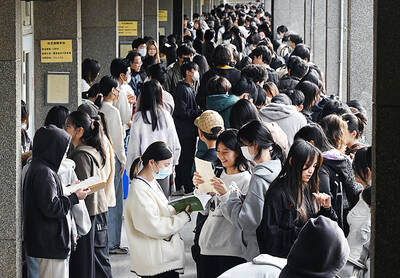
A global survey showed that 60 percent of Taiwanese had attained higher education, second only to Canada, the Ministry of the Interior said. Taiwan easily surpassed the global average of 43 percent and ranked ahead of major economies, including Japan, South Korea and the US, data from the Organisation for Economic Co-operation and Development (OECD) for 2024 showed. Taiwan has a high literacy rate, data released by the ministry showed. As of the end of last year, Taiwan had 20.617 million people aged 15 or older, accounting for 88.5 percent of the total population, with a literacy rate of 99.4 percent, the data
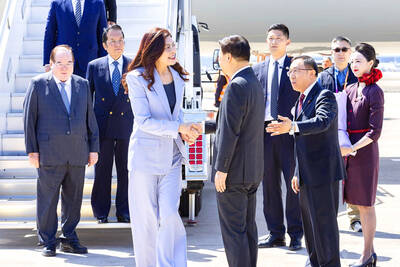
CCP ‘PAWN’? Beijing could use the KMT chairwoman’s visit to signal to the world that many people in Taiwan support the ‘one China’ principle, an academic said Chinese Nationalist Party (KMT) Chairwoman Cheng Li-wun (鄭麗文) yesterday arrived in China for a “peace” mission and potential meeting with Chinese President Xi Jinping (習近平), while a Taiwanese minister detailed the number of Chinese warships currently deployed around the nation. Cheng is visiting at a time of increased Chinese military pressure on Taiwan, as the opposition-dominated Legislative Yuan stalls a government plan for US$40 billion in extra defense spending. Speaking to reporters before going to the airport, Cheng said she was going on a “historic journey for peace,” but added that some people felt uneasy about her trip. “If you truly love Taiwan,

NEW LOW: The council in 2024 based predictions on a pessimistic estimate for the nation’s total fertility rate of 0.84, but last year that rate was 0.69, 17 percent lower An expected National Development Council (NDC) report expects the nation’s population to drop below 12 million by 2065, with the old-age dependency ratio to top 100 percent sooner than 2070, sources said yesterday. The council is slated to release its latest population projections in August, using an ultra-low fertility model, the sources said. The previous report projected that Taiwan’s population would fall to 14.37 million by 2070, but based on a new estimate of the total fertility rate (TFR) — the average number of children born to a woman over her lifetime — the population is expected to reach 12 million by
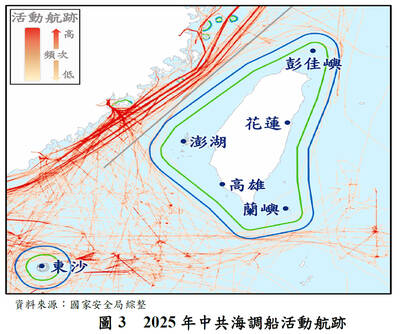
INTENSIFYING THREATS: Beijing’s tactics include massive attacks on the government service network, aircraft and naval vessel incursions and damaging undersea cables China is prepared to interfere in November’s nine-in-one local elections by launching massive attacks on the Taiwanese government’s service network (GSN), a report published by the National Security Bureau showed. The report was submitted to the Legislative Yuan ahead of the bureau’s scheduled briefing at the Foreign Affairs and National Defense Committee tomorrow. The national security team has identified about 13,000 suspicious Internet accounts and 860,000 disputed messages, the bureau said of China’s cognitive warfare against Taiwan. The disputed messages focus on major foreign affairs, national defense and economic issues, which were produced using generative artificial intelligence (AI) and distributed through Chinese


 RSS
RSS