


As playwright Aleshea Harris tells it, something felt missing when she first sat down to write her searing and startling play Is God Is, which made waves off-Broadway in 2018.
Harris was writing an epic story of Black female revenge, one that drew on Greek tragedy and mythology, but also spaghetti westerns and a liberal dose of Quentin Tarantino, among other things. There was a hero character, but it wasn’t enough. That’s when Harris realized it should be a story of sisters. Twin sisters.
Twins, Harris theorized, bring immediate and profound drama, what’s similar about them, and what’s different? How often do they agree, and what happens when they don’t? It was a crucial creative decision both for the Obie-winning play and now, the movie adaptation Harris has written and directed — a no less startling piece of work, eight years later.

Photo: AP
And so we have Racine and Anaia, one of the more fascinating sets of twins to grace a movie screen. Racine (two-time Tony winner Kara Young, funny and fierce), is expressive, emotional, aggressive, sometimes joyful. Anaia (newcomer Mallori Johnson, deeply moving), is quieter, more deliberate, ostensibly meeker.
At age 21, they share everything: a living space, clothing, the same blond braids. They speak and even think in tandem, to the point where regular dialogue is sometimes replaced, cleverly, with subtitles — their communicating doesn’t need words. Heck, they can even pee at the same time.
More profoundly, they share similar, horrific scars — suffered in a fire set by their father when they were small girls, in an attempt to kill their mother. Racine’s scars cover her arm and travel onto her back, while Anaia’s cover her face, permanently altering how the world sees her.
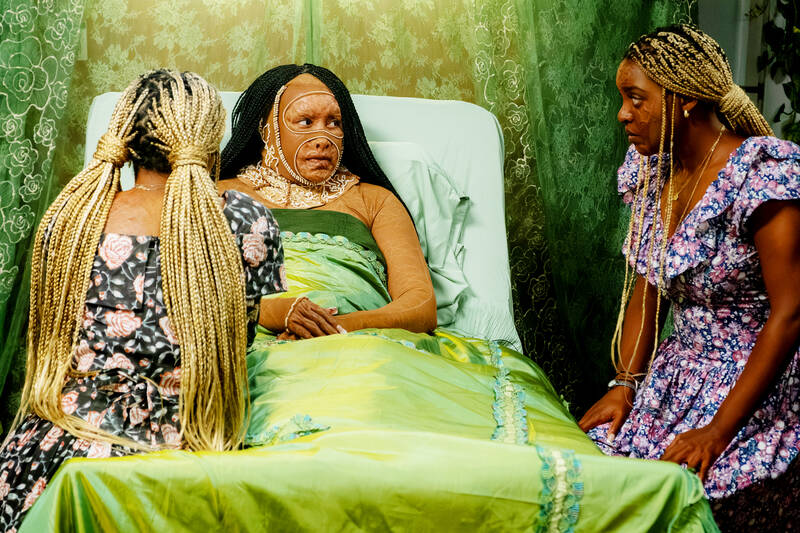
Photo: AP
In the prologue, we learn that Racine has been avenging her sister, whenever she’s called ugly because of those scars, since they were children. Then, back to present time. The twins receive a letter they never expected.
“We got a mama!?” they exclaim. They’d thought she’d died in the fire.
But now, Mother — or God, as the girls refer to the woman who made them (a tragically regal Vivica A. Fox) — has summoned them from their abode somewhere in the Northeast to her deathbed down South, where she, too, lies covered in scars.
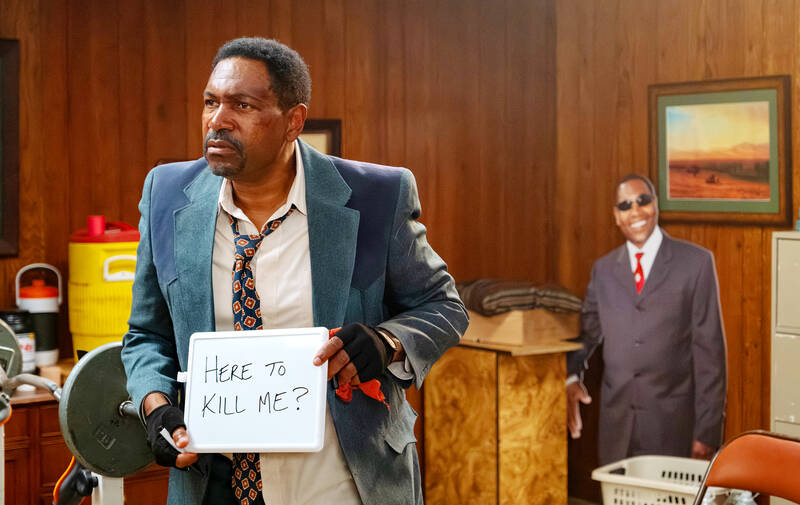
Photo: AP
And she has one request: that her girls avenge her.
The twins argue, as they begin the journey in their beat-up Oldsmobile. Anaia is not feeling this mission. But Racine is. And in a striking moment, Anaia imagines how life would have been without her disfiguring scars.
Nobody knows where “Man” is — that’s the only name we get for this character — but they know the first stop: A cultlike church where a preacher woman lives with the son she bore him and saves his belongings, in a shrine. From there, clues lead them to a lawyer who has lost his tongue to the man’s evils. Literally.
“Do you ever want to scrape off those scars and see what’s underneath?” one twins asks the other at a point along the way. The question sticks with us.
Finally, we reach the luxurious suburban home where Man has been living a life of comfort with his wife Angie (Janelle Monae, memorable in a brief but violent appearance here) and twin sons. Yes, more twins.
Angie appears to be making some sort of great escape. (She picked the day that Racine and Anaia arrived, wouldn’t you know.)
“Mom, what are we gonna do for dinner?” one of Angie’s annoyed sons calls out.
This may be a Greek tragedy, transported to the contemporary American South, but men asking about dinner is universal.
Ultimately, Man arrives home. Let’s just say he’ll need to make his own sandwich.
You may think you know Sterling K. Brown, but trust us, you have never seen this version of Brown — a man utterly dripping with villainy, if villainy were in liquid form, and all the more chilling for the calmness with which he intones the most horrific thoughts.
Especially about rage. Man, in a fateful conversation, explains his murderous actions in a “logical” argument about justifiable male rage.
We all know what happens, basically, at the end of a Greek tragedy. It’s nothing good. Add that dose of Tarantino inspo, and you get the picture.
But let’s go back to that issue of rage.
Because here is where Harris’ message seems to emerge at its loudest and clearest: Rage is not an arena open exclusively to men. It’s not something that becomes explicable only for those who possess the Y chromosome. Yet women, and especially Black women, often have to apologize for their anger, Harris says.
The playwright offers no apologies for her twins on their life-altering, rage-filled journey.
“Do you ever want to scrape off those scars and see what’s underneath?” one of the twins had asked — remember? Turns out, they didn’t need to remove the scars to find out.

Taiwan’s overtaking of South Korea in GDP per capita is not a temporary anomaly, but the result of deeper structural problems in the South Korean economy says Chang Young-chul, the former CEO of Korea Asset Management Corp. Chang says that while it reflects Taiwan’s own gains, it also highlights weakening growth momentum in South Korea. As design and foundry capabilities become more important in the AI era, Seoul risks losing competitiveness if it relies too heavily on memory chips. IMF forecasts showing Taiwan widening its lead over South Korea have fueled debate in Seoul over memory chip dependence, industrial policy and

“China wants to unify with Taiwan at the lowest possible cost, and it currently believes that unification will become easier and less costly as time passes,” wrote Amanda Hsiao (蕭嫣然) and Bonnie Glaser in Foreign Affairs (“Why China Waits”) this month, describing how the People’s Republic of China (PRC) is playing the long game in its quest to seize Taiwan. This has been a favorite claim of many writers over the years, easy to argue because it is so trite. Very obviously, if the PRC isn’t attacking Taiwan, it is waiting. But for what? Hsiao and Glaser’s main point is trivial,
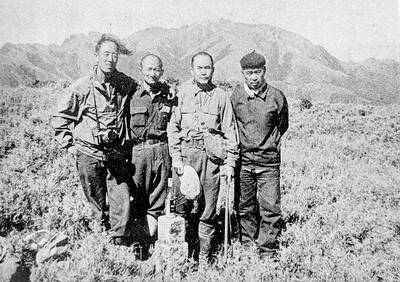
May 18 to May 24 Gathered on Yangtou Mountain (羊頭山) on Dec. 5, 1972, Taiwan’s hiking enthusiasts formally declared the formation of the “100 Peaks Club” (百岳俱樂部) and unveiled the final list of mountains. Famed mountaineer Lin Wen-an (林文安) led this effort for the Chinese Alpine Association (中華山岳協會). Working with other experienced climbers, he chose 100 peaks above 10,000 feet (3,048m) that featured triangulation points and varied in difficulty and character. The list sparked an alpine hiking craze, inspiring many to take up mountaineering and competing to “conquer” the summits. A common misconception is that the 100 Peaks represent Taiwan’s 100 tallest

The Chinese Nationalist Party (KMT), alongside their smaller allies the Taiwan People’s Party (TPP), are often accused of acting on behalf of the Chinese Communist Party (CCP). Some go so far as to call them “traitors.” It is not hard to see why. They regularly pass legislation to stymie the normal functioning of the ruling Democratic Progressive Party’s (DPP) administration, and they have yet to pass this year’s annual budget. They slashed key elements of the government’s proposed NT$1.25 trillion (US$40 billion) special military budget, and in the smaller NT$780 billion package they did pass, it is riddled with provisions that


 RSS
RSS