


They have been our meat and our messengers, a source of fertilizer and a religious symbol: while pigeons are now mostly reviled as dirty city pests, they long played an important role in human society.
Now, research published yesterday has revealed that the humble birds were first domesticated 3,500 years ago, meaning they have been enmeshed in our lives for nearly a millennium longer than previously thought.
“Humans forgetting about pigeons happened relatively recently in human history,” said Anderson Carter, a bioarchaeologist at the University of Groningen in the Netherlands.
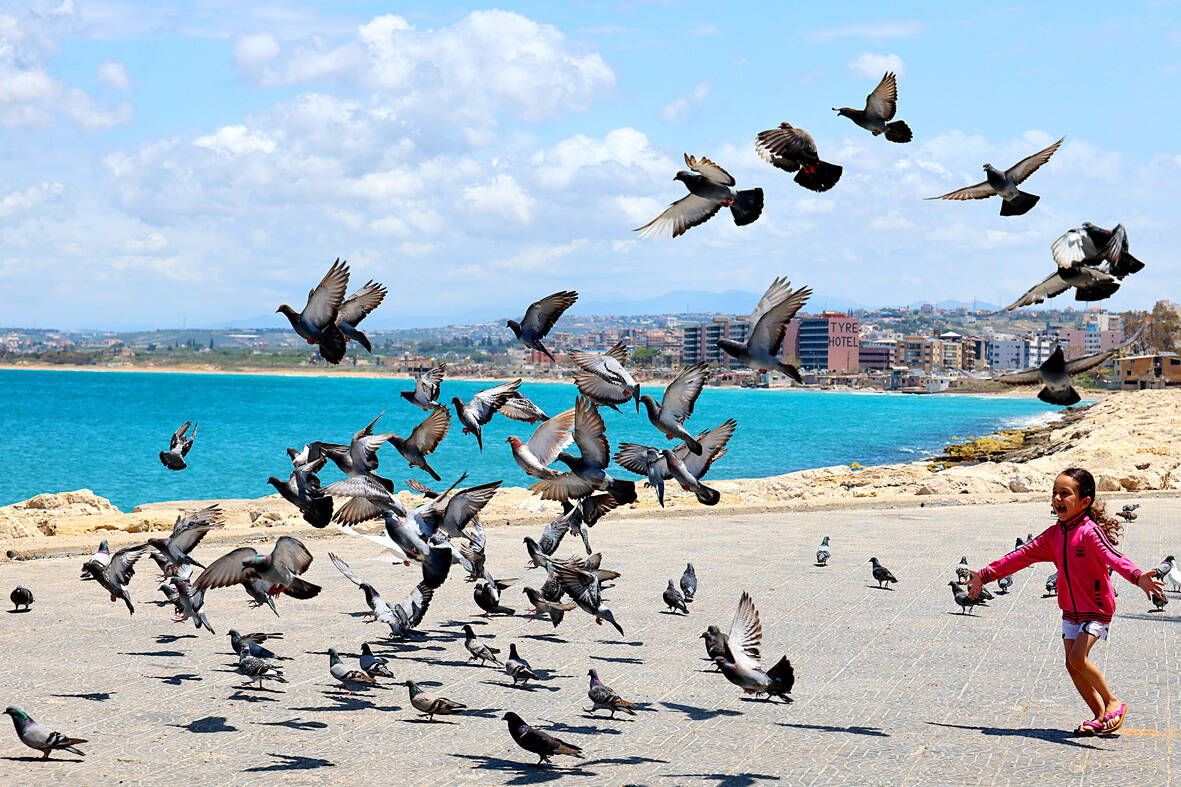
Photo: EPA
Pigeons were still a useful part of society as recently as the 19th and 20th centuries, explained the lead author of a new study in the journal Antiquity.
“They were still being used to carry messages and even had an important role in wars in particular,” she added.
“But then a lot of technological advancements happened, the telegraph was invented and then the telephone, and pigeons were out of a job.”
However, because we had spent thousands of years conditioning them to live alongside us, the birds stayed nearby.
It was only when huge cities emerged after the industrial revolution that “there was a rising view that they were pests, dirty and spreading diseases,” Carter said.
Now, “anti-pigeon architecture such as spikes on top of buildings” are a common sight, she added.
FREE BIRD
The common pigeon — or rock dove — originally came from the Mediterranean region. Genomic analysis has shown that today’s city-dwellers are closely related to wild doves from the Middle East.
For the new research, a Dutch-led team of scientists went to the Hala Sultan Tekke archaeological site on the shores of the Larnaca salt lake in southeast Cyprus.
They analyzed 159 ancient pigeon bones to find out how they lived and died — and look for signs of human intervention, such as cuts.
Biometric and isotopic analysis revealed that the pigeons lived in the 13th and 14th centuries BC, during the Bronze Age.
By extracting collagen from the bones, the scientists were able to find out their ratios of nitrogen and carbon, which is closely linked to an animal’s diet. The results were then compared with animals and humans found in Cyprus dating to the same period.
“The Hala Sultan Tekke pigeons overlapped pretty significantly with the results from humans from other Bronze Age Cypriot sites, showing that they likely ate a very similar diet to humans,” Carter said.
“This very likely means that they were domesticated or on their way to being domesticated” at around 1,400 BC, senior study author Canan Cakirlar of the Royal Netherlands Institute of Sea Research said in a statement.
That is nearly a thousand years earlier than previous research has found, including giant stone structures used as pigeon nesting houses discovered in Greece dating from around 300 BC.
One goal of the research is “to change how we interact with and think about this bird,” Carter said.
“And start realizing that their story is also our story.”

Taiwan’s overtaking of South Korea in GDP per capita is not a temporary anomaly, but the result of deeper structural problems in the South Korean economy says Chang Young-chul, the former CEO of Korea Asset Management Corp. Chang says that while it reflects Taiwan’s own gains, it also highlights weakening growth momentum in South Korea. As design and foundry capabilities become more important in the AI era, Seoul risks losing competitiveness if it relies too heavily on memory chips. IMF forecasts showing Taiwan widening its lead over South Korea have fueled debate in Seoul over memory chip dependence, industrial policy and

“China wants to unify with Taiwan at the lowest possible cost, and it currently believes that unification will become easier and less costly as time passes,” wrote Amanda Hsiao (蕭嫣然) and Bonnie Glaser in Foreign Affairs (“Why China Waits”) this month, describing how the People’s Republic of China (PRC) is playing the long game in its quest to seize Taiwan. This has been a favorite claim of many writers over the years, easy to argue because it is so trite. Very obviously, if the PRC isn’t attacking Taiwan, it is waiting. But for what? Hsiao and Glaser’s main point is trivial,
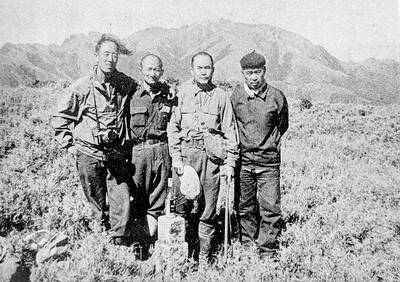
May 18 to May 24 Gathered on Yangtou Mountain (羊頭山) on Dec. 5, 1972, Taiwan’s hiking enthusiasts formally declared the formation of the “100 Peaks Club” (百岳俱樂部) and unveiled the final list of mountains. Famed mountaineer Lin Wen-an (林文安) led this effort for the Chinese Alpine Association (中華山岳協會). Working with other experienced climbers, he chose 100 peaks above 10,000 feet (3,048m) that featured triangulation points and varied in difficulty and character. The list sparked an alpine hiking craze, inspiring many to take up mountaineering and competing to “conquer” the summits. A common misconception is that the 100 Peaks represent Taiwan’s 100 tallest

The Chinese Nationalist Party (KMT), alongside their smaller allies the Taiwan People’s Party (TPP), are often accused of acting on behalf of the Chinese Communist Party (CCP). Some go so far as to call them “traitors.” It is not hard to see why. They regularly pass legislation to stymie the normal functioning of the ruling Democratic Progressive Party’s (DPP) administration, and they have yet to pass this year’s annual budget. They slashed key elements of the government’s proposed NT$1.25 trillion (US$40 billion) special military budget, and in the smaller NT$780 billion package they did pass, it is riddled with provisions that


 RSS
RSS