


As artificial intelligence casts a shadow over career prospects, it is becoming an unwelcome subject at this season’s college commencements. At several campuses, graduates have interrupted speakers with stadium-wide boos when the topic turned to AI.
Former Google CEO Eric Schmidt faced repeated jeers over the weekend during his keynote address to about 10,000 University of Arizona graduates on the rise of AI.
“It will touch every profession, every classroom, every hospital, every laboratory, every person and every relationship you have,” Schmidt said, as booing began to build in the audience.
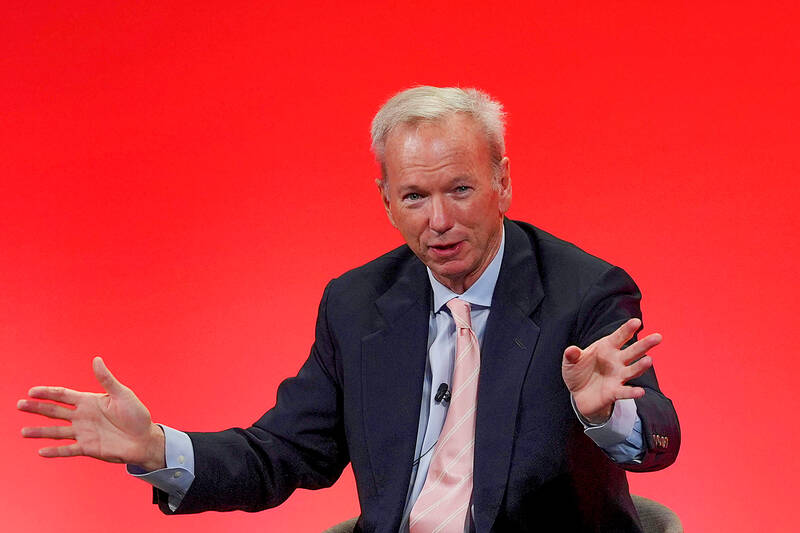
Photo: AP
“I know what many of you are feeling about that. I can hear you,” Schmidt responded as the boos continued. “There is a fear in your generation that the future has already been written, that the machines are coming, that the jobs are evaporating … and I understand that fear.”
To students the topic felt tone deaf, said Olivia Malone, a 22-year-old University of Arizona graduate bound for law school.
“His speech was incredibly disrespectful to students,” said Malone. “We as students are discouraged from using it and penalized for using it. And then to have our speaker be the champion of AI is just like, OK? Why?”
Photo: AP
Similar responses to keynote speakers who touched on AI at other universities highlight a pervasive sense of anxiety among today’s college students.
GROWING CONCERN
Across campuses and in a multitude of recent surveys, students say they are trying to figure out which skills, majors and jobs won’t be rendered useless by AI.
About 70 percent of college students see AI as a threat to their job prospects, according to a poll last year by the Institute of Politics at the Harvard Kennedy School.
A recent Gallup poll of Generation Z youth and adults, between ages 14 and 29, found increasingly negative attitudes toward AI. About half of Gen Z teens and adults say they use AI daily or weekly. But anger about the technology has increased since a year ago, while excitement and hopefulness about AI is declining.
Another speaker, real estate executive Gloria Caulfield, also faced boos when she highlighted the advent of artificial intelligence during a keynote this month at the University of Central Florida.
“The rise of artificial intelligence is the next industrial revolution,” Caulfield said, as boos erupted, to her surprise. She turned around to ask those behind her, “What happened?”
“OK, I struck a chord. May I finish?” said Caulfield, who is vice president of strategic alliances at the Tavistock Development Company in Orlando.
“Only a few years ago, AI was not a factor in our lives,” she said, prompting cheers. “And now, AI capabilities are in the palm of our hand,” she said to more jeering.
SPEAKERS STRESS POSITIVES
A similar response met music executive Scott Borchetta when he spoke to the graduating class of Middle Tennessee State University about how AI is shaping the music industry.
“AI is rewriting production as we sit here,” said Borchetta, the CEO of Big Machine Records, as the students in caps and gowns booed. “I know it. Deal with it … Do something about it. It’s a tool. Make it work for you.”
Schmidt offered a similar message to graduates: Their fear is rational, but they have the power to shape how AI develops.
The advice didn’t land well with students like Malone, who said the former Google executive’s speech was more self-serving than inspirational.
“It felt like a big advertisement. It felt like the longest Gemini ad ever,” said Malone, noting that the choice of Schmidt as keynote speaker had also been controversial because his name appears in a tranche of files on millionaire financier and sex offender Jeffrey Epstein. “Everybody I was sitting by was really hooting and hollering about that, yelling, ‘Epstein files! Epstein files!’”
Simply appearing in the Epstein files doesn’t implicate wrongdoing.
TOUCH JOB MARKET
Part of the backlash from graduating students stems from the dismal job market they’re entering. The unemployment rate for college graduates ages 22 to 27 has reached its highest level in a dozen years.
Sami Wargo just graduated from Marquette University in Milwaukee, where an AI expert was the undergraduate commencement speaker despite a student petition demanding that the school find someone else.
“Given how AI has become an increasing threat towards our jobs, especially for our graduating class, we thought it was a little bit tone deaf,” said Wargo, who majored in digital media and minored in advertising.
Chris Duffey, an AI evangelist at Adobe who recently used AI to “co-author” a book titled “Superhuman Innovation: Transforming Business with Artificial Intelligence,” took the stage anyway.
“Innovation,” he told the students, “will reveal what can be done, but only you can decide what should be done.”
Wargo said she joined other students around her in booing his message.
The 21-year-old has applied for around 30 jobs but hasn’t landed one yet. Many of the job descriptions say applicants must “collaborate with AI,” but “I don’t know what that means,” she said, noting that most of her classes banned her from using AI.
Having to be reminded of all the uncertainty at their graduation, she said, was another “little dent in what was supposed to be a celebratory day.”
Taiwan’s overtaking of South Korea in GDP per capita is not a temporary anomaly, but the result of deeper structural problems in the South Korean economy says Chang Young-chul, the former CEO of Korea Asset Management Corp. Chang says that while it reflects Taiwan’s own gains, it also highlights weakening growth momentum in South Korea. As design and foundry capabilities become more important in the AI era, Seoul risks losing competitiveness if it relies too heavily on memory chips. IMF forecasts showing Taiwan widening its lead over South Korea have fueled debate in Seoul over memory chip dependence, industrial policy and

“China wants to unify with Taiwan at the lowest possible cost, and it currently believes that unification will become easier and less costly as time passes,” wrote Amanda Hsiao (蕭嫣然) and Bonnie Glaser in Foreign Affairs (“Why China Waits”) this month, describing how the People’s Republic of China (PRC) is playing the long game in its quest to seize Taiwan. This has been a favorite claim of many writers over the years, easy to argue because it is so trite. Very obviously, if the PRC isn’t attacking Taiwan, it is waiting. But for what? Hsiao and Glaser’s main point is trivial,
May 18 to May 24 Gathered on Yangtou Mountain (羊頭山) on Dec. 5, 1972, Taiwan’s hiking enthusiasts formally declared the formation of the “100 Peaks Club” (百岳俱樂部) and unveiled the final list of mountains. Famed mountaineer Lin Wen-an (林文安) led this effort for the Chinese Alpine Association (中華山岳協會). Working with other experienced climbers, he chose 100 peaks above 10,000 feet (3,048m) that featured triangulation points and varied in difficulty and character. The list sparked an alpine hiking craze, inspiring many to take up mountaineering and competing to “conquer” the summits. A common misconception is that the 100 Peaks represent Taiwan’s 100 tallest
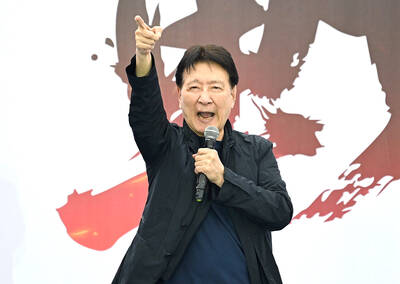
In a sudden move last week, opposition lawmakers of the Chinese Nationalist Party (KMT) and Taiwan People’s Party (TPP) passed a NT$780 billion special defense budget as a preemptive measure to stop either Chinese leader Xi Jinping (習近平) or US President Donald Trump from blocking US arms sales to Taiwan at their summit in Beijing, said KMT heavyweight Jaw Shaw-kong (趙少康), speaking to the Taipei Foreign Correspondents Club on Wednesday night in Taipei. The 76-year-old Jaw, a political talk show host who ran as the KMT’s vice presidential candidate in 2024, says that he personally brokered the deal to resolve


 RSS
RSS