


The opposition coalition of the Chinese Nationalist Party (KMT) and Taiwan People’s Party (TPP) has systematically worked to make things extremely difficult for the ruling Democratic Progressive Party (DPP). They have slashed budgets for military spending, dragged out budget negotiations and blocked appointments for key roles, including on the Constitutional Court and several critical agencies, effectively paralyzing their ability to function normally.
All of this is to the advantage of the Chinese Communist Party (CCP), which is engaged in “unlimited warfare” on many fronts against democracies around the world, but most especially Taiwan, which it wants to annex into its empire as it did with Tibet, Manchuria, Inner Mongolia and the Uighur territories.
This has led many to label them “pro-China” and even as “traitors.” Their behavior makes these accusations easy to make.
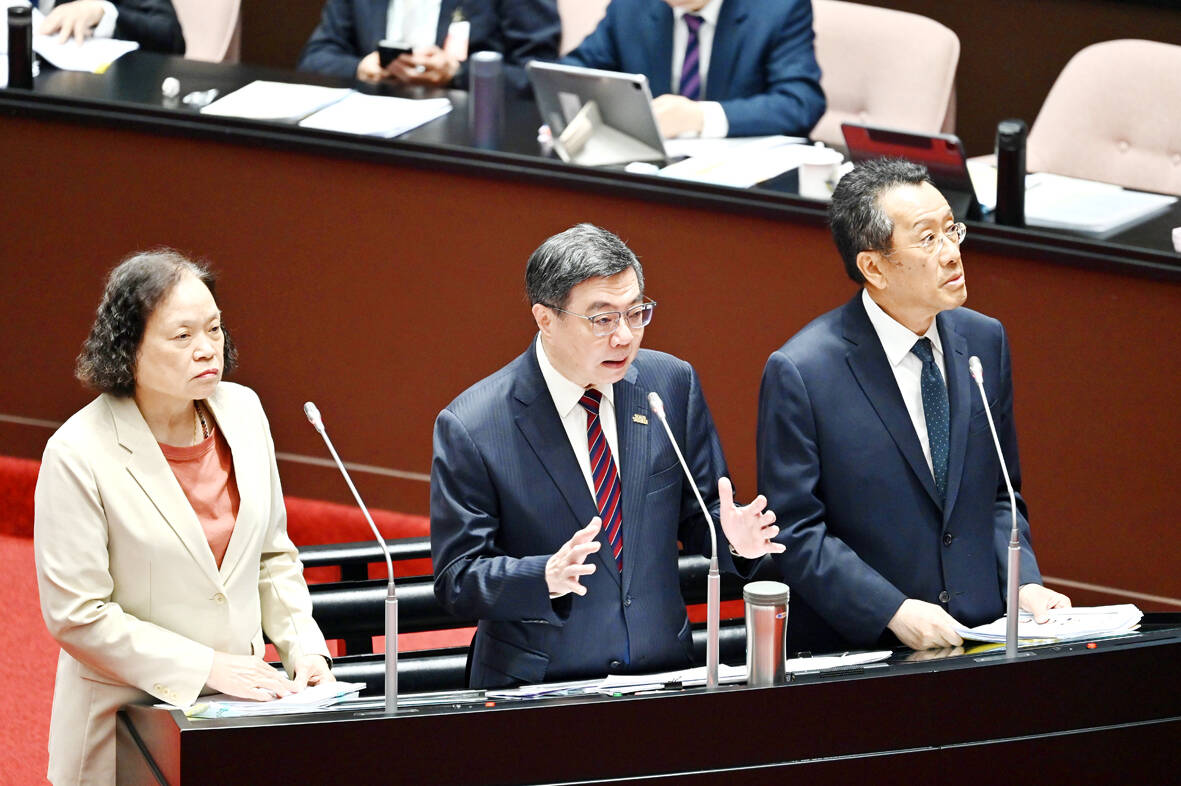
Photo: George Tsorng, Taipei Times
But of course it’s not that simple.
In the last column, “Donovan’s Deep Dives: How and why the TPP and KMT help Beijing” (May 16, page 12), four broad reasons were identified, of which one or more may apply to each lawmaker.
The first two have nothing to do with China, namely legitimate policy and ideological differences normal in democracies and the deep historical enmity many in the KMT and DPP have for each other, and the TPP’s recent anti-DPP turn.
The third reason is that some may have been turned by the CCP; actual traitors. Indeed, some have been found in the DPP, and it seems unlikely that KMT members — who regularly join delegations to China — have not been targeted by the CCP with offers of money, sweet business deals for family members, sex or blackmailed through compromising materials.
It was when approaching the fourth reason, the KMT Chinese ethnonationalists who share ideology with the CCP and whose agendas sometimes align, that I had a startling thought.
There may be a whole generation of English-language readers who have little to no idea of what Chinese ethnonationalism is.
In the mid-to-late 2010s, Taiwan’s English-language media landscape switched from being dominated by KMT ethnonationalist narratives (“pan-blue”) to DPP-friendly pro-Taiwan ones (“pan-green”). Pan-blue outlets all but disappeared, and even the KMT stopped running English content on their Web site in 2020.
It used to be that Taiwanese were regularly referred to as “Chinese,” Taiwanese-Americans were called “ABCs” (American Born Chinese) and “free China” was still used. “Mainland” for China still persists, mostly among those educated prior to 2014.
Before exploring this topic, some caveats are in order. First, keep in mind I am at the opposite end of the political spectrum and disagree with them, but I will do my best to present their worldview.
Not all KMT voters are Chinese ethnonationalists; many have other reasons for supporting the party. By definition, KMT members are, and espouse the eventual “reunification” of Taiwan with the “mainland,” but there is a spectrum and individuals vary. For some, it is a faraway prospect for some distant future when and if China democratizes.
THE CALL OF THE MOTHERLAND
This column focuses on the thinking of those in the KMT who support closer integration with China to lay the groundwork for “reunification” in the short to medium term, such as KMT Chair Cheng Li-wun (鄭麗文) and her allies in the legislature.
At the core of Chinese ethnonationalist ideology is the concept that the Han Chinese people and the Chinese nation are deeply intertwined. Both the CCP and KMT historically view all ethnic Chinese, regardless of nationality or native language, as part of the nation. In this view, for example, Taiwanese-Americans are “Chinese overseas compatriots,” not foreigners. Those who serve the interests of another nation other than their “own” (i.e., China) are viewed as traitors to both their race and their nation.
Some Chinese commentators find the concept that Han Taiwanese do not identify as Chinese and want nothing to do with the “motherland” so outlandish that they claim that Taiwan independence “separatists” must have been tainted with Japanese colonialist blood.
Both the CCP and KMT hardliners consider “Taiwan consciousness” and identity to be extremely threatening and frequently accuse the DPP of “de-sinifying” Taiwan. Many foreigners believe that the CCP’s refusal to speak with the DPP is because the DPP refuses to accept the “1992 consensus” and the “one China principle” embedded in it, but their enmity towards the DPP runs far deeper because they view them as an existential threat.
In Cheng’s comments following her meeting with CCP Secretary-General Xi Jinping (習近平) she said: “people on both sides of the Strait are all descendants of the Yan and Huang Emperors, belong to the same Chinese nation and are nurtured by the same Chinese culture — they are one family.”
This ethnic identification with the nation runs deep, and it is both a blessing and a responsibility. As a Chinese, you are the inheritor of the greatest civilization that ever existed. The Chinese term for “China” (中國) is often translated as “middle kingdom,” but “central kingdom” would be more accurate both historically and in mindset.
Throughout much of history, China was the greatest civilization technologically, economically and militarily — and whose arts and culture were some of the finest ever produced. China was at the center of their east Asian world, and the nations and peoples surrounding them were deeply influenced by China and were often tributary states bowing to the Chinese emperor.
Unlike the Western concept of history as linear, for Chinese, it comes in cycles. The opening line from the Romance of the Three Kingdoms (三國演義) reads: “The (Chinese) empire, long divided, must unite; long united, must divide. Thus it has ever been” (話說天下大勢,分久必合,合久必分).
When a Chinese government falls, it has divine connotations by “losing the mandate of heaven.” Those who divide the Chinese are the villains of history; the uniters are the heroes driven with divine inspiration. As a modern Chinese, it is your duty and responsibility to strive to unite the nation in these times of division.
In this worldview, the separation of Taiwan from the “motherland” is a historical tragedy with spiritual significance to the Chinese nation and people that must be rectified.
DIVINE DESTINY
At a party training session, Cheng reportedly told attendees that she possesses a “divine destiny” (天命, also translated as “mandate of heaven”) to ensure the success of her upcoming meeting with Xi.
Cheng is frequently accused of being a pawn of the CCP, but this is highly unlikely. Cheng and her ideological allies are not working for the CCP; they are working with the CCP on shared aims and goals.
Also in her remarks after meeting with Xi, she said: “There is no denying that interactions between the KMT and [CCP] over more than a century have been marked by twists and turns. Yet, what we have consistently pursued is the rejuvenation of the Chinese nation from decline to revival.”
After delivering her remarks, an NBC reporter asked if Cheng believed that peaceful reunification across the Taiwan Strait was a shared goal of both sides.
Cheng referred to her notes and quoted Xi (translation by Think China): “Social systems and political positions may differ, but our common ancestry and the bonds of our nation cannot be severed. Differences in social systems should not serve as a pretext for division.”
She added that the CCP leadership had conveyed significant goodwill.
She also expressed the view that both sides of the strait should pragmatically face their differences while appreciating each other’s achievements, “handling matters one at a time and moving forward step by step.”
Not all KMT lawmakers are this hardline, but many are.
With this ideology, is it any wonder their wing of the party wants to do everything they can to stymie the DPP and slash defense spending?
Donovan’s Deep Dives is a regular column by Courtney Donovan Smith (石東文) who writes in-depth analysis on everything about Taiwan’s political scene and geopolitics. Donovan is also the central Taiwan correspondent at ICRT FM100 Radio News, co-publisher of Compass Magazine, co-founder Taiwan Report (report.tw) and former chair of the Taichung American Chamber of Commerce. Follow him on X: @donovan_smith.
Taiwan’s overtaking of South Korea in GDP per capita is not a temporary anomaly, but the result of deeper structural problems in the South Korean economy says Chang Young-chul, the former CEO of Korea Asset Management Corp. Chang says that while it reflects Taiwan’s own gains, it also highlights weakening growth momentum in South Korea. As design and foundry capabilities become more important in the AI era, Seoul risks losing competitiveness if it relies too heavily on memory chips. IMF forecasts showing Taiwan widening its lead over South Korea have fueled debate in Seoul over memory chip dependence, industrial policy and
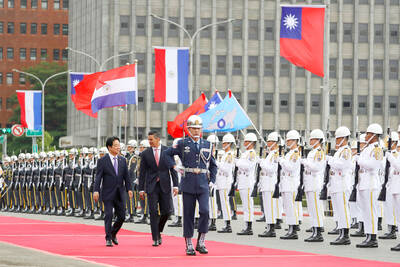
“China wants to unify with Taiwan at the lowest possible cost, and it currently believes that unification will become easier and less costly as time passes,” wrote Amanda Hsiao (蕭嫣然) and Bonnie Glaser in Foreign Affairs (“Why China Waits”) this month, describing how the People’s Republic of China (PRC) is playing the long game in its quest to seize Taiwan. This has been a favorite claim of many writers over the years, easy to argue because it is so trite. Very obviously, if the PRC isn’t attacking Taiwan, it is waiting. But for what? Hsiao and Glaser’s main point is trivial,
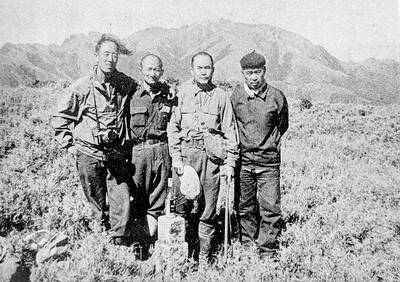
May 18 to May 24 Gathered on Yangtou Mountain (羊頭山) on Dec. 5, 1972, Taiwan’s hiking enthusiasts formally declared the formation of the “100 Peaks Club” (百岳俱樂部) and unveiled the final list of mountains. Famed mountaineer Lin Wen-an (林文安) led this effort for the Chinese Alpine Association (中華山岳協會). Working with other experienced climbers, he chose 100 peaks above 10,000 feet (3,048m) that featured triangulation points and varied in difficulty and character. The list sparked an alpine hiking craze, inspiring many to take up mountaineering and competing to “conquer” the summits. A common misconception is that the 100 Peaks represent Taiwan’s 100 tallest
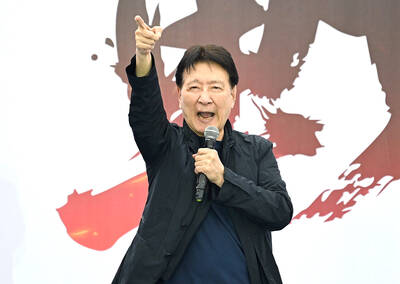
In a sudden move last week, opposition lawmakers of the Chinese Nationalist Party (KMT) and Taiwan People’s Party (TPP) passed a NT$780 billion special defense budget as a preemptive measure to stop either Chinese leader Xi Jinping (習近平) or US President Donald Trump from blocking US arms sales to Taiwan at their summit in Beijing, said KMT heavyweight Jaw Shaw-kong (趙少康), speaking to the Taipei Foreign Correspondents Club on Wednesday night in Taipei. The 76-year-old Jaw, a political talk show host who ran as the KMT’s vice presidential candidate in 2024, says that he personally brokered the deal to resolve


 RSS
RSS