


Last Wednesday, at the Chinese Nationalist Party (KMT) Central Standing Committee public meeting just prior to moving to closed-door session, retired marine general and one of the party’s four vice chairmen, Chi Lin-lien (季麟連), asked to speak. Chi started by reiterating his support for the party’s official “NT$380 billion+N” special military budget proposal backed by party Chairwoman Cheng Li-wun (鄭麗文) and KMT legislative caucus whip Fu Kun-chi (傅?萁).
Chi once led the formerly powerful veterans’ association within the KMT, the Huang Fuhsing (黃復興), that was disbanded in 2024, but he is seeking to revive it. In this context, it is ironic that once upon a time, he was tapped by former Democratic Progressive Party (DPP) president Chen Shui-bian (陳水扁) to help make the case for defense budget spending.
Referencing KMT Legislative Speaker Han Kuo-yu (韓國瑜) reportedly being in favor of a larger NT$810 billion special military budget put forth by KMT caucus member Hsu Chiao-hsin (徐巧芯), Chi said that the Huang Fuhsing, of which Chi and Han were longstanding members, would “stand up, even at the cost of family ties, and urge brother Kuo-yu be expelled from the party,” Chi said. He also attacked Hsu.
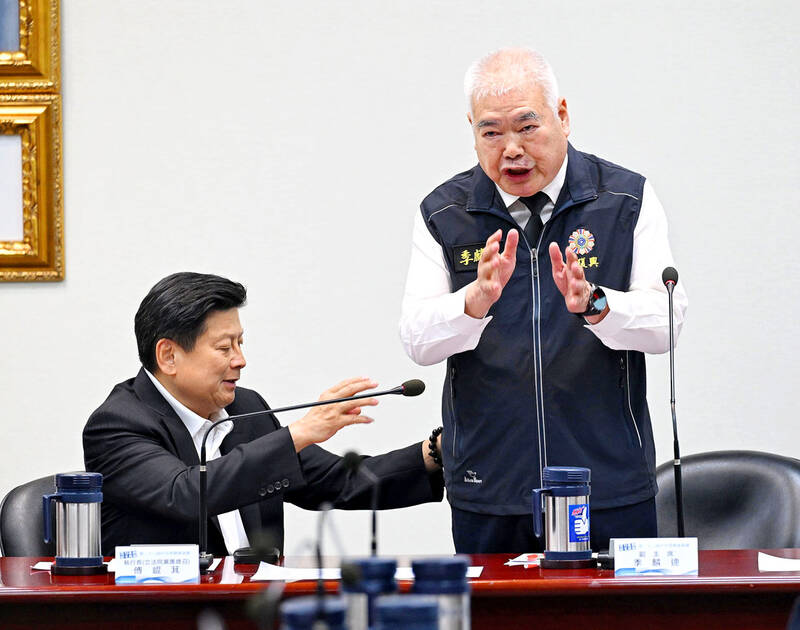
Photo: Chang Chia-ming, Taipei Times
Sitting next to him were Cheng and Fu, and though Chi no doubt thought he was trying to help their cause, their aghast expressions showed they were fully aware of the destruction Chi was causing. Fu gently tried to get Chi to sit down and stop speaking, but Chi was not to be deterred. After he finished, Cheng smiled nervously and tried to repair the damage, saying: “Although Chi Lin-lien’s words were a bit harsh, the party headquarters has had very positive communication with Han Kuo-yu, Hsu Chiao-hsin and all other legislators.”
DYNAMITE IN A FRACTURE
Chi’s comments went off like a bomb within the KMT, which was already deeply split over the special military budget, and in the midst of tense internal negotiations. For detailed background on this evolving story, see last Saturday’s column “Donovan’s Deep Dives: The battle over Taiwan’s defense spending” (page 12).
Han is a popular figure in the KMT and beloved by many. Constitutionally tasked with being the neutral arbiter attempting the Herculean task of trying to bring the party caucuses together to negotiate, he had only recently finally had a breakthrough in getting the caucuses back to the table, though each side remains far apart. This attack on Han was viewed as unfair and inappropriate.
The KMT is split between those who support the “380+N” plan and the “at least NT$800 billion” plan that is rumored to be the “bottom line” for the US. On talk shows, Cheng claims that the majority of the KMT caucus supports her plan because it is the most “reasonable.”
Many in the caucus disagree. Estimates vary, but most put the “800” camp outnumbering the “380+N” camp by two or three to one. The “800” camp also has the implicit or explicit backing of almost all the major KMT figures who have to face constituents. These include presumptive frontrunner to be the KMT’s presidential candidate in 2028, Taichung Mayor Lu Shiow-yen (盧秀燕), as well as the popular Taipei Mayor Chiang Wan-an (蔣萬安), New Taipei Mayor and the KMT’s 2024 presidential candidate Hou You-yi (侯友宜) and current Kaohsiung mayoral candidate Ko Chih-en (柯志恩).
Chi’s comments caused the internal tensions to boil over, with 2024 vice presidential candidate and media personality Jaw Shaw-kong (趙少康) leading the pushback. Soon, accusations between the two sides devolved to “running dogs for the CIA” and “running dogs for the Chinese Communist Party (CCP).”
It is true that some in the KMT caucus are more pro-American, but the CIA hardly needs to get involved. The Americans have been waging a blunt, public pressure campaign to get the budget passed, ideally the DPP’s NT$1.25 trillion version — but have dropped hints that the NT$800 billion might be acceptable.
However, many in the “800” camp are not so much “pro-American” as they are pro-getting elected. Polling consistently shows support for a larger special military budget, and they do not want to lose votes.
On the other side, it is very possible some are pro-CCP. Others, however, are hardline KMTers and ideologically support the “one China” framework, which is aligned with the CCP’s views.
Both Cheng and Fu appear to be going all out to fight for the “380+N” plan despite the opposition within the party and their legislative caucus.
Initially, both wanted no special military budget at all, but relented under pressure and presented the relatively small “380+N” plan.
CHENG’S STRATEGIC AGENDA
Strategically, Cheng needs to defeat the “800” plan.
Her mission is to negotiate a “peace framework” with the CCP that she can present to voters in 2028.
To accomplish that, she needs to convince the CCP to sign on to a plan. By choking off defense spending, she is sending a message to Beijing she is serious.
Additionally, passing a smaller budget would frustrate the Americans, who have been loudly demanding that “allies and partners” step up and pay their fair share on defense.
If she succeeds, the US could announce that it will not come to “ungrateful” Taiwan’s aid — why should it if the Taiwanese will not step up for their own defense?
This would further weaken Taiwanese confidence that the US would support Taiwan in a crisis. That insecurity will increase hopes among some voters in a peace settlement, which she hopes to offer. Additionally, the US may give up hope on defending Taiwan, and be more amenable to supporting a peace deal — something that may also appeal to US President Donald Trump personally.
As party chair, Cheng has some leverage over the KMT caucus, but it is not infinite. The “380+N” plan is already a compromise forced under pressure.
Mathematically, she needs the support of 57 lawmakers in the 113-member body. Since Chen Chao-ming (陳超明) has been readmitted to the party, the KMT has 53 seats.
One independent caucuses with the KMT, and the eight Taiwan People’s Party (TPP) lawmakers are in an alliance with the KMT, bringing their majority to 62. The TPP has been quiet, backing their own NT$400 billion plan. Theoretically, they could vote against the final KMT proposal, but in the last couple of years have been staunchly loyal to the KMT.
There are examples of KMT lawmakers breaking ranks and voting with the other side. For example, seven joined the DPP in voting for marriage equality. It is rare, though; the party may argue before going to vote, but usually the caucus sticks together.
This issue could be important enough for some lawmakers to consider defying Cheng. If six break ranks, Cheng’s plan is doomed and her authority could crumble.
Lawmakers are already under a pressure campaign to toe the party line, including from Huang Fuhsing supporters.
Cheng can also threaten those who are running for office this year by withdrawing funding and support, but that could easily backfire if they then run as independents.
She could threaten to set in motion the process to expel lawmakers from the party. Most could safely ignore that and turn independent, but the 13 party list lawmakers could lose their seats if successful.
Either way, she risks a split, which would be very damaging both to her and her party.
Cheng will continue her pressure campaign to win over opposition as long as she can, but ultimately she may have to bend and compromise. Negotiations are ongoing, so watch carefully how they play out.
This is turning into a crucial test of Cheng’s and Fu’s authority and party unity.
Donovan’s Deep Dives is a regular column by Courtney Donovan Smith (石東文) who writes in-depth analysis on everything about Taiwan’s political scene and geopolitics. Donovan is also the central Taiwan correspondent at ICRT FM100 Radio News, co-publisher of Compass Magazine, co-founder Taiwan Report (report.tw) and former chair of the Taichung American Chamber of Commerce. Follow him on X: @donovan_smith.

Ajay Verma, a consultant gastroenterologist at Kettering general hospital in Northamptonshire, says our gut is a “complex machine.” “It is constantly providing us with the nutrition we need, initially to grow and develop, and then for us to survive, thrive and repair from injury and illness.” How can we keep it functioning well? Put simply: “Make sure what you put into it is balanced, and that you clear out its waste products adequately,” Verma says. “In a general gastroenterology clinic, the most common conditions we see are irritable bowel syndrome (IBS), gastroesophageal reflux disease, inflammatory bowel disease and constipation,” says Nisha
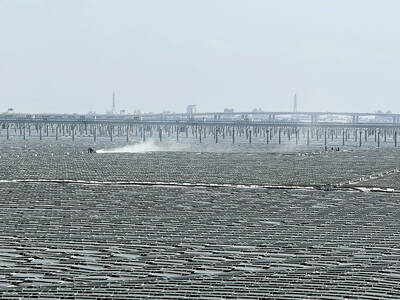
The arithmetic is straightforward and uncomfortable. By the end of 2025, Taiwan had committed itself to a 50-30-20 electricity mix — half natural gas, 30 per cent coal, 20 per cent renewables. The Ministry of Economic Affairs’s (MOEA) own monthly energy reports tell a different story. Natural gas reached 47.8 per cent of generation last year. Coal stood at 35.4 per cent, comfortably above its target ceiling. Renewables came in at 13.1 per cent, well short of the 20 per cent Taipei had pledged a decade earlier. Installed renewable capacity reached roughly half of the 12 gigawatts (GW) the government

Last week US President Donald Trump was asked by a reporter whether he would speak on the phone to the President of Taiwan. “l’ll speak to him. I speak to everybody. We have that situation very well in hand,” Trump said. This marked the second time in a couple of weeks he had said he would talk to the President of Taiwan. In 2016 he famously took a call from then-president Tsai Ing-wen (蔡英文), when he was president-elect. Despite warnings that the apocalypse was nigh because of a phone call, the world quickly forgot about the conversation between two democratically-elected presidents.

May 25 to May 31 Few believed that apples could be cultivated on a commercial scale in Taiwan’s high mountains. When horticulturalist Cheng Chao-hsiung (程兆熊) first proposed the idea in 1955, both American and Taiwanese colleagues dismissed it as implausible, arguing that temperate fruit could not be reliably grown on a subtropical island, especially on rugged terrain. However, it was this terrain in the Central Mountain Range where many Chinese Civil War veterans were resettled in the late 1950s. With limited job prospects and no family in Taiwan, they were placed on cooperative farms aimed toward self-sufficiency. Some say the conditions


 RSS
RSS