


Hulien County’s Fenglin Township (鳳林) has grown a reputation as a place where life moves slowly and people can catch their breath.
Rather than push against this rhythm, the town of around 10,000 has chosen to embrace it and make it part of its identity. Enter the snails.
Fenglin has been putting on snail races as a way to celebrate its focus on a slower, sustainable lifestyle that values healthcare, longevity and community connections while bringing in more tourists in the wake of a strong earthquake in 2024 that dampened travel in surrounding areas.
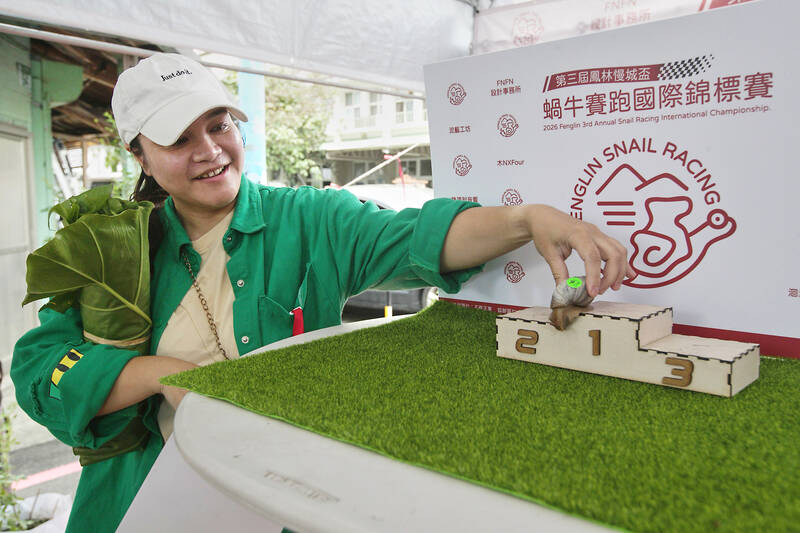
Photo: AP
“The earthquake two years ago had a relatively big impact on tourism because people are worried an earthquake may happen again,” said Hsu Lu, a 32-year-old resident. “Many people have left Hualien because of earthquakes,” Hsu said, referring to the surrounding county and the site of frequent quakes.
Snails are one way to bring tourists back, even if slowly.
QUALITY OF LIFE
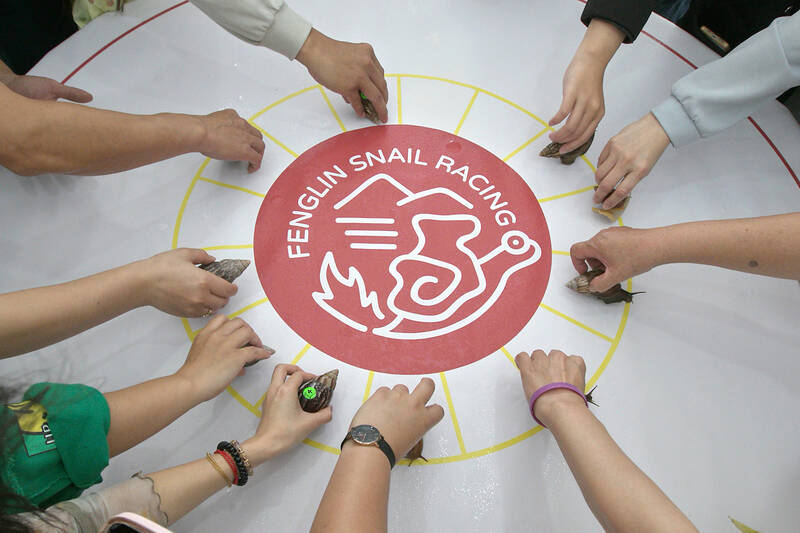
Photo: AP
Fenglin has associated itself with snails since 2014, when it joined the Cittaslow international network of small cities focused on quality of life and locally sourced foods. Cittaslow’s symbol is a snail carrying an assortment of buildings on its back.
The designation of a slow city seemed to fit Fenglin, whose population has shrunk threefold over the past few decades. Today, it is also an example of Taiwan’s “super-aged” society, with more than 20 percent of its residents older than 65.
To help reinvigorate local tourism after the April 2024 earthquake, which killed 19 people and injured more than 1,100, Fenglin residents decided to host a snail race the following month, said organizer Cheng Jen-shou.
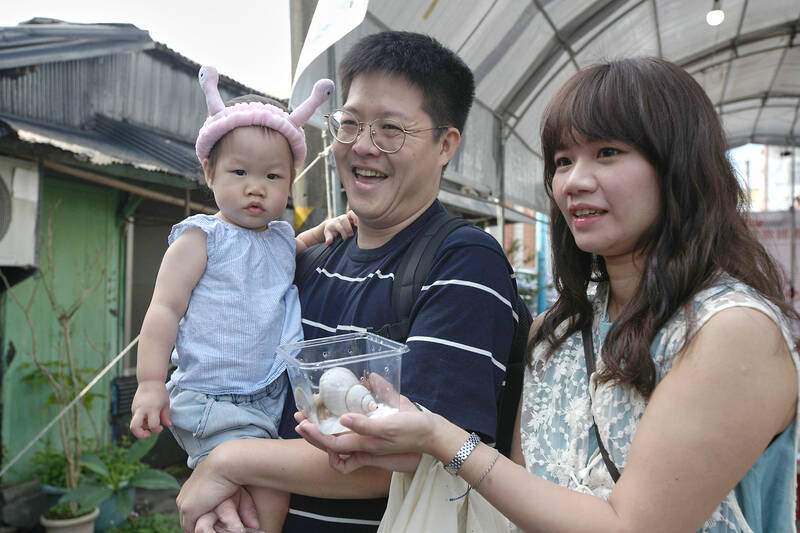
Photo: AP
“We thought that our event could attract people, and that would be a small help,” he said.
This year, the town held the third edition of the race over the weekend.
Several dozen enthusiastic residents and tourists attended the event, which featured six snail races spaced out over two days. The winners from each race competed in the final, but not before posing in front of their audiences while slowly being pulled on a piece of plywood across a green carpet as their fans cheered them on.
ATTRACTING TOURISTS
Li Cheng-wen, a 70-year-old retiree from Fenglin, brought several snails to the race. He caught them in his vegetable garden snacking on his leafy greens, and instead of killing them as some farmers do, he decided to raise them as pets, he said. He feeds them slices of bananas, papaya and vegetable leaves and showers them daily.
“As to the criteria for choosing snails for the race, I usually select those that are very active and pleasing to the eye,” Li said.
Kelvin Hong and Tiara Lin also brought a sightly snail to the race. The couple traveled all the way from the southern city of Kaohsiung, about a five-hour drive away, together with their 2-year-old daughter, Murphy, and their giant African snail, Aquaman.
The couple had signed up Aquaman for a previous race in 2024, but just as they were headed for Fenglin, Lin went into labor. Now the whole family returned to cheer on Aquaman.
BROTHER SNAIL, RECURRING CHAMPION
Despite being larger than most of its homegrown competitors — which had been picked out from local gardens or the side of the road — Aquaman was rather slow.
Once the race started, it and nine other snails were placed near the center of a round table covered with a thin vinyl sheet. The first to reach the edge of the table was crowned the winner.
The absolute champion was Guage, or Brother Snail. Its owner, 39-year-old Tanya Lin from Hualien, had been raising the snail since 2024, when it also won one race.
This year, Brother Snail crossed the 33-centimeter tablecloth in 3 minutes and 3 seconds. That performance earned it the top spot on a tiny stadium and a prize of organic sweet potato leaves.
SLOW-PACED LIFESTYLE
Besides the snail race, the local government has been trying to attract tourism by offering guided e-bike tours with stops at historic tobacco barns, Japanese colonial-era buildings and a Hakka-minority museum.
The idea of a slower pace of life was compelling enough to attract university students Annette Lin and Tanya Liu, who rode the train for about 30 minutes from Hualien on Saturday to check out the snail race and Fenglin’s slow vibes.
The friends found the competition unique and enjoyed Fenglin’s leisurely pace — but only as a respite from the busy city life.
“I think for travel or a trip, it’s a great choice,” Liu said. “But maybe living here would not really be my dream choice.”

Ajay Verma, a consultant gastroenterologist at Kettering general hospital in Northamptonshire, says our gut is a “complex machine.” “It is constantly providing us with the nutrition we need, initially to grow and develop, and then for us to survive, thrive and repair from injury and illness.” How can we keep it functioning well? Put simply: “Make sure what you put into it is balanced, and that you clear out its waste products adequately,” Verma says. “In a general gastroenterology clinic, the most common conditions we see are irritable bowel syndrome (IBS), gastroesophageal reflux disease, inflammatory bowel disease and constipation,” says Nisha
The arithmetic is straightforward and uncomfortable. By the end of 2025, Taiwan had committed itself to a 50-30-20 electricity mix — half natural gas, 30 per cent coal, 20 per cent renewables. The Ministry of Economic Affairs’s (MOEA) own monthly energy reports tell a different story. Natural gas reached 47.8 per cent of generation last year. Coal stood at 35.4 per cent, comfortably above its target ceiling. Renewables came in at 13.1 per cent, well short of the 20 per cent Taipei had pledged a decade earlier. Installed renewable capacity reached roughly half of the 12 gigawatts (GW) the government

Last week US President Donald Trump was asked by a reporter whether he would speak on the phone to the President of Taiwan. “l’ll speak to him. I speak to everybody. We have that situation very well in hand,” Trump said. This marked the second time in a couple of weeks he had said he would talk to the President of Taiwan. In 2016 he famously took a call from then-president Tsai Ing-wen (蔡英文), when he was president-elect. Despite warnings that the apocalypse was nigh because of a phone call, the world quickly forgot about the conversation between two democratically-elected presidents.
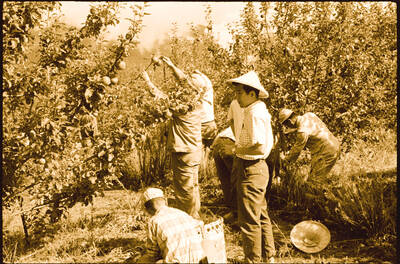
May 25 to May 31 Few believed that apples could be cultivated on a commercial scale in Taiwan’s high mountains. When horticulturalist Cheng Chao-hsiung (程兆熊) first proposed the idea in 1955, both American and Taiwanese colleagues dismissed it as implausible, arguing that temperate fruit could not be reliably grown on a subtropical island, especially on rugged terrain. However, it was this terrain in the Central Mountain Range where many Chinese Civil War veterans were resettled in the late 1950s. With limited job prospects and no family in Taiwan, they were placed on cooperative farms aimed toward self-sufficiency. Some say the conditions


 RSS
RSS