


Afforestation and reforestation have long been central to Taiwan’s environmental and climate policy. If the goals set under the “Afforestation 2.0” program launched late last year are met, the central government will spend at least NT$7.5 billion to incentivize tree-planting over the next half decade. At the same time, however, dismayed dendrophiles have denounced the authorities for allowing the felling of roadside trees and the clearing of low-elevation woodlands.
At two locations in Kaohsiung, hundreds of mature trees were recently felled, apparently to safeguard high-voltage power lines.
One of these places is a 3.5km-long strip of land beside Provincial Highway 29 in Daliao District (大寮). Trucks going to and from Hofa Industrial Park (和發工業區), which is just west of the road, account for much of the traffic. The Kaoping River (高屏溪) flows within a few hundred meters of the highway, and the verge where the felling is taking place is under the jurisdiction of the Seventh River Management Branch of the Water Resources Agency, part of the Ministry of Economic Affairs.
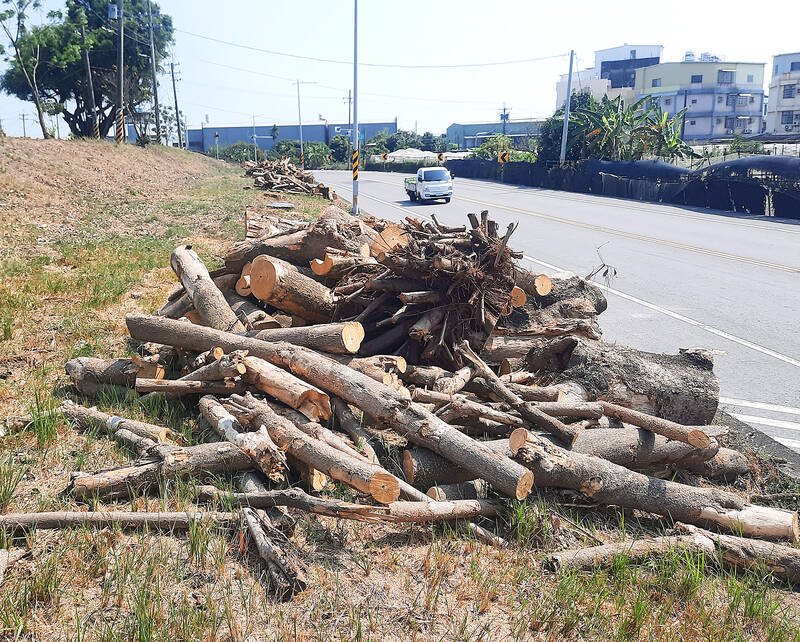
Photo: Steven Crook
Addressing what it calls “ecological controversies due to tree felling,” a Feb. 3 press release published on the Web site of the Ministry of Transportation and Communications’ Highway Bureau notes that the trees in question — as well as those on a 900m-long plot adjacent to Provincial Highway 3 in Cishan District (旗山) — are located beside Taiwan Power Co (Taipower) transmission poles, and that, “during typhoons, broken branches have affected high-voltage power lines and traffic safety.”
The Cishan site is owned by the state-run Taiwan Sugar Co (Taisugar), which in the past three decades has launched afforestation projects on many of its former plantations. One aspect of this push to increase Taiwan’s tree cover is the Environmental Protection Forest Avenue Project (環保林園大道計畫), which led to the planting of around 150,000 trees, mainly in the counties of Yunlin, Chiayi and Pingtung, and in the cities of Tainan and Kaohsiung.
A self-congratulatory press release (Oct. 3, 2019) from the Environmental Protection Administration (now the Ministry of the Environment) reads: “Most of these trees have now matured into shady forests. After 20 years, the project has yielded fruitful results, with beautiful trees forming green corridors that enhance roadside scenery. These forests not only purify the air but also serve as habitats for various birds and insects, providing excellent places for recreation.”
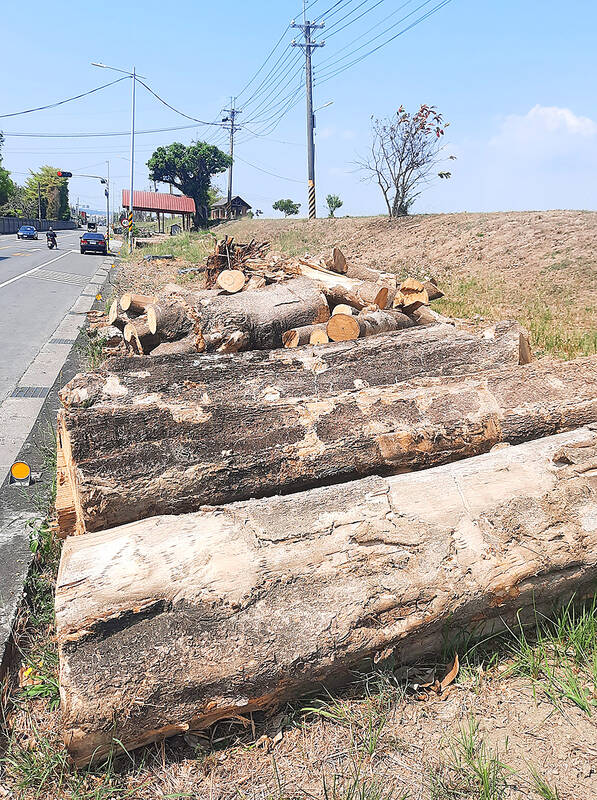
Photo: Steven Crook
According to media reports, many of those living near Taisugar’s Shoujinliao Farm (手巾寮農場) reacted to the clearing of part of an Environmental Protection Forest Avenue with outrage or disappointment, saying it was begun without prior explanation or communication. Neither ecological assessments nor justification for the sudden action were given, they complained. Over the years, regular pruning had ensured that the trees didn’t interfere with traffic or power lines, locals said.
Among those who protested the cutting was the Democratic Progressive Party’s Chiu Yi-ying (邱議瑩), whose legislative constituency includes Cishan.
ARBOREAL SLAUGHTER
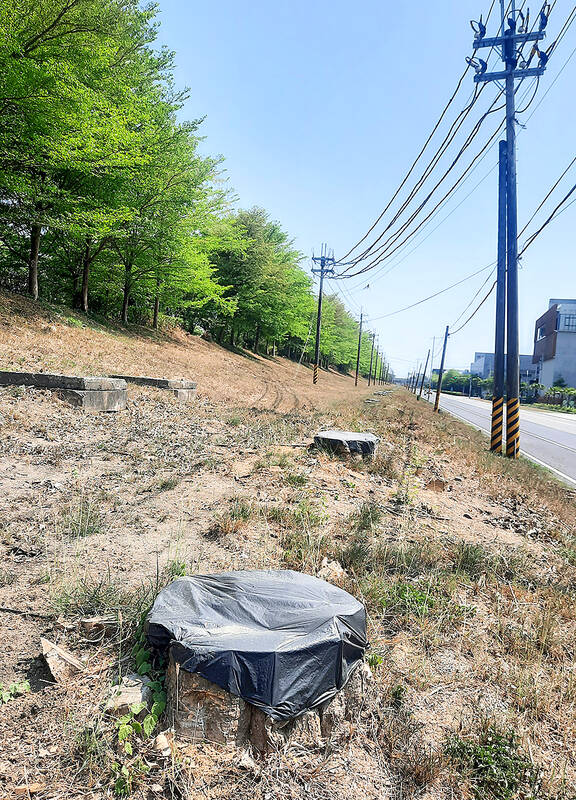
Photo: Steven Crook
The extent of the woodland clearance at Cishan was significantly greater than originally intended, it seems. On Feb. 3, Taiwan-based digital news outlet All Life News (全民生活資訊網) quoted a senior Taisugar manager as saying the initial plan called for removing the first row of trees only, but the on-site supervisor found there wasn’t enough space to work in and that branches could still affect the high-voltage cables, so it was expanded to include the second row. Then, because the site was still too cramped for their machinery, the contractors also chopped down the third row.
“The entire process was not proactively reported in advance, nor was it explained to senior management in a timely manner,” the report states.
The same manager also offered an apology on behalf of Taisugar, saying the failure to coordinate with the local community beforehand was a serious oversight.
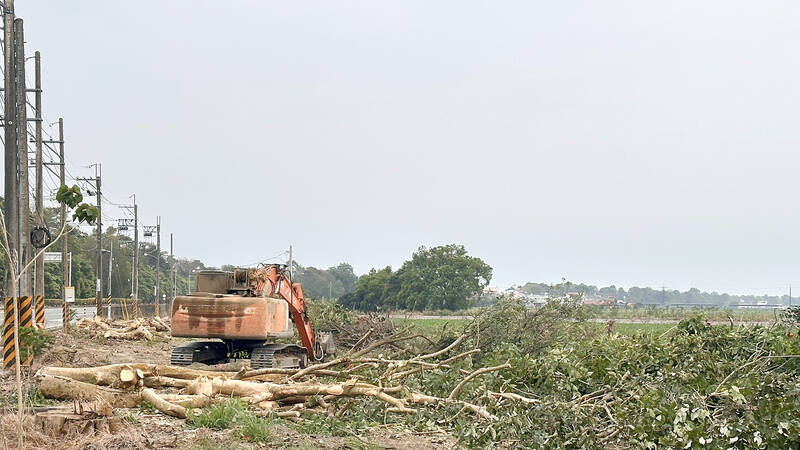
Photo courtesy of reader
Those involved in the Cishan case possibly lacked the skills or equipment to carry out a limited felling. Maybe they were under time pressure; clear-cutting is always quicker than working around mature growth. Perhaps they didn’t care enough to pause and seek an alternative solution. (Taisugar did not respond to questions e-mailed by the Taipei Times.)
According to Forest City Association, Taiwan (森林城市協會), a Kaohsiung-based NGO, “pruning, plus securing trees with steel cables to prevent them from falling,” should be enough to protect power cables in the vicinity. The association is currently campaigning to save pockets of woodland around the shuttered sugar refinery in Kaohsiung’s Ciatou District (橋頭).
Burying grid infrastructure is another option. This is expensive (the cost per km is often 12 times that of stringing wires between transmission towers) but Taiwan already has made considerable progress in this direction. As of the summer of last year, 47.6 percent of the country’s power lines were underground, with money set aside to accelerate the transition.
OVERSEAS LESSONS?
Stressing that he doesn’t know enough about the Cishan and Daliao cases to comment on the ecological impact of cutting down those trees, and that he’d want to talk to those making the decisions at those places before suggesting how things could have been done differently, Chiang Jyh-min (江智民) outlines his “ideal picture of what land managers should do.”
Entities as large as Taisugar or a city or county government, “should have regulations or a standard operating procedure for tree removal, and risk assessments need to be carried out by certified arborists,” says Chiang, a professor in the Department of Life Science at Tunghai University.
“Judging by media pictures [of the site in Cishan], many trees along an extensive corridor were removed. With work of that magnitude, there should be a public hearing for negotiation and to explain why cutting trees is the only solution,” he adds.
Contrasting what he thinks ought to happen with reality, Chiang laments that “in Taiwan, trees are often decapitated or cut overnight without any explanation. There are complaints, but then we just move on.”
He previously served as a member of Tunghai University’s Green Campus Committee, which would visit and assess any trees that campus management wanted to chop down. There are gaps in the system, however. “Last year, 40 mango trees were decapitated at the parking lot for the Affiliated Elementary School of Tunghai University. I think the school administration ordered the cutting, that’s why the university didn’t know. It was quite a scene; those mango trees lost their entire canopies. That parking lot serves the rich parents who send their kids to this private elementary school,” he recalls.
Chiang recalls that, during a recent visit to Tokyo, he saw “arborists in neat uniforms and helmets, measuring devices in hands, doing something for already-perfect trees. They really take it seriously. I certainly hope we can catch up with them.”
Steven Crook, the author or co-author of four books about Taiwan, has been following environmental issues since he arrived in the country in 1991. He drives a hybrid and carries his own chopsticks. The views expressed here are his own.
Ajay Verma, a consultant gastroenterologist at Kettering general hospital in Northamptonshire, says our gut is a “complex machine.” “It is constantly providing us with the nutrition we need, initially to grow and develop, and then for us to survive, thrive and repair from injury and illness.” How can we keep it functioning well? Put simply: “Make sure what you put into it is balanced, and that you clear out its waste products adequately,” Verma says. “In a general gastroenterology clinic, the most common conditions we see are irritable bowel syndrome (IBS), gastroesophageal reflux disease, inflammatory bowel disease and constipation,” says Nisha
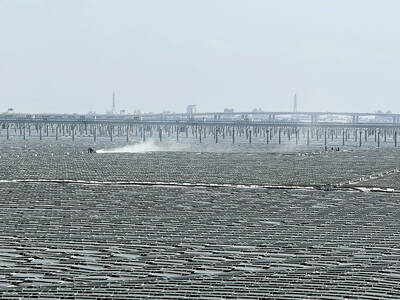
The arithmetic is straightforward and uncomfortable. By the end of 2025, Taiwan had committed itself to a 50-30-20 electricity mix — half natural gas, 30 per cent coal, 20 per cent renewables. The Ministry of Economic Affairs’s (MOEA) own monthly energy reports tell a different story. Natural gas reached 47.8 per cent of generation last year. Coal stood at 35.4 per cent, comfortably above its target ceiling. Renewables came in at 13.1 per cent, well short of the 20 per cent Taipei had pledged a decade earlier. Installed renewable capacity reached roughly half of the 12 gigawatts (GW) the government

Last week US President Donald Trump was asked by a reporter whether he would speak on the phone to the President of Taiwan. “l’ll speak to him. I speak to everybody. We have that situation very well in hand,” Trump said. This marked the second time in a couple of weeks he had said he would talk to the President of Taiwan. In 2016 he famously took a call from then-president Tsai Ing-wen (蔡英文), when he was president-elect. Despite warnings that the apocalypse was nigh because of a phone call, the world quickly forgot about the conversation between two democratically-elected presidents.
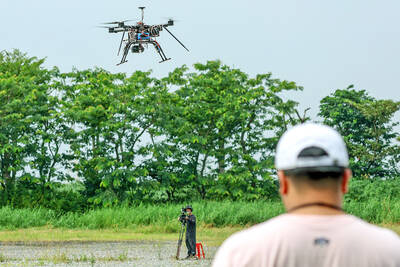
Taiwan’s drone exports are taking off, fuelled by the war in Ukraine, as Taiwanese companies seek a stake in the fast-growing global market for unmanned aerial vehicles (UAV). Low-cost drones used for reconnaissance and strikes are in high demand as governments around the world boost defense spending in the face of intensifying conflicts. A relative new player in the increasingly competitive industry, Taiwan’s pitch is to be an “Asian hub” for the production of UAVs and components free of Chinese materials, or “non-red.” That means its UAVs can be up to three times more expensive than their Chinese competitors, like the world’s biggest


 RSS
RSS