


Last week saw Ko Wen-je (柯文哲), former Taipei mayor and founder of the Taiwan People’s Party (TPP), receive a 17-year sentence for crimes involving political corruption. This was only the opening round: the case is likely to drag on for several more years in appeals.
Both the TPP and the Chinese Nationalist Party (KMT) are claiming that the prosecutors are engaging in a political witch hunt, green terror, fascism and so forth. It is easy to see this as a kind of compensation. After all, otherwise they would have to admit that the rather impressive collection of evidence against Ko actually meant something. But it is also an old theme, and one with particular functions and targets.
It is standard operating procedure for KMT targets of investigation to claim the prosecutors are working for the ruling Democratic Progressive Party (DPP). Former president Ma Ying-jeou (馬英九), under investigation for corruption for the umpteenth time, last year blamed the DPP, saying it was in cahoots with the prosecutors and the media, for his troubles. He was found innocent.
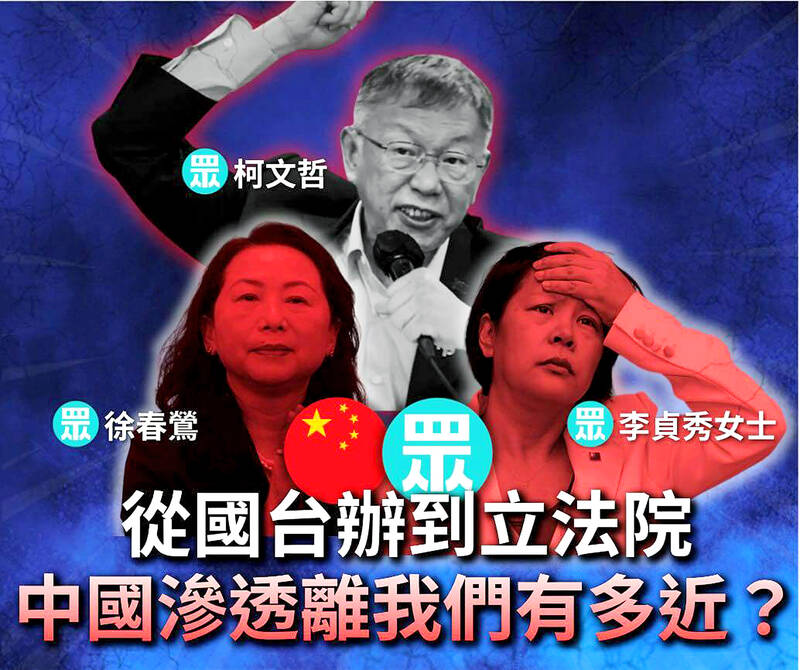
Illustration: Courtesy of DPP caucus secretary-general Chen Pei-yu
Former KMT legislator Alex Tsai (蔡正元), also charged in that same case (which involved selling companies at below-market value) was not as lucky as Ma. He began serving his sentence last week, also claiming to be a victim of political persecution, and comparing himself to Ko. In the run-up to the 2024 election Ko had made a public appearance with Tsai, and Chiu Yi (邱毅), both far-right pro-China stalwarts.
In 2017 prosecutors raided the headquarters of the New Party while investigating an espionage case. The New Party was a far-right KMT spin-off. New Party officials complained of “green terror” and said it was politics. Ma Ying-jeou said it was fascism. As I remarked at the time, an admirer of one dictator and servant of another, Ma probably knows a bit about fascism.
Similarly in 2016, when the Tsai Ing-wen (蔡英文) administration and the DPP-controlled legislature were working on drafts of the transitional justice act, Alex Tsai accused the DPP of initiating “green terror.”
Photo: TT file photo
The DPP in 2007 introduced a draft “Special Law on the Determination of Responsibility for Government Illegalities during the February 28th Incident (of 1947) and the Martial Law Period,” one KMT lawmaker declaimed that the “green terror” of seven and half years of DPP governance was “over 10 times worse” than the KMT’s “white terror.” That was when the KMT controlled the legislature.
These comments have two functions. As with any cult, one function of obvious reality-denying assertions is to signal the speaker’s devotion to the cult and its leaders. People who utter things like “green terror!” know perfectly well there is no such thing. They are simply showing their commitment to the KMT’s views.
AD NAUSEAM
More importantly, the attacks on the prosecutors, habitual for the last two decades with KMT officials and lawmakers under investigation are also a component of the KMT’s efforts to render governance by the DPP illegitimate. Propaganda, in order to be effective, need not be much related to reality, but it must be repeated. Hence, for two decades that has been the official line.
Last week also saw important revelations of how rule of law and pro-Taiwan governance were under attack by the pro-China parties. Prosecutors indicted Chinese immigrant spouse Xu Chunying (徐春鶯) with helping Beijing interfere in elections. Xu is close to the TPP, which once offered her a party list legislator nomination. The New Taipei City Prosecutor’s office said in the indictment that Xu, despite being a legal resident, had remained loyal to China and had spied on local immigrant communities and meddled in elections on Beijing’s behalf. Prosecutors charged her with violations of the Anti-Infiltration Act (反滲透法) and the Banking Act (銀行法), along with fraud and forgery.
According to media reports, Xu had moved over to the TPP from the KMT, since she felt the latter did not support Chinese spouses and would not nominate one for the legislature. She campaigned for TPP candidates, according to prosecutors, at the orders of Beijing.
The offer to Xu shows that the TPP’s goal was to get a citizen of the People’s Republic of China (PRC) into the legislature, not to put a particular person into the legislature. When Xu turned them down, the TPP instead appointed Chinese citizen Li Zhenxiu (李貞秀), leading to the mess currently underway in the legislature, where a foreign national with dual citizenship now sits, apparently a gross violation of the constitution and the law. DPP officials and lawmakers are refusing to interact with her in the legislature because she is so obviously an illegal appointment.
The appointment of a PRC national was deliberate, the obvious intent is to cause chaos. If the Constitutional Court strikes down her appointment, the TPP and KMT will claim — what else? — the DPP is engaging in authoritarianism. If the Court recognizes her appointment, the ramifications of that will be far-reaching, effectively a ruling that PRC citizens are ROC citizens as well, and perhaps that dual nationals can not only exist, but hold seats in the legislature. A win-win situation for the pro-China parties.
The offer to Xu also raises another question: how much did TPP officials know about her alleged connections to Beijing when they asked her to become a legislator? Consider: prosecutors alleged that Xu had been suborned on trips to the PRC, which TPP officials must have known about when they vetted her. According to the indictment, Xu arranged for Sun Xian (孫憲), an official of the Shanghai branch of the Revolutionary Committee of the Chinese Kuomintang, to enter Taiwan in October last year, providing false itineraries and false information to hide Sun’s real identity, and meet KMT Vice Chairman Chi Lin-lien (季麟連), and TPP official Lee Wei-hua (李偉華), among others.
If the prosecutors are right, Xu had to tell the TPP officials who he really was, otherwise why would they bother to meet him? She had to have revealed that his identity was a secret that she knew. It is hard to imagine how any TPP or KMT official meeting with Sun would not then have known that Xu was working on behalf of Beijing. When she revealed Sun’s true identity, she revealed her own.
The TPP knew it was appointing a PRC citizen when it sought out Xu for a legislative seat. The question is: did they want her in that position not only because she was a PRC citizen, but also because she was a PRC agent?
What did they know, and when did they know it?
Notes from Central Taiwan is a column written by long-term resident Michael Turton, who provides incisive commentary informed by three decades of living in and writing about his adoptive country. The views expressed here are his own.

Just after 6am, I walked up to the ticket gate at Taipei Main Station and entered the Taiwan Railway platform without scanning any ticket; instead, I flashed the Sanrio Fun Rail pass on my phone to the gate worker and was admitted. I found my train and prepared to board. My destination? This very same station. I was embarking on a 13-hour journey on one of two round-the-island trains operated by ezTravel. They run each day, one counterclockwise around the island and one clockwise. They differ in a number of ways from an ordinary Taiwan Railway train and can make for
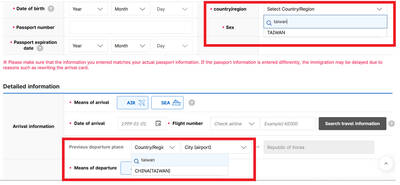
Jason Han says that the e-arrival card spat between South Korea and Taiwan shows that Seoul is signaling adherence to its “one-China” policy, while Taiwan’s response reflects a reciprocal approach. “Attempts to alter the diplomatic status quo often lead to tit-for-tat responses,” the analyst on international affairs tells the Taipei Times, adding that Taiwan may become more cautious in its dealings with South Korea going forward. Taipei has called on Seoul to correct its electronic entry system, which currently lists Taiwan as “China (Taiwan),” warning that reciprocal measures may follow if the wording is not changed before March 31. As of yesterday,

The Portuguese never established a presence on Taiwan, but they must have traded with the indigenous people because later traders reported that the locals referred to parts of deer using Portuguese words. What goods might the Portuguese have offered their indigenous trade partners? Among them must have been slaves, for the Portuguese dealt slaves across Asia. Though we often speak of “Portuguese” ships, imagining them as picturesque vessels manned by pointy-bearded Iberians, in Asia Portuguese shipping between local destinations was crewed by Asian seamen, with a handful of white or Eurasian officers. “Even the great carracks of 1,000-2,000 tons which plied

On Thursday, former Taipei mayor and founder of the Taiwan People’s Party (TPP) Ko Wen-je (柯文哲) was sentenced to 17 years in prison and had his civil rights suspended for six years over corruption, embezzlement and other charges. Seven others related to the case were also handed prison sentences, while two were found not guilty. It has been a bad week for the TPP. On Tuesday, prosecutors charged Chinese immigrant Xu Chunying (徐春鶯) with suspicion of taking part in Beijing-directed election interference. Xu has strong links to the TPP, which once offered her a party list legislator nomination. Tuesday also


 RSS
RSS