


Jason Han says that the e-arrival card spat between South Korea and Taiwan shows that Seoul is signaling adherence to its “one-China” policy, while Taiwan’s response reflects a reciprocal approach.
“Attempts to alter the diplomatic status quo often lead to tit-for-tat responses,” the analyst on international affairs tells the Taipei Times, adding that Taiwan may become more cautious in its dealings with South Korea going forward.
Taipei has called on Seoul to correct its electronic entry system, which currently lists Taiwan as “China (Taiwan),” warning that reciprocal measures may follow if the wording is not changed before March 31. As of yesterday, South Korea’s foreign ministry has yet to do so. The e-arrival card system fully replaced paper forms in December last year. When filling out the paper arrival cards, Taiwanese would typically fill out “Taiwan” as their home country. With the digital system, Taiwanese are now forced to choose “China (Taiwan)”.
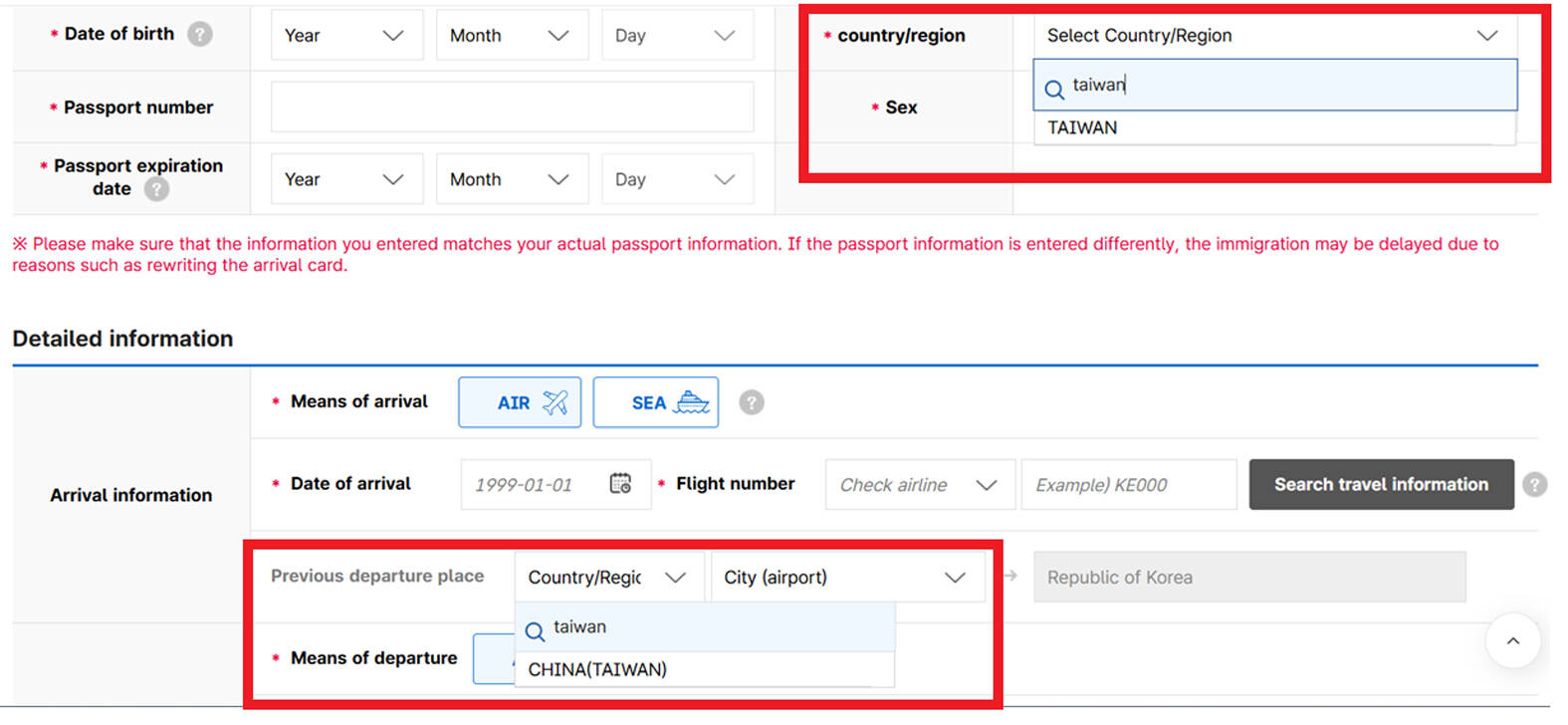
Photo: Don Huh
A Taipei Times review yesterday found inconsistencies in the e-arrival card system: while the nationality field for individual travelers is listed as “Taiwan,” other fields — including “previous departure place” — continue to display “China (Taiwan).”
Group and agency applications also retain the same “China (Taiwan)” designation.
The government has responded with a series of measures, including adjusting how South Korean nationals are labeled in its own systems and signaling further changes if no response is received by the end of the month.
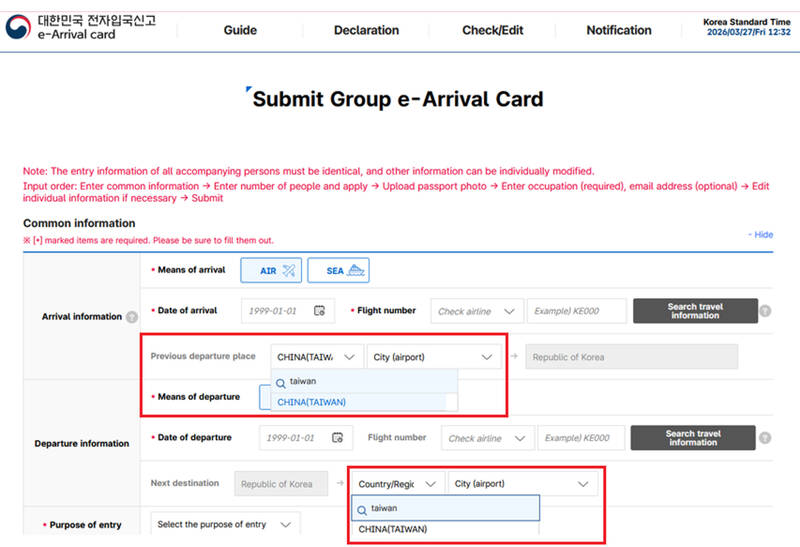
Photo: Don Huh
INTEREST FROM ANTI-CHINA SUPPORTERS
Media coverage in South Korea has run along political lines.
The Dong-A Ilbo, a conservative, pro-opposition party and anti-China newspaper, reported on the issue at least five times, with reader comments often criticizing the government for being too cautious in its China policy.
One widely liked comment on March 18 suggested that Taiwan should start referring to South Korea as “South Joson” (南朝鮮), a designation primarily used by North Korea until recently. It was also used by China before 1992, but was dropped after a diplomatic detente between Seoul and Beijing, which saw the former break ties with Taipei in favor of the latter.
Meanwhile, the Kyunghyang Shinmun, generally seen as more progressive, pro-government and pro-China, reported on the issue only once after Taiwan’s announcement. The article drew limited engagement, with relatively few comments and minimal interaction, suggesting the issue has not gained widespread attention among its readership.
‘SOUTH KOREA’ ALREADY WIDELY ACCEPTED
Discussions on major Korean online forums reflect a similar pattern, with many users describing Taiwan’s countermeasures as having limited practical impact. Some noted that “South Korea” is already the widely accepted international term, viewing Taiwan’s move as largely symbolic.
Han says the move is unlikely to provoke a strong response from either the South Korean government or the general public.
However, he said some in South Korea’s intellectual class may interpret the issue through a broader regional lens.
“They know Taiwan is Japan’s lifeline. Therefore, they may see this as part of wider tensions involving Taiwan, Japan and the US, rather than a bilateral issue alone,” he said.
THE MOVE IS UNNECCSARY
Han Ki-beom, a researcher at the Asan Institute for Policy Studies, said formally adopting “China (Taiwan)” in entry systems would mark a departure from established practice.
“Given that Taiwan is already dissatisfied, there is no need to escalate the issue further,” Han Ki-beom said.
He added that ties between Taiwan and South Korea have not deteriorated, and from the perspective of South Korean citizens, such a move would be unnecessary.
Lee Jae-choon, South Korea’s former ambassador to the European Union and Russia, described the 1992 break in diplomatic relations with Taiwan as the result of poorly managed diplomacy by South Korea but acknowledged that unofficial exchanges have grown in the years since.
Lee criticized South Korea’s hesitant participation in international operations like those in the Strait of Hormuz, linking it to broader concerns about offending China.
“The current dispute is unfortunate given the overall improvement in ties,” Lee said, “Taiwan’s protest is ‘legitimate’.”
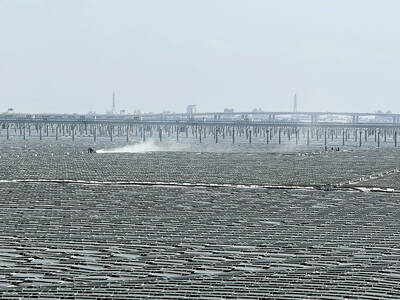
The arithmetic is straightforward and uncomfortable. By the end of 2025, Taiwan had committed itself to a 50-30-20 electricity mix — half natural gas, 30 per cent coal, 20 per cent renewables. The Ministry of Economic Affairs’s (MOEA) own monthly energy reports tell a different story. Natural gas reached 47.8 per cent of generation last year. Coal stood at 35.4 per cent, comfortably above its target ceiling. Renewables came in at 13.1 per cent, well short of the 20 per cent Taipei had pledged a decade earlier. Installed renewable capacity reached roughly half of the 12 gigawatts (GW) the government
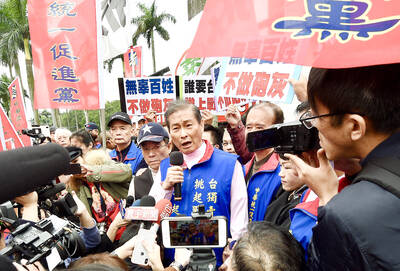
There are shadowy cabals plotting to sell out Taiwan to be annexed by China, by invasion if necessary. Fortunately, they are buffoons. In 2019, former Bamboo Union gangster and founder of the China Unification Promotion Party (CUPP), Chang An-le (張安樂, colorfully known as “White Wolf”), led a protest at the Legislative Yuan against comments made by then-premier Su Tseng-chang (蘇貞昌) that in the event of an attack by China, he would never surrender, but would protect the nation by fighting to the end, even if he only had a broom. Chang had party members bring a wooden casket that they
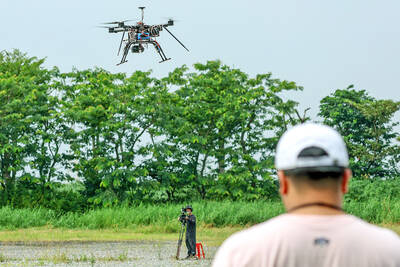
Taiwan’s drone exports are taking off, fuelled by the war in Ukraine, as Taiwanese companies seek a stake in the fast-growing global market for unmanned aerial vehicles (UAV). Low-cost drones used for reconnaissance and strikes are in high demand as governments around the world boost defense spending in the face of intensifying conflicts. A relative new player in the increasingly competitive industry, Taiwan’s pitch is to be an “Asian hub” for the production of UAVs and components free of Chinese materials, or “non-red.” That means its UAVs can be up to three times more expensive than their Chinese competitors, like the world’s biggest
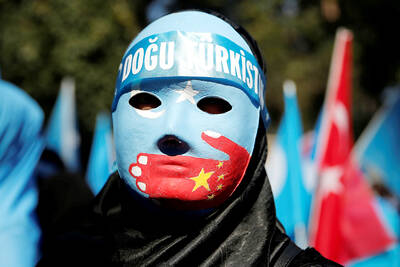
It seems every few days one bumps into one of those “real man” comments in which Taiwan is urged to “face reality” or similar, and “make a deal,” with the speaker implying that soon it will be too late. “Deal” advocates always present themselves as having a superior grip on reality, and the manly ability to make the “hard choice.” Their testosterone-laden language often echoes that of Taiwan sellout advocates. Note that such commentary always specifies a process (“make a deal, work with, make progress”), never the end state of what occupation by a violent authoritarian colonialist state will entail. In


 RSS
RSS