


On Thursday, former Taipei mayor and founder of the Taiwan People’s Party (TPP) Ko Wen-je (柯文哲) was sentenced to 17 years in prison and had his civil rights suspended for six years over corruption, embezzlement and other charges. Seven others related to the case were also handed prison sentences, while two were found not guilty.
It has been a bad week for the TPP.
On Tuesday, prosecutors charged Chinese immigrant Xu Chunying (徐春鶯) with suspicion of taking part in Beijing-directed election interference. Xu has strong links to the TPP, which once offered her a party list legislator nomination.
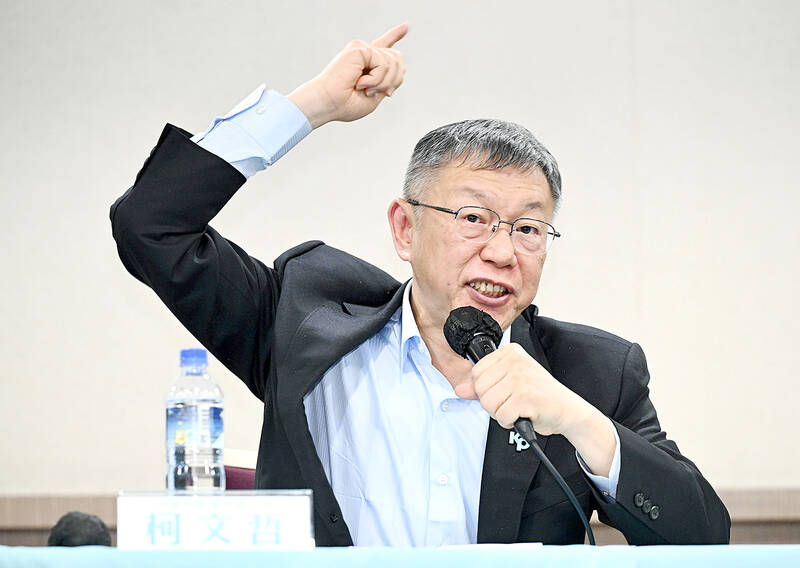
Photo: Lo Pei-der, Taipei Times
Tuesday also saw the release of a Taiwan Public Opinion Survey poll showing that about 70 percent of respondents said Chinese-born TPP Legislator Li Zhenxiu (李貞秀) was not eligible to serve as a legislator, including among 40.7 percent of TPP supporters.
On Monday, Li alleged that she had learned while attending court hearings that Hsinchu Mayor Ann Kao (高虹安) had received NT$7 million from Ko, though she has since walked that back and apologized, saying she had misunderstood.
Looming in the background are allegations that current TPP Chairman Huang Kuo-chang (黃國昌) hired a team of journalists to form a “paparazzi squad” to spy on political opponents. Prosecutors sniffed around the case, but it is unclear if they intend to follow up with formal charges.
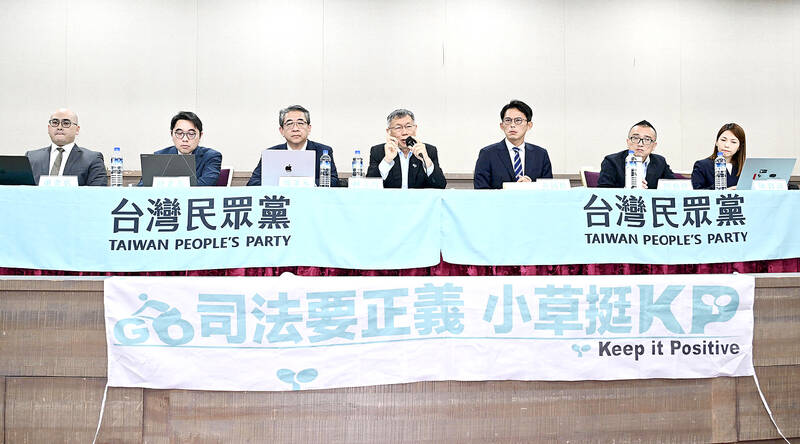
Photo: Lo Pei-der, Taipei Times
HOW THE TPP DEFIED GRAVITY
What are the political implications of all this during an election year? That is unclear; we are in uncharted territory.
By the rules of a bygone era of Taiwan politics that lasted into the beginning of this decade, the TPP should have been doomed already. The New Power Party (NPP) that Huang co-founded had many problems, but their collapse into irrelevance accelerated with the indictment of then-party chairman Hsu Yung-ming (徐永明) on corruption charges in 2020 and his subsequent sentencing in 2022.
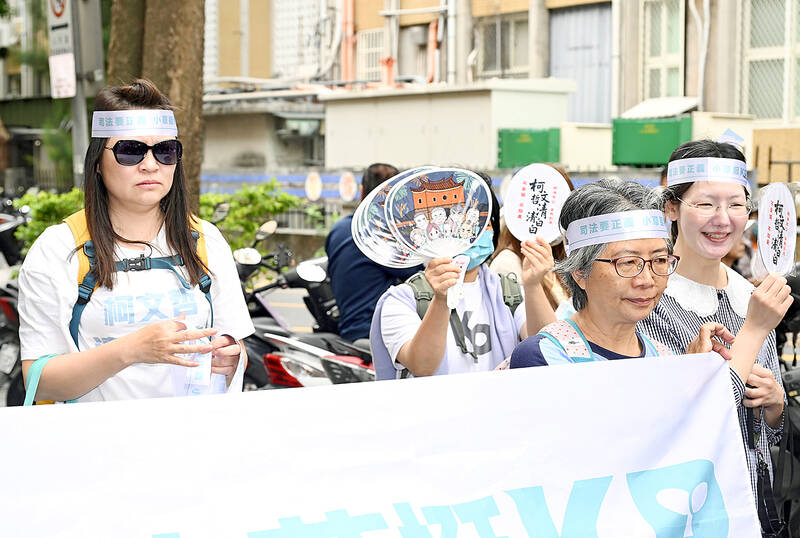
Photo: Lo Pei-der, Taipei Times
That Ko does not keep promises (despite a key presidential campaign slogan “keep promise”), plays fast and loose with the rules and was out to enrich himself has been known and publicly acknowledged since August 2024 — prior to his arrest on corruption charges in September.
The party was forced to apologize for filing false financial reports for his presidential campaign, and Ko stepped back from his duties as party chair to take responsibility. Illegally pocketing funds from the campaign was included in Thursday’s conviction, though the majority of his sentence is for corruption during his time as mayor.
Though not illegal, he and his wife also spent about NT$43 million (US$1.35 million at the time) from public subsidies from his campaign to purchase office property for himself in downtown Taipei. His party had earlier promised to use those funds as all other presidential candidates across party lines had done; to bolster democracy to support their parties and give to charity.
After his arrest on corruption charges, unlike the NPP, the TPP did not hang their heads in shame and humiliation — they chose defiance, despite it already being obvious that Ko was not the paragon of virtue he presented himself to be.
They claimed that President William Lai (賴清德) and his ruling Democratic Progressive Party (DPP) were “weaponizing the judiciary” to “hunt down and kill” political opponents. They likened Ko to Nelson Mandela, Jesus and bodhisattvas, claiming him as a “martyr for democracy.”
To be sure, some of the TPP’s claims have merit. The amount of leaks coming from people in or near the prosecution was shocking, and as far as is known, they did nothing to investigate or stop it. This is horribly unprofessional at best, malicious at worst.
It is unclear what the motivations of the leaker or leakers were, but it is not a stretch to suspect a political agenda — though other possibilities, such as personal aggrandizement, grudges or money could have been behind it.
The prosecutors also jailed and held Ko incommunicado for an entire year, despite not yet having been convicted of any crimes, which is illegal in most countries for non-violent suspects. Though legal in Taiwan’s system, this was excessive even by local standards, though not unprecedented.
Accusing the president of weaponizing the judiciary is also not unprecedented. Former President Ma Ying-jeou (馬英九) was suspected of interfering in the corruption trial and subsequent (mis)treatment of his predecessor Chen Shui-bian (陳水扁) while in jail, though this was never proven. Ironically, for many people, Ko first became known for his medical assessment of Chen’s condition, and his support for Chen’s release on medical parole.
Ma was also accused of using the Special Investigation Division to spy on political opponents, and was found guilty by the High Court, but was exonerated on appeal.
However, the case against Lai’s involvement is weak for two reasons. One is that the facts suggest this is a legitimate case. Others involved in the case fled or attempted to flee, and there were confessions.
It also makes little sense politically for Lai to risk his entire presidency on persecuting Ko, who conveniently split the vote in the 2024 presidential race, ensuring Lai’s victory — and could have done so again in 2028. This case started long before the currently tight-knit relationship between the TPP and the Chinese Nationalist Party (KMT) was formed.
Of course, it cannot be entirely ruled out. After all, Richard Nixon ruined his presidency over a botched burglary of his political opponents’ office at the Watergate complex. Still, if Lai were really this foolish, why would he target Ko when there are far more powerful, challenging figures he could have gone after, like Taichung Mayor Lu Shiow-yen (盧秀燕) of the KMT?
Regardless, the TPP’s campaign of defiance worked politically. Prior to August 2024, the TPP’s favorability in Formosa polling had been in the mid-to-low 30s, but cratered following his arrest to the low 20s.
Yet, over time, the TPP recovered most or all of that lost ground. However, unfavorability ratings have remained high.
WHAT TO WATCH
What happens next will be fascinating to watch.
In the next couple of weeks, we can expect a flood of polling, and they will likely show a dip in support for the party. However, will that hold or bounce back over time, as it did after Ko’s initial arrest?
Or will the cumulative weight of the various scandals sink the party permanently? It is too early to say.
The partnership with the KMT in the legislature will almost certainly hold; the KMT needs them to maintain a majority. But will cooperation break down elsewhere?
In a KMT press release, they stated: “When a ruling carries the potential to end the political career of a major opposition leader, the public has every right to question whether systemic imbalance exists.” The press release was carefully worded to show support for Ko, but fell short of saying he was innocent.
Huang has called for a rally on Sunday. Will the KMT join the rally officially, unofficially by individuals or keep away entirely?
According to existing law, Ko has effectively no hope of running for president again. To change that would require changing the law, which the KMT and TPP have the majority to bring about.
It is hard to see the KMT getting on board with that. It would risk Ko splitting the ticket again, and would project the image that they find convicted felons running for president acceptable.
If the TPP shows signs of cratering in the polls permanently, will the KMT break away from their alliance in November’s local elections? Will they embark on a campaign to poach whatever talent from the TPP they can get their hands on and absorb the party, as they did with all formerly allied parties?
So many questions, but as yet, few answers.
Donovan’s Deep Dives is a regular column by Courtney Donovan Smith (石東文) who writes in-depth analysis on everything about Taiwan’s political scene and geopolitics. Donovan is also the central Taiwan correspondent at ICRT FM100 Radio News, co-publisher of Compass Magazine, co-founder Taiwan Report (report.tw) and former chair of the Taichung American Chamber of Commerce. Follow him on X: @donovan_smith.
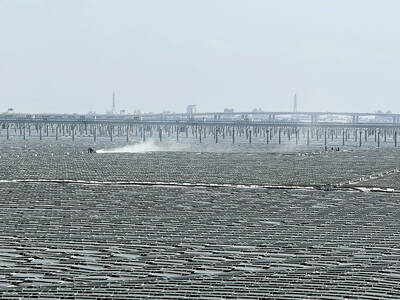
The arithmetic is straightforward and uncomfortable. By the end of 2025, Taiwan had committed itself to a 50-30-20 electricity mix — half natural gas, 30 per cent coal, 20 per cent renewables. The Ministry of Economic Affairs’s (MOEA) own monthly energy reports tell a different story. Natural gas reached 47.8 per cent of generation last year. Coal stood at 35.4 per cent, comfortably above its target ceiling. Renewables came in at 13.1 per cent, well short of the 20 per cent Taipei had pledged a decade earlier. Installed renewable capacity reached roughly half of the 12 gigawatts (GW) the government
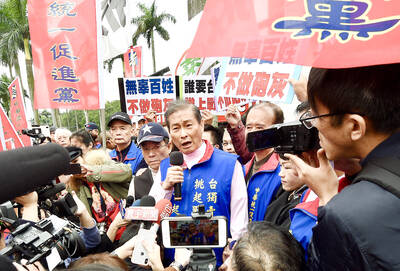
There are shadowy cabals plotting to sell out Taiwan to be annexed by China, by invasion if necessary. Fortunately, they are buffoons. In 2019, former Bamboo Union gangster and founder of the China Unification Promotion Party (CUPP), Chang An-le (張安樂, colorfully known as “White Wolf”), led a protest at the Legislative Yuan against comments made by then-premier Su Tseng-chang (蘇貞昌) that in the event of an attack by China, he would never surrender, but would protect the nation by fighting to the end, even if he only had a broom. Chang had party members bring a wooden casket that they
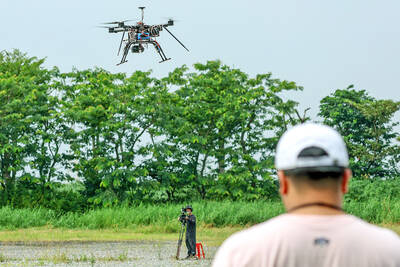
Taiwan’s drone exports are taking off, fuelled by the war in Ukraine, as Taiwanese companies seek a stake in the fast-growing global market for unmanned aerial vehicles (UAV). Low-cost drones used for reconnaissance and strikes are in high demand as governments around the world boost defense spending in the face of intensifying conflicts. A relative new player in the increasingly competitive industry, Taiwan’s pitch is to be an “Asian hub” for the production of UAVs and components free of Chinese materials, or “non-red.” That means its UAVs can be up to three times more expensive than their Chinese competitors, like the world’s biggest

It seems every few days one bumps into one of those “real man” comments in which Taiwan is urged to “face reality” or similar, and “make a deal,” with the speaker implying that soon it will be too late. “Deal” advocates always present themselves as having a superior grip on reality, and the manly ability to make the “hard choice.” Their testosterone-laden language often echoes that of Taiwan sellout advocates. Note that such commentary always specifies a process (“make a deal, work with, make progress”), never the end state of what occupation by a violent authoritarian colonialist state will entail. In


 RSS
RSS