


The nation’s fastest supercomputer, Nano 4 (晶創26), is scheduled to be launched in the third quarter, and would be used to train large language models in finance and national defense sectors, the National Center for High-Performance Computing (NCHC) said.
The supercomputer, which would operate at about 86.05 petaflops, is being tested at a new cloud computing center in the Southern Taiwan Science Park in Tainan. The exterior of the server cabinet features chip circuitry patterns overlaid with a map of Taiwan, highlighting the nation’s central position in the semiconductor industry.
The center also houses Taiwania 2, Taiwania 3, Forerunner 1 and Nano 5, which have a maximum combined computing power of 28.26 petaflops.
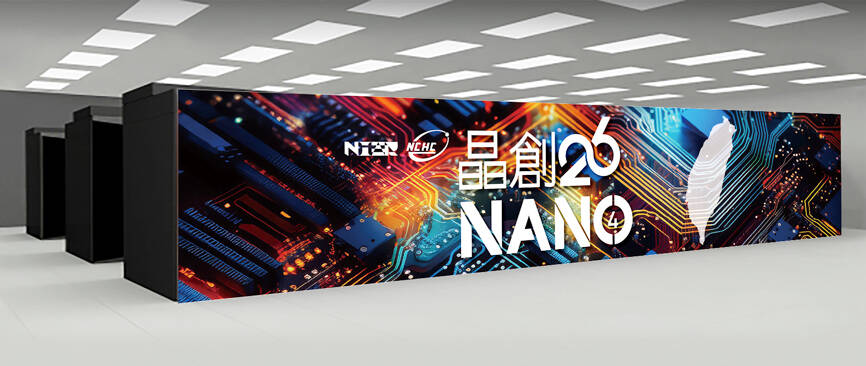
Photo courtesy of the National Center for High-Performance Computing
With the addition of Nano 4, the nation’s computing power would jump threefold to 114.31 petaflops.
The computing power buildup is part of the five-year Chip-based Industrial Innovation Program, which began in 2024.
Nano 4 ranks 29th globally according to the Top500 project, which ranks and details the 500 most powerful non-distributed computer systems.
Nano 4 has a dual-compute architecture, featuring 220 Nvidia H200 nodes, each equipped with eight H200 GPUs and 2TB of memory, the center said. The supercomputer is also the first in Taiwan to deploy Nvidia’s flagship artificial intelligence (AI) computing platform introduced last year — two GB200 NVL72 systems, each configured with 72 Blackwell GPUs and 13.5TB of memory.
NCHC director-general Chang Chau-lyan (張朝亮) said that H200 nodes are in charge of large-scale parallel scientific simulations and hybrid AI workloads, while GB200 systems are dedicated to ultra-large-scale AI training tasks.
The Korea Institute of Science and Technology Information and the National Supercomputing Center Singapore use Nvidia H-series chips and have reservations about Blackwell architecture, Chang said.
Taiwan, by contrast, adopted GB-series chips for its high efficiency to run AI applications.
Taiwan was slightly behind in building advanced computing power due to a limited budget, Chang said, adding that Nano 4 must provide the strong support that Taiwan needs to speed up AI development.
“We have high expectations for Nano 4 and hope that it would meet the urgent demand for AI computing power,” he said.
One-third of computing power generated by Nano 4 would be used by researchers in academia and projects funded by the National Science and Technology Council, while another third would be used by the government so that it would not have to use AI models developed by other countries, Chang said.
The remaining third would be used by industry, including small and medium-sized firms and start-ups, he said.
“Should industry professionals need to develop AI models, they can bring their data to the center and do a proof of concept or conduct a trial in a confidential environment,” he added.
The Nano 4 would make it possible to create large language models to train AI to understand high-level professional knowledge in financial, legal and defense sectors, Chang said.
Nano 4 is open for testing for certain users until June and is scheduled to be launched in the third quarter, he said.
The center is proposing to build Nano 3 (晶創27), a large mainframe equipped with CPUs and GPUs that would replace Taiwania 3, which would retire next year.
In addition to Nvidia, the center also procures machinery from Advanced Micro Devices to avoid becoming dependent on certain suppliers, Chang said.
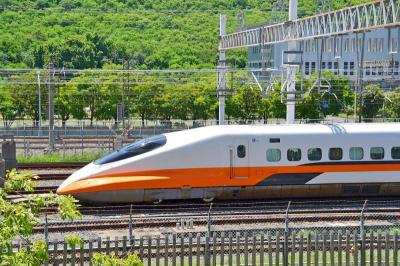
A signaling system malfunction disrupted high-speed rail (HSR) services beginning at 8am today, with trains temporarily reduced to three northbound and three southbound trains per hour as authorities conduct inspections. The malfunction occurred on a section of track in Miaoli County during pre-operation checks early this morning, forcing northbound and southbound trains to use a single track, the HSR operator said. The regular schedule has been replaced with three hourly trains offering only nonreserved seating in each direction, stopping at every station, it said, adding that business class cars would still have reserved seating. Departures from terminal stations are scheduled at the top
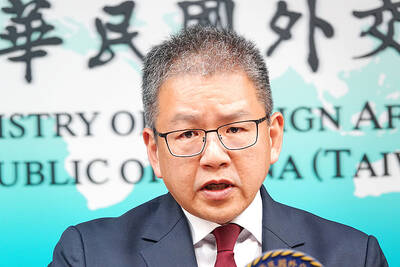
Taiwan is still in the process of assessing the possibility of recruiting workers from Eswatini, the Ministry of Foreign Affairs said yesterday, adding that its goal is to help Eswatini upgrade its vocational training centers. If there are plans to recruit workers from Eswatini, safeguarding national security, protecting public health and ensuring the employment rights of Taiwanese would be prerequisites, Department of West Asian and African Affairs Director-General Yen Chia-liang (顏嘉良) told a news conference. Key considerations would also include filling labor shortages in specific industries, and fostering bilateral professional and technical exchanges, he said. Yen was asked about the progress of labor
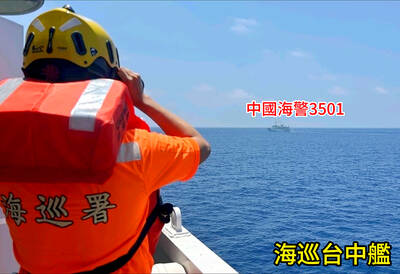
VERBOSE VESSELS: A CGA cutter and a China Coast Guard exchanged verbal barbs for more than a day in Taiwanese-controlled waters before the Chinese vessel left The Taiwanese and Chinese coast guards had a standoff near the strategically located Pratas Islands (Dongsha Islands, 東沙群島) in the north of the South China Sea, the Coast Guard Administration (CGA) said yesterday. The two sides engaged in intense radio exchanges over sovereignty claims during the 33-hour standoff. China Coast Guard vessel 3501 eventually left the restricted waters, 26.6 nautical miles (49.2km) west of the Pratas Islands, at 5pm yesterday, the CGA said. Lying approximately between southern Taiwan and Hong Kong, the Taiwan-controlled Pratas are seen by some security experts as vulnerable to Chinese attack due to their distance — more than

A US uncrewed surface vessel (USV) encountered multiple Chinese warships during an autonomous transit of the Taiwan Strait, US defense company Seasats said in a statement on Wednesday. Seasats announced that a Lightfish USV had completed the first autonomous transit of the Taiwan Strait. Over five days, the USV traversed the entire length of the Strait while constantly monitoring surface vessel traffic, the company said. The Lightfish encountered multiple Chinese warships, one of which was a Chinese People’s Liberation Army Navy (PLAN) Type 056 corvette, it said. The Chinese vessels were operating “well within Taiwan’s exclusive economic zone without transmitting their identity via the


 RSS
RSS