


The tiny Caribbean island of Terre-de-Haut boasts pristine turquoise waters and deserted coves. It also has goats, hundreds of them.
There are as many goats as humans on the island and, while they charm the tourists as they roam on the beaches and graze in the gardens, there is a darker side to this uncontrolled feral herd.
They ravage protected areas, munch through vegetation and destroy the habitats of other animals — some of which are endangered and endemic to Terre-de-Haut and other islands in Les Saintes archipelago.
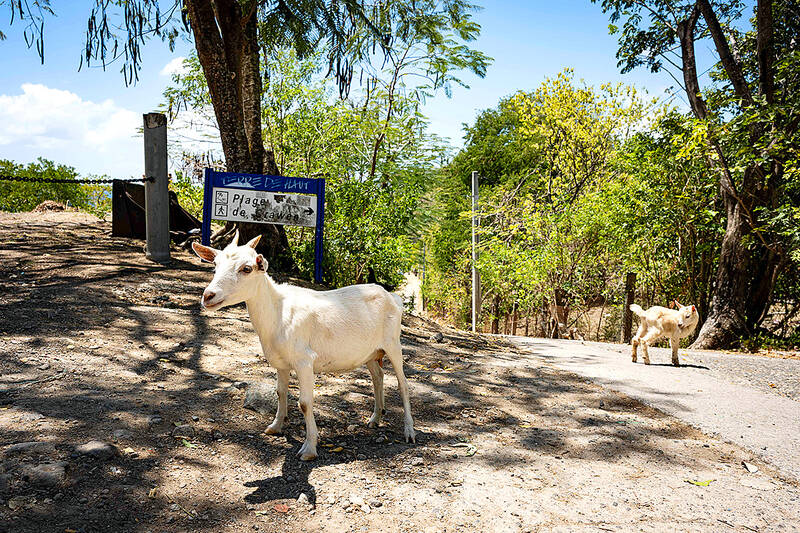
Photo: AFP
Officials on the island chain, which is part of the French overseas territory of Guadeloupe, are now considering drastic action.
The animals could be shunted into designated grazing areas then, after health checks are carried out, they could be used for meat.
Marie Robert of the French Office for Biodiversity (OFB), a government body, said the situation was alarming.
“On Terre-de-Haut alone, the herd is estimated at least one goat per inhabitant, or about 1,500,” she said.
“They overconsume native plants, leaving all the space to more resilient invasive exotic species.”
SPECIES AT RISK
At Le Chameau, the highest point on Terre-de-Haut, the vegetation is devastated — trees stripped bare and branches gnawed away.
Robert said the destruction wrought by the goats raised the risk of landslides and threatened animal biodiversity.
Several endemic species are particularly at risk, including the Terre-de-Haut racer snake, the Guadeloupe skink and a tiny brightly colored gecko called Les Saintes Sphaerodactylus.
It’s feared that these species, already weakened by rats and stray dogs and cats, could disappear entirely.
The OFB is tapping the EU’s fund for environmental projects, the LIFE program.
It has an estimated budget of 10 million euros (NT$368 million) to protect reptiles in Guadeloupe and the nearby islands of Saint-Martin and Saint-Barthelemy, which face similar pressures.
“It involves eradicating species like rats, but also bringing goats under control,” said Philippe De Proft, a coastal warden in Les Saintes for nearly 20 years.
A NEW SCOURGE
The goats were brought over by humans and were used for many years as the only local source of meat.
But tourism has long since displaced livestock farming as a way of life.
The goats, however, have not stopped reproducing — a female can give birth to two or three kids several times a year.
The authorities are looking to Saint-Barthelemy for inspiration.
Goats are already being captured there and confined to grazing areas.
Officials have given an exemption from the usual rules to allow the animals to be used for meat.
“Even wild adults can be put to good use,” explained Rudi Laplace, whose Island Nature Experience group organized the capture on Saint-Barthelemy.
Officials on Les Saintes are keen to follow the example, and they cannot act quickly enough as a new scourge could be on the way.
Sheep abandoned by a farmer are beginning to proliferate — from a single pair, the flock has now grown to 25 animals.

As mega K-pop group BTS returns to the stage after a hiatus of more than three years, one major market is conspicuously missing from its 12-month world tour: China. The omission of one of the group’s biggest fan bases comes as no surprise. In fact, just the opposite would have been huge news. China has blocked most South Korean entertainment since 2016 under an unofficial ban that also restricts movies and the country’s popular TV dramas. For some Chinese, that means flying to Seoul to see their favorite groups perform — as many were expected to do for three shows opening

Taiwan’s semiconductor industry consumes electricity at rates that would strain most national grids. Taiwan Semiconductor Manufacturing Co (TSMC) alone accounted for more than 9 percent, or 2,590 megawatts (MW), of the nation’s power demand last year. The factories that produce chips for the world’s phones and servers run around the clock. They cannot tolerate blackouts. Yet Taiwan imports 97 percent of its energy, with liquefied natural gas reserves measured in days. Underground, Taiwan has options. Studies from National Taiwan University estimate recoverable geothermal resources at more than 33,000 MW. Current installed capacity stands below 10 MW. OBSTACLES Despite Taiwan’s significant geothermal potential, the

The entire Li Zhenxiu (李貞秀) saga has been an ugly, complicated mess. Born in China’s Hunan Province, she moved to work in Shenzhen, where she met her future Taiwanese husband. Most accounts have her arriving in Taiwan and marrying somewhere between 1993 and 1999. She built a successful career in Taiwan in the tech industry before founding her own company. She also served in high-ranking positions on various environmentally-focused tech associations. She says she was inspired by the founding of the Taiwan People’s Party (TPP) in 2019 by Ko Wen-je (柯文哲), and began volunteering for the party soon after. Ko
Chinese Nationalist Party (KMT) Chair Cheng Li-wun (鄭麗文) returned from her trip to meet People’s Republic of China (PRC) dictator Xi Jinping (習近平) bearing “a gift” for the people of Taiwan: 10 measures the PRC proposed to “facilitate the peaceful development of cross-strait relations.” “China on Sunday unveiled 10 new incentive measures for Taiwan,” wrote Reuters, wrongly. The PRC’s longstanding habit with Taiwan relations is to repackage already extant or once-existing policies and declare that they are “new.” The list forwarded by Cheng reflects that practice. NEW MEASURES? Note the first item: establishing regular communication mechanisms between the Chinese Communist Party


 RSS
RSS