


A man walks through the crowd, naked except for a G-string made from rope, his body fully adorned with intricate artwork that makes him look like the hero of a seventies Hong Kong movie.
This is a common sight at the Taiwan Tattoo Convention, which is currently being held in Kaohsiung until tomorrow.
“Tattoo is a very special kind of art, very delicate, very different,” says Chen Tai-yun (陳運泰), who has operated the convention for 16 years. “You can’t regret it, it has to be meaningful. It’s an art that shows compassion.”
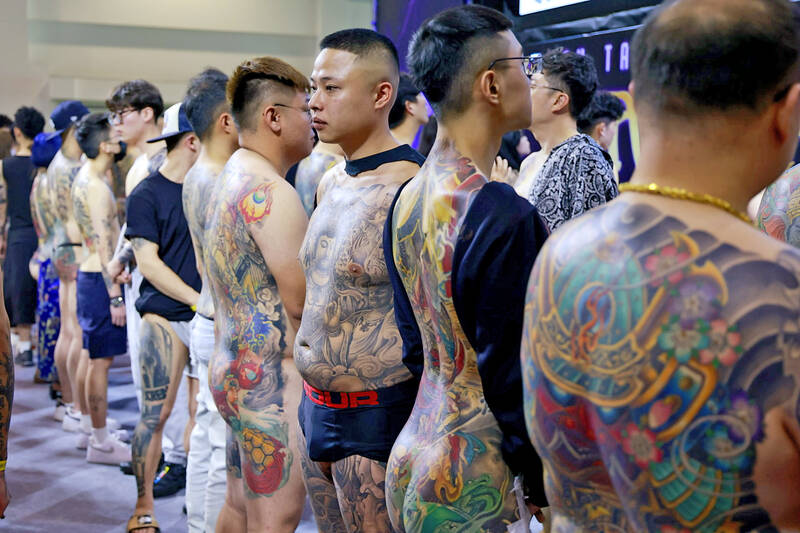
Photo: Danny Chu
Although youngsters make up the bulk of the audience, there are people of all ages. One older-looking Japanese man proudly displays his “bodysuit” (a tattoo that covers almost the entire body).
INCLUSIVE
Tattoo culture is very inclusive — there are many styles, but all are valid.
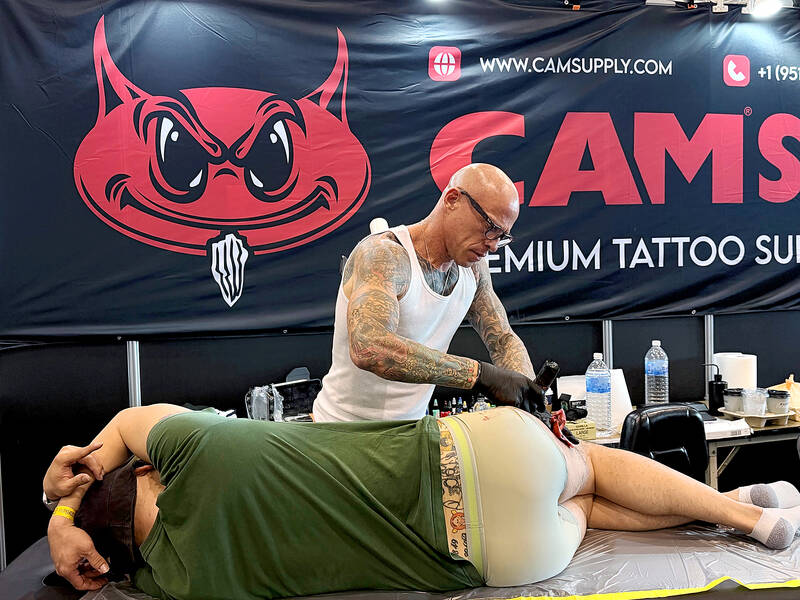
Photo: Danny Chu
“There are tattoos that are cute or religious or very artistic,” Tai says. “I invited people from different countries so the public can get more perspective on what kind they want, a style that they probably did not think about before.”
Tattoo studios from around the world show their art and offer to tattoo people on site.
“It’s a really big convention,” says Riccardo Lauri, a tattoo artist from Bologna-based Lagunatre Tattoo. “It’s overwhelming. On just the first day I saw so many good people, good artists.”
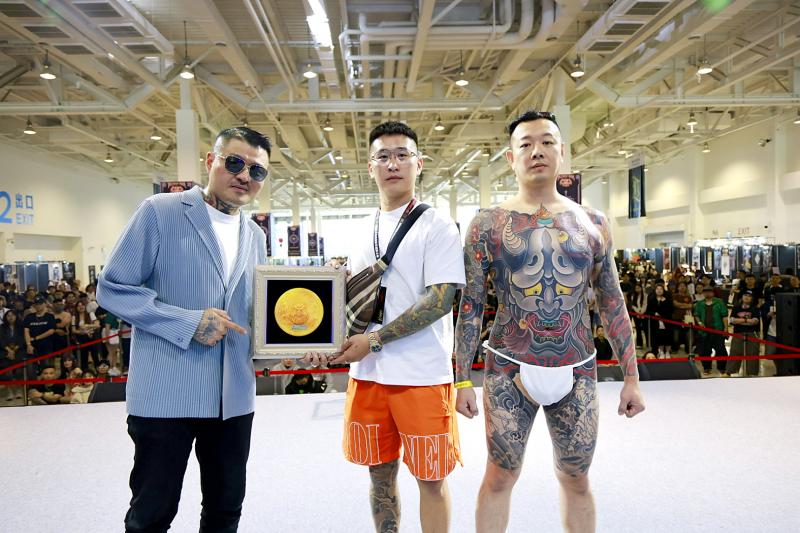
Photo: Danny Chu
He mentions being impressed by “the precision” of Taiwanese tattoo artists.
Tai always wanted his convention to be a place where tattoo cultures could mix.
“People used to think that you can only wear tattoos from your culture,” he says, “but we show you can mix Western styles and Asian styles of tattoos. There is no discrimination, no boundary.”
A young man with a shaved head bears tattoos all over his scalp, while others carry a full graphic novel on their limbs.
Kaohsiung’s convention is reportedly the biggest in East Asia, to Tai’s immense satisfaction.
TABOO NO MORE
“Asian culture didn’t accept tattoos in the past,” he says, “because it was associated with criminals. I created this convention to show this is an artform and change this perception.”
This year, Tai brought an important guest: Ami James, an American tattoo artist with a large following in the field.
And he concurs with Tai: “One of the reasons why I ended up in my position is because it was important for me to bring tattoos into the mainstream,” James says. “It used to be taboo. But we convinced people to look at tattoos as an art rather than the stigma that was being pushed on it. It’s for everybody now. Art is art!”
This is James’s first visit to Taiwan. He sees “a lot of great art, I’m really surprised about how much talent there is. New people come in, change things, push things, I love this.”
A large number of Taiwanese tattoo artists present at the convention are women.
Japanese tattoo artist Horihina, from Osaka-based studio Good Times Ink, says “there are not as many women who work as tattoo artists in Japan despite our big scene. And such conventions do not really exist, not with so many things. We only have competitions.”
Kaohsiung’s convention also has competitions.
A voice calls out for competitors in specific categories, such as “best large tattoo in green and black colors” to take the stage. Some are wearing only a G-string, while others simply roll up their pants or shirts.
“We assemble a panel of judges made up of tattoo artists who got awards or are specialized in the theme,” Tai explains. “Judges take into account the art, the colors and the presentation on the skin and body.”
Although he has his own studio, Top Tattoo (首席紋身), Tai himself does not get involved in the jury.
“This is how I keep credibility,” he says. “The hardest thing to create and establish such a convention is to get everyone’s trust. Tattoo artists like to keep their secrets, so I do not take part in events and they know this is not about promoting myself.”
SOCIAL VALUE
Tai is a firm believer in tattoo’s social value and tells the story of a girl who suffered burns to half of her body due to a propane gas explosion.
“She was depressed. I talked with her and she gave me ideas on what to tattoo on her to cover her scars and burn marks. Now she feels more brave than before.”
She later became a counselor for victims of burn injuries.
Tai’s vision that tattoos show someone’s light rather than their dark side is shared by most of the artists present.
Horikasiwa, a tattoo artist who came from Taichung, studied in Japan and finds inspiration in ukiyo-e.
“Tattoo is a lifestyle,” he says, “it’s about art. I want to enhance the taste of people and the environment around tattoo.”
He is also an underground rapper.
His eclecticism shows the connection between tattoo culture and other subcultures. Many people wear piercings. Some women appear in fetish-inspired clothing, while some men are dressed like cyberpunk samurai. But there is no elitism: even simpler styles are welcome.
Tai is very attached to Kaohsiung and wouldn’t set the convention anywhere else. “It’s my home. Other cities are just big cities, but Kaohsiung for me is everything.”
He says he will keep working to grow the convention: “every year we have new people, a new generation, new performers, so it gets better and better.”
Taiwan’s overtaking of South Korea in GDP per capita is not a temporary anomaly, but the result of deeper structural problems in the South Korean economy says Chang Young-chul, the former CEO of Korea Asset Management Corp. Chang says that while it reflects Taiwan’s own gains, it also highlights weakening growth momentum in South Korea. As design and foundry capabilities become more important in the AI era, Seoul risks losing competitiveness if it relies too heavily on memory chips. IMF forecasts showing Taiwan widening its lead over South Korea have fueled debate in Seoul over memory chip dependence, industrial policy and
“China wants to unify with Taiwan at the lowest possible cost, and it currently believes that unification will become easier and less costly as time passes,” wrote Amanda Hsiao (蕭嫣然) and Bonnie Glaser in Foreign Affairs (“Why China Waits”) this month, describing how the People’s Republic of China (PRC) is playing the long game in its quest to seize Taiwan. This has been a favorite claim of many writers over the years, easy to argue because it is so trite. Very obviously, if the PRC isn’t attacking Taiwan, it is waiting. But for what? Hsiao and Glaser’s main point is trivial,
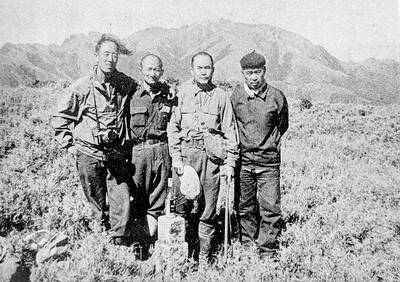
May 18 to May 24 Gathered on Yangtou Mountain (羊頭山) on Dec. 5, 1972, Taiwan’s hiking enthusiasts formally declared the formation of the “100 Peaks Club” (百岳俱樂部) and unveiled the final list of mountains. Famed mountaineer Lin Wen-an (林文安) led this effort for the Chinese Alpine Association (中華山岳協會). Working with other experienced climbers, he chose 100 peaks above 10,000 feet (3,048m) that featured triangulation points and varied in difficulty and character. The list sparked an alpine hiking craze, inspiring many to take up mountaineering and competing to “conquer” the summits. A common misconception is that the 100 Peaks represent Taiwan’s 100 tallest
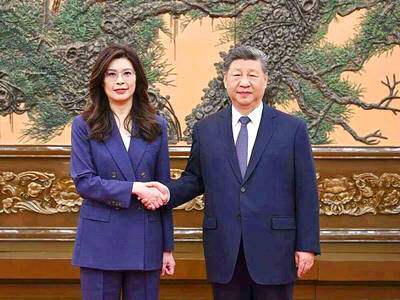
The Chinese Nationalist Party (KMT), alongside their smaller allies the Taiwan People’s Party (TPP), are often accused of acting on behalf of the Chinese Communist Party (CCP). Some go so far as to call them “traitors.” It is not hard to see why. They regularly pass legislation to stymie the normal functioning of the ruling Democratic Progressive Party’s (DPP) administration, and they have yet to pass this year’s annual budget. They slashed key elements of the government’s proposed NT$1.25 trillion (US$40 billion) special military budget, and in the smaller NT$780 billion package they did pass, it is riddled with provisions that


 RSS
RSS