


In Kaohsiung’s Indigenous People’s Park (原住民主題公園), the dance group Push Hands is training.
All its members are from Taiwan’s indigenous community, but their vibe is closer to that of a modern, urban hip-hop posse.
MIXING CULTURES
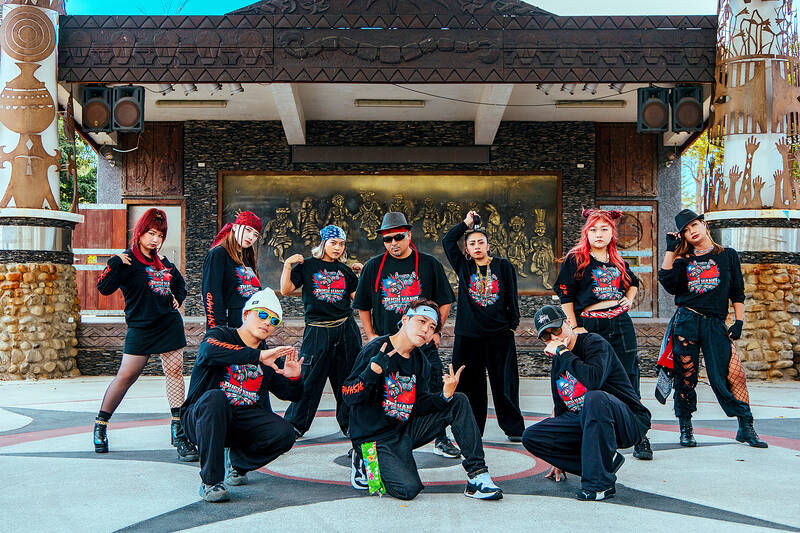
Photo courtesy of Danny Chu
“The name Push Hands comes from the idea of pushing away tradition to expand our culture,” says Ljakuon (洪濬嚴), the 44-year-old founder and main teacher of the dance group.
This is what makes Push Hands unique: while retaining their Aboriginal roots, and even reconnecting with them, they are adamant about doing something modern.
Ljakuon started the group 20 years ago, initially with the sole intention of doing hip-hop dancing.
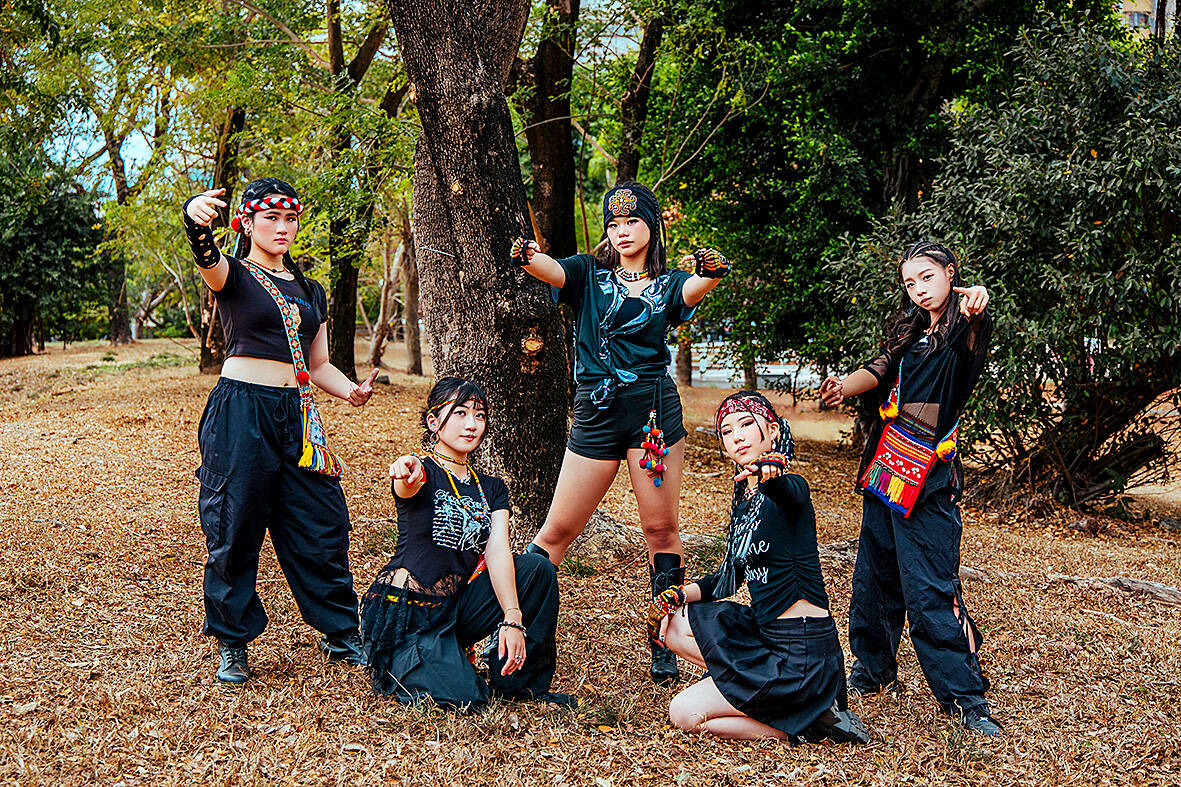
Photo courtesy of Danny Chu
“We did not even have a classroom then,” he recalls, “so we were training in the street.”
Later, he added a layer of traditional Aboriginal dancing.
“More young Aborigines want to learn about their culture now,” says Ken Hung (洪濬嚴), one of the male dancers. “And dances and songs, along with language, are the most important things to learn.”
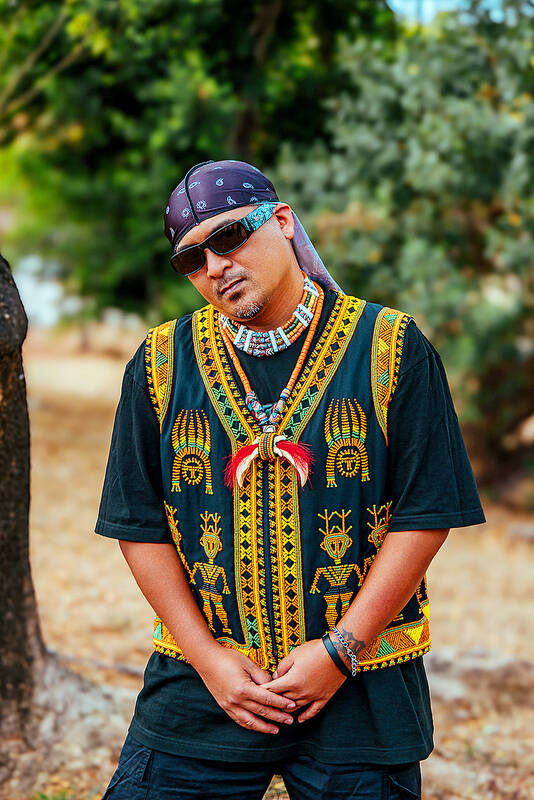
Photo courtesy of Danny Chu
Crew members wear black T-shirts sporting the logo of Push Hands, which was designed by Ljakuon himself to blend hip-hop imagery with Aboriginal patterns.
One boy wears a necklace with a boar tooth and red hair.
“Originally, red hair on pendants were scalped from Dutch invaders,” Hung says, “now they are dyed boar hair.”
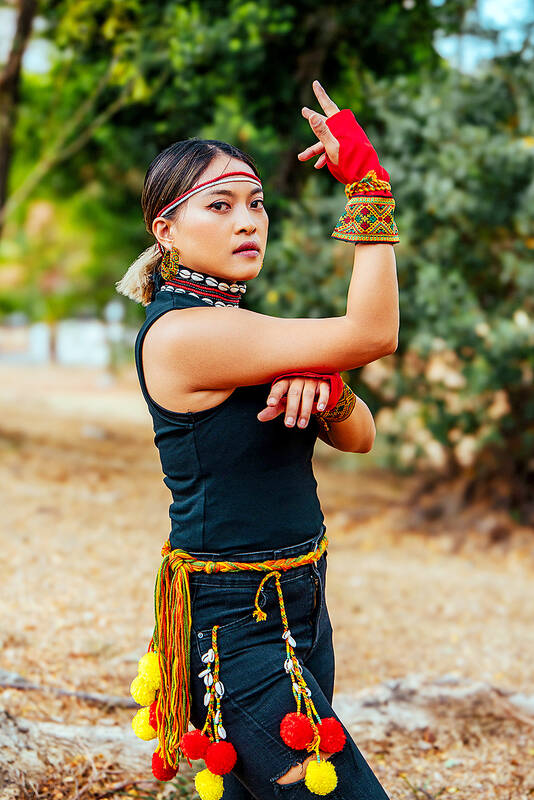
Photo courtesy of Danny Chu
Blake wears an embroidered traditional vest he inherited from his grandfather.
“This merging is how we promote our culture,” says Hung.
There is a general feeling among the troupe that traditional indigenous culture is valuable and must be preserved, but should not become a self-imposed constraint.
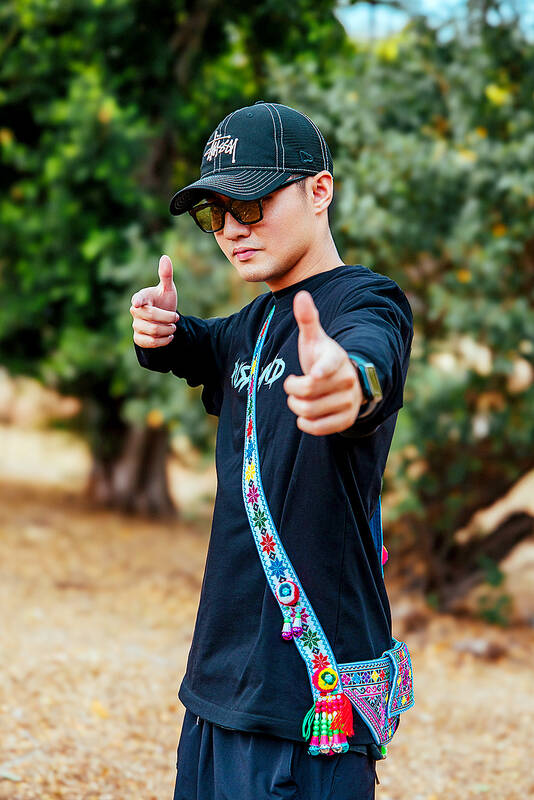
Photo courtesy of Danny Chu
“Our fathers had their time, now is our time!” says Muakai (曾櫻瑩), 36, one of the female dancers. “There was never such a thing as mixing these dancing cultures before we did it, but times change.”
The troupe doesn’t want to be limited by tradition. This means their culture is alive and keeps evolving, mutating, adapting and exploring new ways of expression in phase with the contemporary experience of being indigenous Taiwanese in an urban and global context.
“In villages they stay attached to the past,” adds Hung. “They don’t think modern styles are good. They are focused on their fear that their culture could disappear.”
A lot of elders did not agree with what Ljakuon was doing.
“They thought I was destroying the culture,” he says. “They thought what I did was not ‘them’. It was mingling with what they call ‘flatland people’: Han Taiwanese.”
URBAN ABORIGINES
Indeed, we learn that there is a significant difference between what they refer to as “city aborigines” and “town aborigines,” the latter referring to those living in rural areas.
“[Rural communities] don’t have much technology,” Ljakuon says, “they are very slow to adopt new ways. In the city, we already have access to diverse views, we learn worldly views faster.”
Hung says the difference is also obvious in the way people speak.
“[Rural] aborigines speak Mandarin with an accent or even insert Aboriginal words. They have less access to education. We have more resources to do what we want.”
Almost all members of Push Hands are “city aborigines.”
Muakai recalls: “in the mountain back in the days there was no good TV, just radiooung people like me were always curious about who were the popular singers. My first inspiration was Taiwanese singer A-mei (阿妹), and then international hip-hop music came into my life.”
“City aborigines” have the advantage of access to global culture, but they also seek to connect with Aboriginal roots.
“Muakai is important to the Push Hands crew because she is a skilled hip-hop dancer but into traditional culture too, she can speak her aboriginal language fluently, so she is [valuable] in modern times,” Hung says.
Ljakuon, in contrast, had to go back to his roots.
“Ljakuon is like me: a city boy,” Hung says. “When he turned 25 he realized that he needed to go learn the culture, the language, the music. Then he brought it back to the crew, from the village to the city. He also encouraged me to learn the language. We are not the same tribe: I am Amis and he is Paiwan.”
In the end, Ljakuon and Push Hands managed to get the more traditionalist Aborigines on board.
“[Our] elders understand the changing times and they have become more open to how we share our [indigenous] culture with Taiwanese,” Ljakuon says.
He adds that they always add a song or two during their performances that are purely traditional, including the costumes. And because each indigenous community has different music and dress, it is an opportunity to teach people about them.
“Non-Aboriginal Taiwanese, when they see us, are surprised,” Hung says. “It’s ‘fresh’ in their eyes. But then they want to come dance with us. Our music encourages them to join the fight, so to speak.”
Push Hands has also generated social bonds between its members.
“City aborigines are not close to each other,” Ljakuon says, “they’re out there doing their own individual thing. Creating this dance group was also a way to bring them together.”
“I think we can help Aborigine people being better known around the world,” Hung says, “we do more and more performances across Asia. Modern dancing helps for that.”
Push Hands will soon take part in more dancing competitions, eyeing the ultimate prize: being invited to compete in the US — and later all around the world.
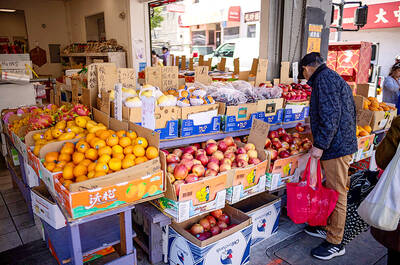
Ajay Verma, a consultant gastroenterologist at Kettering general hospital in Northamptonshire, says our gut is a “complex machine.” “It is constantly providing us with the nutrition we need, initially to grow and develop, and then for us to survive, thrive and repair from injury and illness.” How can we keep it functioning well? Put simply: “Make sure what you put into it is balanced, and that you clear out its waste products adequately,” Verma says. “In a general gastroenterology clinic, the most common conditions we see are irritable bowel syndrome (IBS), gastroesophageal reflux disease, inflammatory bowel disease and constipation,” says Nisha
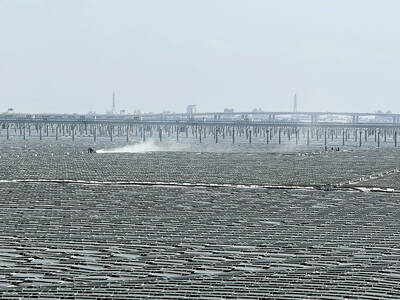
The arithmetic is straightforward and uncomfortable. By the end of 2025, Taiwan had committed itself to a 50-30-20 electricity mix — half natural gas, 30 per cent coal, 20 per cent renewables. The Ministry of Economic Affairs’s (MOEA) own monthly energy reports tell a different story. Natural gas reached 47.8 per cent of generation last year. Coal stood at 35.4 per cent, comfortably above its target ceiling. Renewables came in at 13.1 per cent, well short of the 20 per cent Taipei had pledged a decade earlier. Installed renewable capacity reached roughly half of the 12 gigawatts (GW) the government

Last week US President Donald Trump was asked by a reporter whether he would speak on the phone to the President of Taiwan. “l’ll speak to him. I speak to everybody. We have that situation very well in hand,” Trump said. This marked the second time in a couple of weeks he had said he would talk to the President of Taiwan. In 2016 he famously took a call from then-president Tsai Ing-wen (蔡英文), when he was president-elect. Despite warnings that the apocalypse was nigh because of a phone call, the world quickly forgot about the conversation between two democratically-elected presidents.
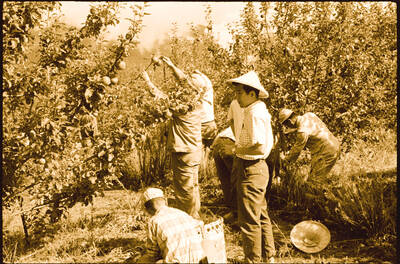
May 25 to May 31 Few believed that apples could be cultivated on a commercial scale in Taiwan’s high mountains. When horticulturalist Cheng Chao-hsiung (程兆熊) first proposed the idea in 1955, both American and Taiwanese colleagues dismissed it as implausible, arguing that temperate fruit could not be reliably grown on a subtropical island, especially on rugged terrain. However, it was this terrain in the Central Mountain Range where many Chinese Civil War veterans were resettled in the late 1950s. With limited job prospects and no family in Taiwan, they were placed on cooperative farms aimed toward self-sufficiency. Some say the conditions


 RSS
RSS